
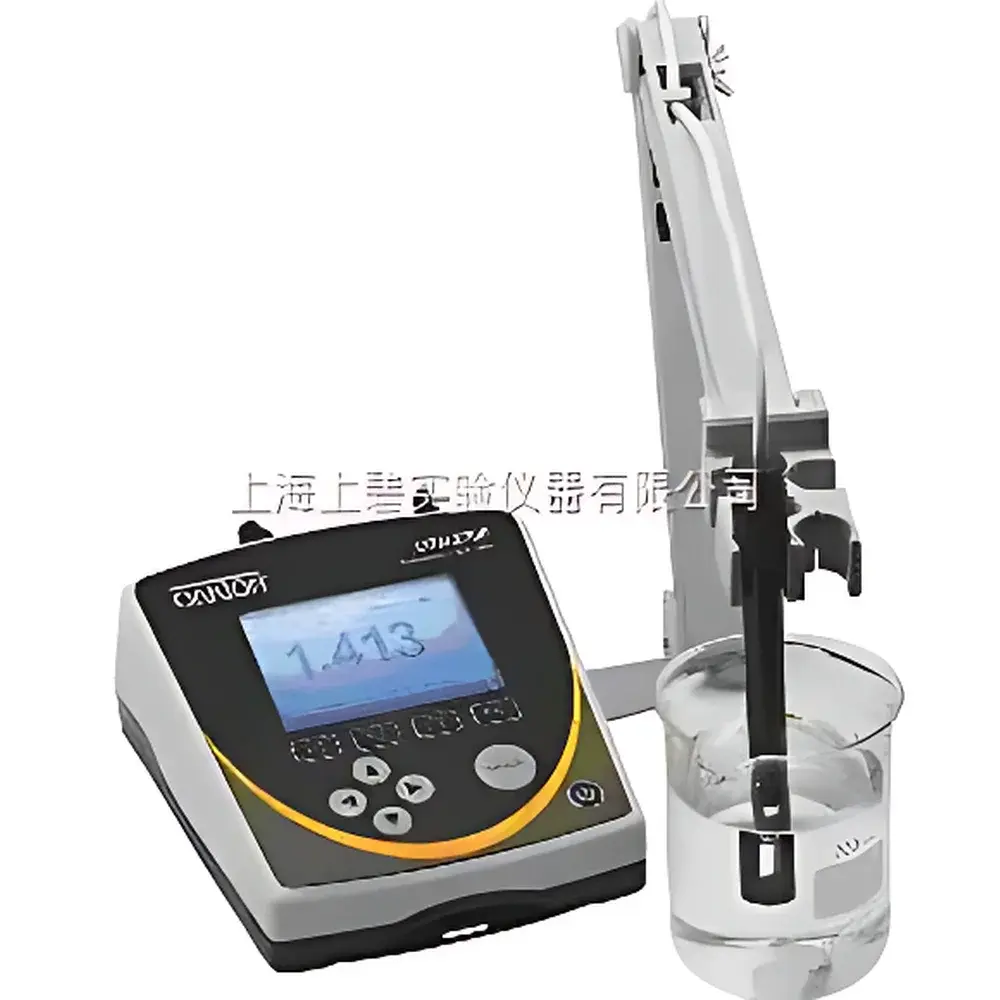
Oakton DO2700 Dissolved Oxygen Meter with 05991-36 pH/ATC Combination Electrode
| Origin | USA |
|---|---|
| Manufacturer Type | Authorized Distributor |
| Origin Category | Imported |
| Model | 05991-36 |
| Price Range | USD $1–4,999 |
| Instrument Type | Laboratory |
| Measurement Principle | Electrochemical Clark-type Polarographic Probe |
| Measurement Range | 0–19.99 mg/L (DO), 0–600.0% saturation |
| Accuracy | ±0.5% of full scale (DO), ±0.002 pH units |
| Repeatability | ±0.15% of reading |
| Detection Limit | 0.01 mg/L (DO), 0.1% saturation |
| Temperature Range (for DO mode) | 0–50 °C |
| Temperature Compensation | Automatic or manual (0–50 °C) |
| Salinity Compensation | Manual or automatic (0–50 ppt) |
| Atmospheric Pressure Compensation | Manual or automatic (450–825 mmHg) |
| Data Storage | 500 measurement sets with timestamp |
| Interface | RS232 serial output |
| Dimensions | 15.5 × 17.5 × 6.9 cm (L×W×H) |
Overview
The Oakton DO2700 Dissolved Oxygen Meter is a laboratory-grade, multi-parameter benchtop analyzer engineered for precise, trace-level dissolved oxygen (DO) quantification in aqueous environmental, wastewater, and research applications. It operates on the Clark-type polarographic principle—utilizing a gas-permeable membrane, cathode-anode electrochemical cell, and applied polarization voltage to generate a current proportional to molecular oxygen concentration diffusing across the membrane. This method delivers high reproducibility, low drift, and immunity to color, turbidity, or chemical interferences common in field-deployed optical sensors. The instrument is part of Oakton’s 2700 Series platform, designed for compliance with standard methods including ASTM D888, ISO 5814, and APHA 4500-O G. Its integration with the 05991-36 dual-function pH/ATC (Automatic Temperature Compensation) electrode enables concurrent pH and temperature monitoring—critical for accurate DO compensation and calibration validation under variable thermal conditions.
Key Features
- Clark-type polarographic sensor architecture with replaceable membranes and electrolyte—ensuring long-term stability and minimal maintenance.
- Dual-range DO measurement: 0–19.99 mg/L (ppm) and extended range up to 50.0 mg/L; saturation mode: 0–600.0% with 0.1% resolution.
- Integrated ATC via the 05991-36 glass-body combination electrode (pH 0–14, temp. 0–50 °C), eliminating separate probe handling and reducing cross-contamination risk.
- Full suite of environmental compensation algorithms: automatic salinity (0–50 ppt), atmospheric pressure (450–825 mmHg), and temperature (0–50 °C).
- Calibration flexibility: single-point (air-saturated water) or two-point (zero-oxygen and air-saturated) modes with user-defined calibration constants.
- RS232 interface compliant with ANSI/TIA/EIA-232-F standards for direct connection to PCs or LIMS; supports ASCII data export with time/date stamping.
- GLP-compliant data logging: stores 500 readings with parameter ID, date/time, temperature, salinity, pressure, and operator ID fields.
- Robust benchtop housing with chemical-resistant ABS casing, front-panel keypad lock, and IP20-rated enclosure suitable for controlled laboratory environments.
Sample Compatibility & Compliance
The DO2700 is validated for use with freshwater, seawater, wastewater effluents, biological reactors, aquaculture systems, and pharmaceutical process water. Its polarographic probe design ensures reliable performance in samples containing suspended solids, organic films, or moderate levels of hydrogen sulfide—provided routine membrane cleaning and electrolyte replacement protocols are followed. The system meets key regulatory frameworks: it supports audit-trail-ready documentation per FDA 21 CFR Part 11 when paired with compliant software; aligns with ISO/IEC 17025 calibration traceability requirements; and conforms to USP for dissolved oxygen in purified water and water for injection (WFI). All electrodes—including the 05991-36 pH/ATC unit—are CE-marked and RoHS-compliant.
Software & Data Management
Data acquisition and reporting are enabled through Oakton’s optional Logger Pro™ PC software (v4.0+), which provides real-time graphing, statistical analysis (mean, SD, CV%), and customizable report templates exportable to PDF or CSV. The RS232 protocol supports command-driven control (e.g., *IDN?, MEAS?, CAL?) for automated test sequences in QA/QC workflows. Internal memory retains calibration history, last-used compensation values, and firmware version—accessible via menu navigation. For regulated labs, the instrument supports electronic signature capture and user-access level configuration (admin/operator modes) to satisfy GLP/GMP documentation integrity requirements.
Applications
- Environmental monitoring: BOD5 incubation tracking, river/stream health assessment, wetland restoration projects.
- Wastewater treatment: Aeration basin optimization, nitrification/denitrification process control, sludge respiration rate analysis.
- Aquaculture & fisheries: Pond DO profiling, hatchery water quality assurance, hypoxia stress modeling.
- Pharmaceutical manufacturing: Validation of purified water systems, bioreactor sparging control, clean-in-place (CIP) rinse verification.
- Academic research: Microbial metabolism studies, sediment oxygen demand (SOD) measurements, climate change-related hypoxia modeling.
FAQ
What is the recommended calibration frequency for the DO2700 in routine lab use?
For daily QC operations, perform a one-point air-saturation calibration before each analytical session. Two-point calibration (zero and air-saturated) is required after membrane replacement, electrolyte refill, or when measuring outside typical environmental ranges.
Can the 05991-36 electrode be used for both pH and temperature compensation simultaneously during DO measurement?
Yes—the 05991-36 is a true combination electrode with integrated pH-sensing glass membrane and Pt1000 ATC element, enabling real-time, co-located pH and temperature input for dynamic DO compensation without probe swapping.
Is the DO2700 compatible with third-party polarographic probes?
No—only Oakton-certified Clark-type probes (e.g., model 35420-82) are electrically and mechanically compatible due to proprietary polarization voltage and signal conditioning specifications.
How does atmospheric pressure compensation improve DO accuracy at elevation?
Since oxygen solubility is inversely related to barometric pressure, uncorrected measurements at >500 m above sea level may incur >3% error; the built-in barometric sensor or manual entry corrects for local partial pressure of O₂.
Does the instrument support Good Laboratory Practice (GLP) audit requirements?
Yes—data logs include immutable timestamps, operator IDs, calibration metadata, and full compensation parameters, satisfying core GLP record-keeping mandates per OECD Principles of GLP.
Related Products







