
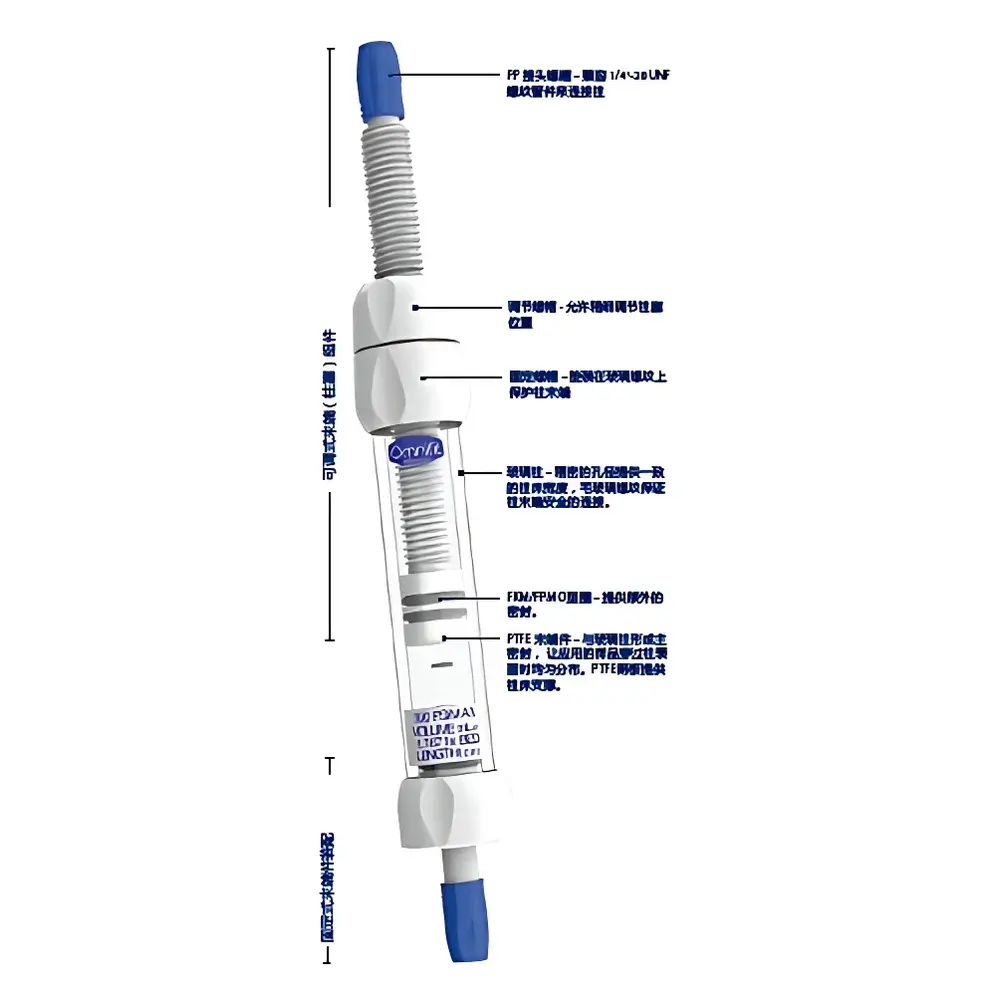
Omnifit® EZ Chromatography Columns (UK-Made) by Diba Fluids
| Origin | UK |
|---|---|
| Manufacturer Type | Authorized Distributor |
| Product Origin | Imported |
| Model | Omnifit® EZ |
| Pressure Rating | Up to 900 psi |
| Column Dimensions | ID 5–50 mm, Length 50–500 mm, Volume 1 mL–940 mL |
| Construction | Borosilicate Glass Tube with PEEK Threaded End Fittings |
| End Fitting Type | 10-32 Conical |
| Sealing | Dual O-ring + PTFE Endpieces (Fixed or Adjustable) |
| Temperature Rating | ≤80 °C |
| Chemical Compatibility | Broad (incl. aqueous buffers, organic solvents, mild acids/bases) |
| Regulatory Alignment | Designed for GLP-compliant lab workflows |
Overview
The Omnifit® EZ Chromatography Columns are precision-engineered, UK-manufactured glass columns designed for medium- to low-pressure liquid chromatography applications—including protein purification, biomolecule isolation, peptide synthesis, and continuous-flow reaction workup. Built on the established Omnifit® platform, these columns employ classical column chromatography principles: separation occurs via differential partitioning of analytes between a stationary phase (e.g., resin bed) and a mobile phase (eluent), driven by controlled peristaltic or low-pressure pump flow. Their borosilicate glass construction ensures optical clarity for visual bed monitoring, high thermal stability (up to 80 °C), and resistance to thermal shock—critical during buffer equilibration or gradient elution. Unlike stainless-steel or polymer alternatives, glass offers inertness across a wide pH range (pH 1–14) and compatibility with aggressive solvents including acetonitrile, methanol, isopropanol, and 6 M guanidine HCl—enabling rigorous cleaning-in-place (CIP) protocols without material degradation.
Key Features
- Modular, Tool-Free Assembly: PEEK-threaded end fittings eliminate risk of glass fracture during tightening; torque is precisely controlled via 10-32 conical interface, ensuring leak-free operation up to 900 psi.
- Ergonomic Enhancements: Redesigned knurled barrel and textured grip surface prevent hand slippage during manual assembly—particularly valuable during repetitive column packing or system reconfiguration.
- Three Endpiece Configurations: Fixed-Fixed (FF), Fixed-Adjustable (AF), and Adjustable-Adjustable (AA) variants support diverse packing methodologies, bed compression requirements, and in-line pressure monitoring setups.
- Optimized Flow Distribution: Precision-machined stainless-steel or polyethylene frits (typically 20–40 µm pore size) provide uniform sample introduction and stable resin support—minimizing channeling and maximizing resolution.
- Scalable Geometry Range: Available in internal diameters from 5 mm to 50 mm and lengths from 50 mm to 500 mm—covering analytical-scale screening (≤5 mL) through pilot-scale purification (≥500 mL).
Sample Compatibility & Compliance
Omnifit® EZ columns accommodate a broad spectrum of chromatographic media—including agarose-, sepharose-, silica-, and polymer-based resins (e.g., SP Sepharose, Q Sepharose, Ni-NTA Agarose, C4/C18 silica). Their chemical resilience permits use with chaotropic agents (urea, guanidine), reducing agents (DTT, β-mercaptoethanol), and detergents (Triton X-100, CHAPS). Columns meet ISO 8573-1 air purity standards when used with filtered, oil-free nitrogen for dry-packing. While not individually certified, the design aligns with ICH Q5A/Q5B guidelines for biopharmaceutical process development and supports adherence to GLP (Good Laboratory Practice) and GMP (Good Manufacturing Practice) documentation requirements when deployed within validated AKTA, NGC, or Biolot purification workflows. Traceability is enhanced via laser-etched model/lot identifiers on each column body.
Software & Data Management
As passive hardware components, Omnifit® EZ columns do not incorporate embedded electronics or firmware. However, they are fully interoperable with industry-standard chromatography control software—including Cytiva UNICORN™ (v7.0+), Bio-Rad NGC™ System Software, and Sanotac ChromaLink™—when connected to compatible detection modules (UV-Vis, conductivity, pH) and fraction collectors. All column configurations generate consistent retention time reproducibility (<1.5% RSD over 10 runs) under identical flow and temperature conditions—enabling reliable method transfer between labs. Audit trails, electronic signatures, and raw data archiving are managed at the system level; column-specific metadata (ID, length, batch number) can be logged manually or via barcode-scanned LIMS integration.
Applications
- Lab-scale purification of monoclonal antibodies (mAbs), recombinant enzymes, and His-tagged proteins using IMAC or ion-exchange resins.
- Desalting and buffer exchange of nucleic acid preparations prior to sequencing or transfection.
- Removal of endotoxins from plasmid DNA preps via polymyxin B affinity chromatography.
- Small-molecule purification in natural product isolation and medicinal chemistry workflows.
- Continuous-flow hydrogenation and asymmetric catalysis where column residence time and backpressure stability are critical.
FAQ
Are Omnifit® EZ columns compatible with high-pressure systems such as AKTA Pure or NGC Discover?
Yes—when operated within their rated 900 psi limit and paired with appropriate end fittings and tubing, they integrate seamlessly with AKTA and NGC platforms. For >900 psi applications, stainless-steel or reinforced polymer columns are recommended.
Can I autoclave Omnifit® EZ columns?
No—borosilicate glass columns are not autoclavable due to thermal stress risks from rapid temperature cycling. Sterilization is achieved via 0.22 µm filtration of buffers and 70% ethanol or 0.1 M NaOH rinses followed by extensive equilibration.
What is the maximum recommended flow rate for a 25 mm ID × 250 mm column?
At 900 psi and using standard 50–100 µm particle resins, linear velocity should be maintained ≤15 cm/h to preserve resolution—translating to ~15–25 mL/min depending on bed porosity and viscosity.
Do you offer custom frit pore sizes or alternative endpiece materials?
Standard frits are 20 µm (for fine resins) or 40 µm (for coarse media); custom options (5 µm, 100 µm) and Hastelloy endpieces are available upon request for specialized corrosion resistance.
How is column performance validated post-packing?
Users perform standard test injections (e.g., acetone, sodium nitrate) to assess asymmetry (As), plate count (N), and backpressure stability—comparing results against manufacturer-provided baseline curves for each geometry.
Related Products






