
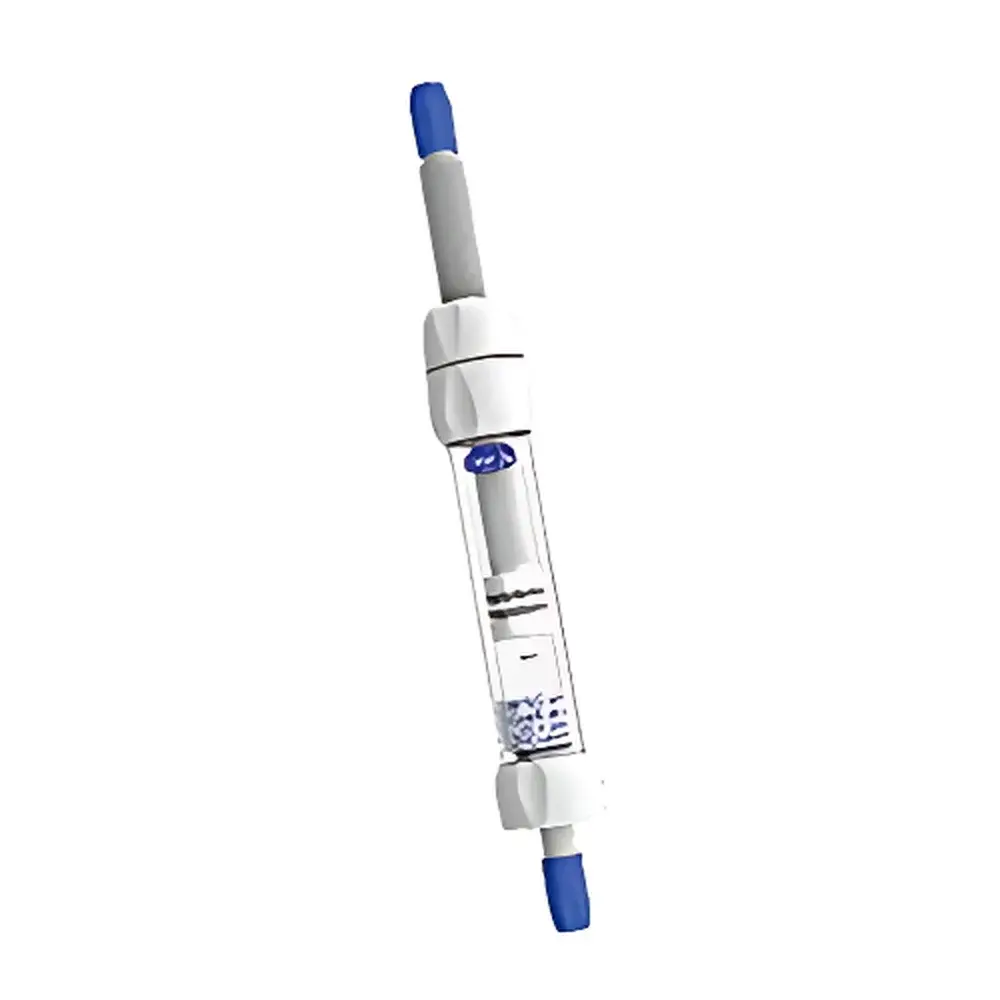
Omnifit EZ SolventPlus Medium-Pressure Glass Chromatography Column (Sanotac OEM, UK-Made)
| Brand | Sanotac |
|---|---|
| Origin | United Kingdom |
| Manufacturer | Omnifit (UK) / Sanotac OEM |
| Category | Imported |
| Model | 006EZS-06-40-AF |
| Pressure Rating (5 mm ID) | 80 bar (1200 psi) |
| Material | Borosilicate Glass Tube, PEEK™ End Fittings, Chemraz® O-Rings, PTFE Frits, ETFE Caps & Connectors |
| Internal Diameter Range | 5–50 mm |
| Column Height Range | 50–500 mm |
| pH Compatibility | 1–14 |
| Operating Temperature | 4–40 °C |
| Chemical Resistance | Compatible with HPLC-grade organic solvents (e.g., DMSO, DMF, chloroform, toluene, pyridine, formamide) and aqueous buffers |
| Axial Compression | Single-ended adjustable (AF), double-ended adjustable (AA), or fixed-end (FF) configurations |
Overview
The Omnifit EZ SolventPlus Medium-Pressure Glass Chromatography Column is a rigorously engineered, UK-manufactured chromatographic column designed for reproducible, scalable purification of proteins, peptides, antibodies, and other biomolecules under medium-pressure liquid chromatography (MPLC) conditions. Built upon the proven Omnifit® Labware platform and distributed globally by Sanotac as the authorized OEM partner in China, this column series leverages borosilicate glass construction and fully inert fluidic pathways to ensure compatibility with both aqueous and aggressive organic mobile phases—enabling seamless transition between ion exchange, size exclusion, hydrophobic interaction, and reversed-phase chromatography workflows. Its design adheres to fundamental principles of laminar flow distribution and uniform bed packing, minimizing channeling and backpressure variability across operating pressures up to 80 bar (1200 psi) for 5 mm ID columns. The column is not a consumable but a reusable, serviceable hardware component intended for integration into regulated laboratory environments where traceability, chemical resilience, and mechanical stability are critical.
Key Features
- Chemically inert fluid path: All wetted materials consist exclusively of borosilicate glass (Duran®-grade), PTFE frits (10–25 µm pore size), Chemraz® elastomeric O-rings (resistant to swelling in polar aprotic solvents), and ETFE end caps—eliminating metal ion leaching and adsorptive losses common in stainless-steel alternatives.
- Modular axial compression system: Available in three configurations—fixed-end (FF), single-ended adjustable (AF), and double-ended adjustable (AA)—allowing precise, repeatable bed consolidation prior to and during runs; critical for maintaining column efficiency over repeated cycles and preventing void formation.
- Wide dimensional scalability: Standard inner diameters from 5 mm to 50 mm and lengths from 50 mm to 500 mm support analytical screening (≤1 mL volume), semi-preparative (1–100 mL), and preparative-scale (up to 940 mL) applications without redesigning method parameters.
- Validatable mechanical integrity: Each column undergoes hydrostatic pressure testing at 1.5× rated working pressure per ISO 7206-1; batch-certified documentation includes material traceability (glass lot number, Chemraz® grade, PTFE frit certification) and dimensional inspection reports.
- Interoperable hardware interface: 1/4″-28 UNF threaded ports with ETFE ferrules ensure leak-free connection to standard HPLC/MPLC manifolds; compatible with GE Cytiva AKTA systems (via Omnifit adapter kits), Sanotac Biolot platforms, Bio-Rad NGC systems, and custom-built gradient pumps with pulse-dampened flow paths.
Sample Compatibility & Compliance
The Omnifit EZ SolventPlus column supports broad sample matrix compatibility—including clarified cell lysates, ammonium sulfate precipitates, affinity eluates, and synthetic peptide solutions—without compromising column longevity or resolution. Its pH stability (1–14) and thermal tolerance (4–40 °C) permit cleaning-in-place (CIP) protocols using 0.5 M NaOH, 70% ethanol, or 30% isopropanol without degradation. For GxP-regulated environments, the column’s construction enables full audit trail support when used with compliant systems: all wetted components meet USP Class VI biocompatibility standards; Chemraz® O-rings comply with FDA 21 CFR 177.2600 for repeated food-contact use; and the absence of adhesives or coatings eliminates extractables risk per ICH Q5C and Q5D guidelines. Columns are supplied with a Certificate of Conformance (CoC) listing raw material certifications and pressure test records—essential for GLP/GMP validation packages.
Software & Data Management
While the column itself is hardware-only, its performance is fully integrable into digital chromatography data systems (CDS). When paired with AKTA Unicorn, Bio-Rad ChromLab, or Sanotac ChromaSoft software, users can assign unique identifiers (e.g., “EZS-06-40-AF-LOT2247”) to each column instance, logging usage cycles, packing history, regeneration steps, and pressure decay profiles. The modular design facilitates routine maintenance logging—frit replacement, O-ring inspection, and compression calibration—within electronic lab notebooks (ELN) aligned with 21 CFR Part 11 requirements. Sanotac provides optional CSV-based column lifecycle templates compatible with LabVantage and Benchling for automated QC flagging based on cumulative run hours or observed ΔP increase >15% above baseline.
Applications
- Monoclonal antibody purification: Capture via Protein A, followed by polishing via cation exchange or SEC on 25–50 mm ID columns operated at 1–5 mL/min flow rates.
- His-tagged protein isolation: IMAC purification under denaturing conditions (8 M urea + 500 mM imidazole) leveraging full organic solvent compatibility.
- Natural product fractionation: Reversed-phase MPLC of plant extracts using acetonitrile/water gradients in 15–35 mm ID columns with PTFE frits resistant to silanol interactions.
- Virus-like particle (VLP) buffer exchange: Size exclusion chromatography at low flow (0.2–0.5 mL/min) in 10–25 mm ID columns to preserve structural integrity.
- Method development & transfer: Parallel screening of resin candidates across 5–15 mm ID columns with identical compression mechanics ensures linear scalability to production-scale stainless-steel columns.
FAQ
What is the maximum recommended operating pressure for the 50 mm ID column?
The rated working pressure for the 50 mm ID configuration is 6.7 bar (100 psi); exceeding this may compromise seal integrity and frit retention.
Can these columns be sterilized using autoclaving?
No—borosilicate glass and ETFE components are not autoclave-rated; instead, validated CIP protocols using 0.5 M NaOH or 70% ethanol are recommended.
Is column re-packing supported in-house?
Yes—the modular end-fitting design allows full disassembly, frit replacement, and resin re-bedding using standard slurry packing techniques and a calibrated hydraulic press.
Do you supply validation documentation for GMP use?
Yes—each shipment includes a CoC with material certifications, pressure test records, and dimensional verification; IQ/OQ protocol templates are available upon request.
How does axial compression affect resolution in multi-step purifications?
Consistent bed density minimizes peak broadening and improves mass transfer kinetics; single-ended (AF) compression is sufficient for most protein applications, while double-ended (AA) is preferred for high-viscosity samples or long-duration runs (>48 h).




