
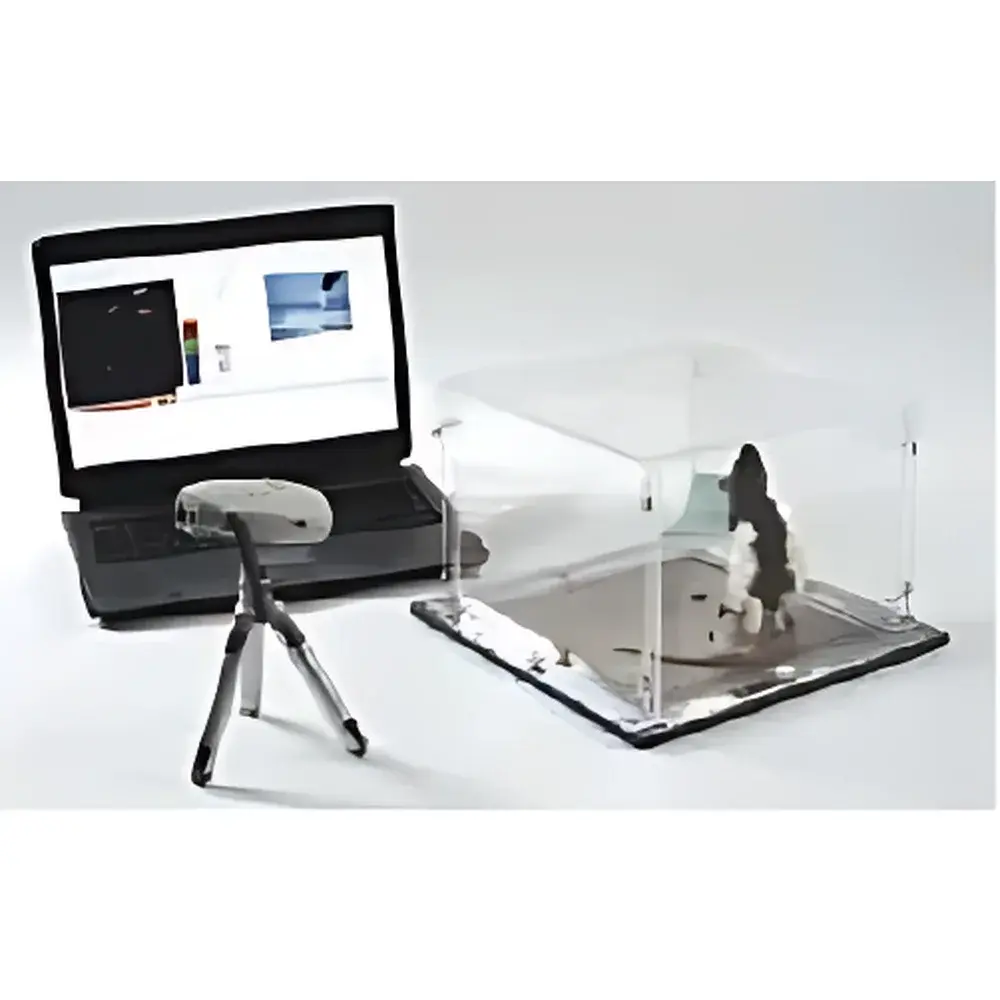
Panlab Dynamic Weight Bearing System
| Brand | Panlab |
|---|---|
| Origin | Spain |
| Model | Dynamic Weight Bearing System |
| Animal Compatibility | Mice (15–50 g), Rats (150–500 g) |
| Force Resolution | 0.2 g (mice), 0.8 g (rats) |
| Force Accuracy | ±1 g |
| Data Synchronization | Real-time video-embedded force recording via USB |
| Output Format | Native Excel (.xlsx) |
| Compliance | Designed for GLP-aligned preclinical behavioral phenotyping |
Overview
The Panlab Dynamic Weight Bearing System is a high-resolution, floor-integrated force measurement platform engineered for quantitative assessment of spontaneous weight distribution in freely moving rodents. Unlike static or treadmill-based load assays, this system employs an array of calibrated piezoresistive sensors embedded within a standardized walking surface to capture dynamic vertical ground reaction forces (vGRF) from each limb independently—without physical restraints, harnesses, or forced locomotion. The core measurement principle relies on real-time acquisition of transient force profiles during natural gait cycles, enabling detection of subtle asymmetries in limb loading associated with neuropathic pain, joint inflammation, motor neuron degeneration, or post-surgical recovery. Its design conforms to established preclinical behavioral testing paradigms defined in the NIH Pain Consortium guidelines and aligns with OECD Test No. 425 (Acute Oral Toxicity) and ICH S5(R3) requirements for functional observational battery (FOB) integration.
Key Features
- Floor-integrated sensor array with independent quadrupedal force resolution: 0.2 g for mice (15–50 g) and 0.8 g for rats (150–500 g), calibrated to ±1 g absolute accuracy per limb.
- Synchronized multimodal data acquisition: Simultaneous timestamp-matched recording of force traces and high-frame-rate video (via integrated or external USB camera), enabling precise event anchoring (e.g., paw contact onset, peak load, lift-off).
- Onboard digital signal conditioning and real-time zero-drift compensation, eliminating manual baseline recalibration between sessions.
- Dose-correction algorithm suite for inter-subject normalization—adjusting for body mass, gait speed variance, and sensor thermal drift—ensuring cross-session reproducibility (CV < 4.2% across 10-day longitudinal studies).
- Minimalist experimental setup: No acclimation cages, no training protocols, and no aversive stimuli; animals enter the arena voluntarily, reducing stress-induced confounding in nociceptive or motor assessments.
Sample Compatibility & Compliance
The system supports standard laboratory rodent strains including C57BL/6, Sprague-Dawley, and Wistar rats, as well as transgenic models used in osteoarthritis (e.g., STR/ort), neuropathic pain (e.g., CCI, SNI), and Parkinson’s disease (e.g., 6-OHDA-lesioned). All hardware and firmware comply with IEC 61000-6-3 (EMC emission standards) and CE marking for Class I medical devices under EU MDR Annex XVI (non-invasive monitoring equipment). Data handling workflows support ALCOA+ principles (Attributable, Legible, Contemporaneous, Original, Accurate, Complete, Consistent, Enduring, Available) and are compatible with 21 CFR Part 11–compliant electronic signature modules when deployed with validated LIMS or ELN platforms.
Software & Data Management
The included EthoVision XT–integrated software module provides automated limb assignment, gait cycle segmentation, and parameter extraction—including peak force (PF), stance duration (SD), load rate (LR), symmetry index (SI = [FL−FR]/[FL+FR] × 100), and interlimb coordination metrics. Raw force time-series data are stored in HDF5 format for trace-level auditability, while summary statistics export natively to Excel (.xlsx) with embedded metadata (animal ID, session timestamp, operator, environmental conditions). Audit trails record all user-initiated processing steps—including filtering thresholds, ROI adjustments, and outlier rejection criteria—with immutable timestamps. Remote analysis is supported via secure SSH tunneling or institutional VPN, allowing off-site collaboration without raw data transfer.
Applications
- Preclinical evaluation of analgesic efficacy in inflammatory and neuropathic pain models (e.g., carrageenan-induced edema, chronic constriction injury).
- Longitudinal monitoring of functional recovery following peripheral nerve repair or spinal cord injury.
- Phenotypic screening of genetically modified lines exhibiting gait abnormalities (e.g., dystrophin-deficient mdx mice).
- Assessment of joint dysfunction progression in monoiodoacetate (MIA)-induced osteoarthritis.
- Validation endpoint in toxicology studies where motor function is a critical safety biomarker (e.g., neurotoxicant exposure, chemotherapeutic agents).
FAQ
What species and weight ranges does the system support?
It is validated for mice (15–50 g) and rats (150–500 g). Sensor geometry and calibration curves are optimized for these mass ranges; use outside these limits requires custom validation.
Is video synchronization mandatory for data acquisition?
No—force data are recorded autonomously—but synchronized video is required for automated limb identification and gait event annotation in the standard analysis pipeline.
Can the system be integrated into existing behavioral test batteries?
Yes. It outputs standardized CSV and Excel files compatible with GraphPad Prism, MATLAB, and Python (pandas, SciPy) for secondary statistical modeling and machine learning pipelines.
Does the software meet regulatory requirements for GLP studies?
The base software supports audit trail logging and electronic signatures when deployed with a validated third-party e-signature framework compliant with 21 CFR Part 11 and EU Annex 11.
How often does the system require recalibration?
Factory calibration is stable for 12 months under normal lab conditions (20–25°C, non-condensing humidity); annual verification using NIST-traceable deadweight standards is recommended for regulated studies.
Related Products





