
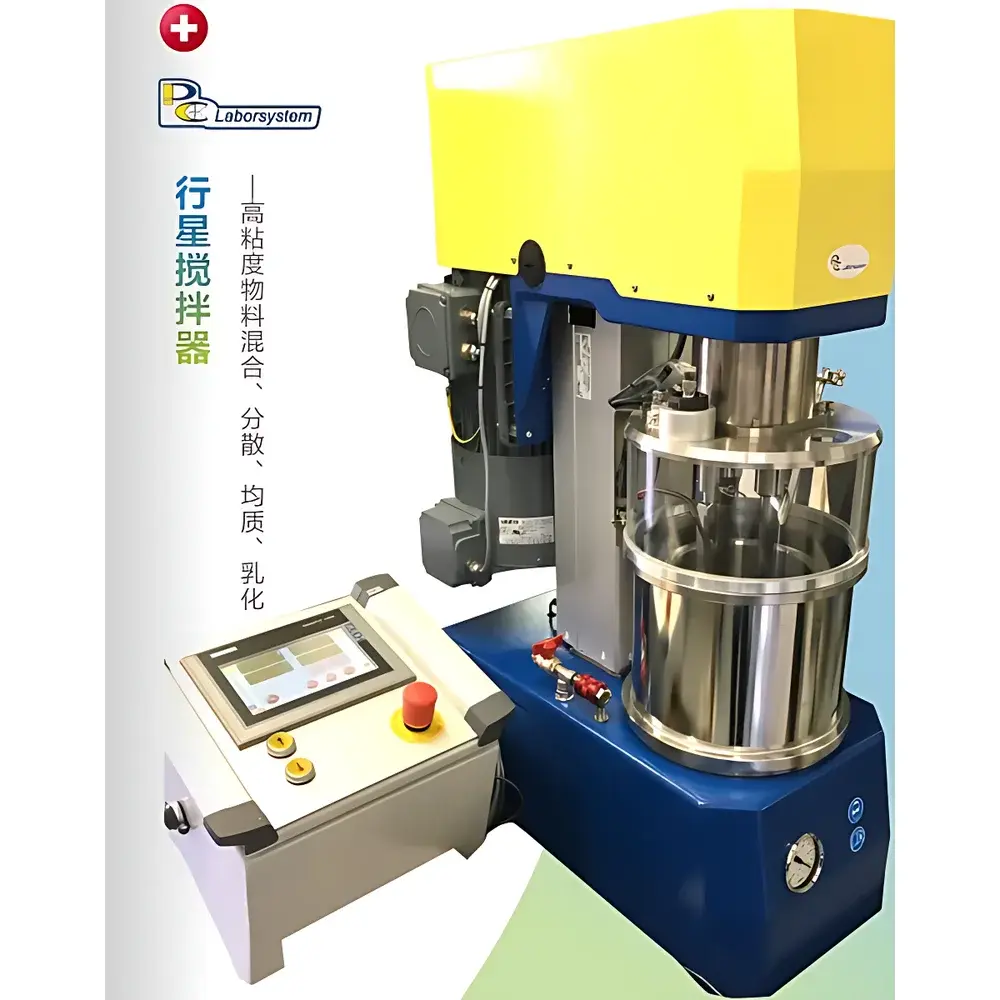
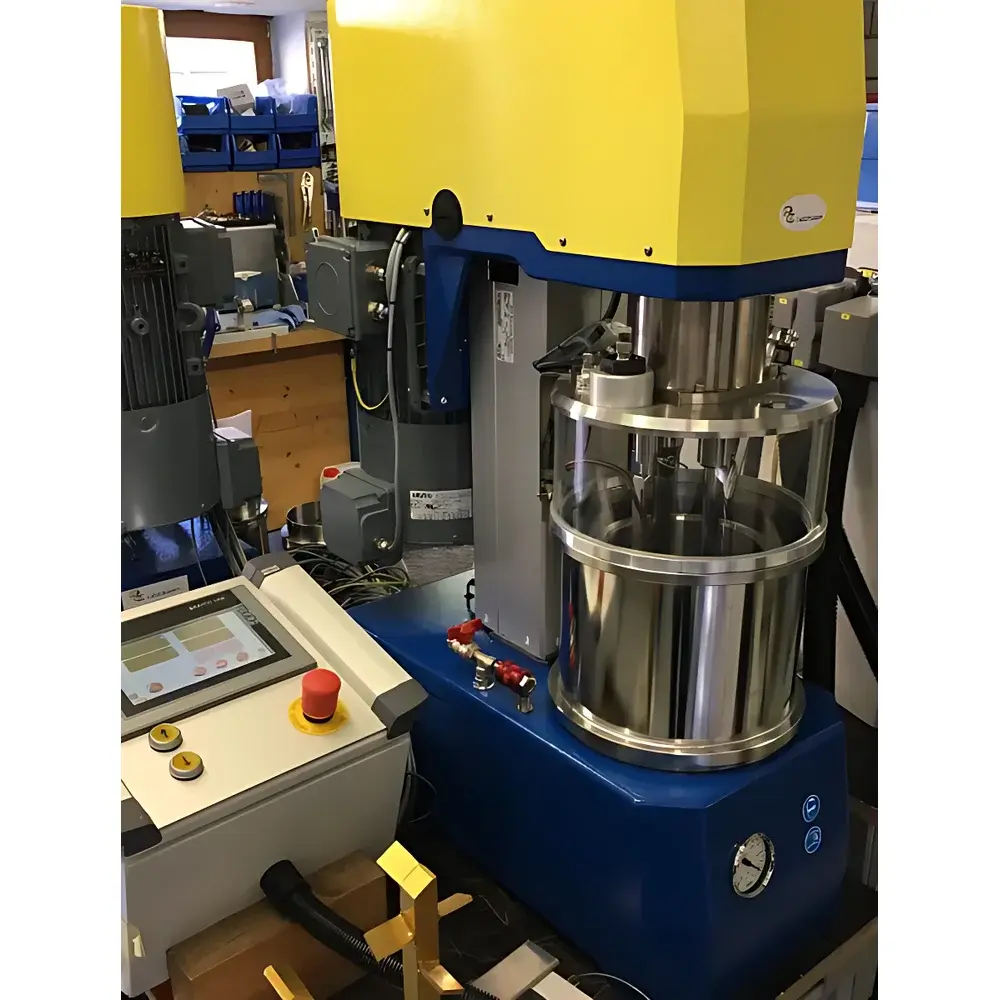
PC Laborsystems GmbH Combined Planetary Mixer
| Brand | PC Laborsystems GmbH |
|---|---|
| Origin | Switzerland |
| Instrument Type | Electric Planetary Mixer |
| Max. Mixing Volume | 100 L |
| Speed Range | 2000 rpm (high-speed spindle), 600 rpm (low-speed spindle) |
| Jacket Temperature Range | −50 to 200 °C |
| Vacuum Capability | −0.1 MPa |
| Vessel Material Options | AISI 304 (1.4301) stainless steel, tinplate, borosilicate glass, PTFE-lined or polymer vessels |
| Drive Power | 0.75 kW (low-speed), 1.5 kW (high-speed) |
| Vessel Rotation Speed | 10 rpm |
| Temperature Sensing | Integrated PT100 probe in scraper blade |
| Control Interface | 7″ touchscreen HMI with data logging and safety modules |
Overview
The PC Laborsystems GmbH Combined Planetary Mixer is an engineered solution for high-precision mixing, dispersion, homogenization, emulsification, and kneading of multi-phase systems—including solids, powders, pastes, viscous liquids, and temperature-sensitive formulations. Operating on dual-axis planetary kinematics, the system simultaneously rotates the mixing vessel around its central axis while driving multiple agitators (e.g., dispersing discs, butterfly impellers, and PTFE-coated scrapers) on independent orbital paths. This motion generates controlled shear gradients, radial and axial flow patterns, and continuous wall-scraping—enabling uniform energy input across heterogeneous media without dead zones. Designed for laboratory through pilot-scale process development, it supports reproducible scale-up of formulation protocols under tightly regulated thermal and vacuum conditions.
Key Features
- Dual-drive architecture: Independent control of high-speed dispersion spindle (up to 2000 rpm, 1.5 kW) and low-speed planetary vessel rotation (10 rpm, 0.75 kW motor)
- Integrated thermostatic jacket: Precise temperature control from −50 °C to +200 °C via external circulator coupling; real-time monitoring of both jacket and product temperatures using embedded PT100 sensors
- Vacuum-compatible design: Stainless steel (AISI 304 / 1.4301) vacuum chamber rated to −0.1 MPa, equipped with borosilicate glass viewport and pressure relief valve
- Modular tooling system: Interchangeable agitator configurations—including tree-type disperser discs, butterfly impellers, and self-cleaning PTFE-coated scrapers—optimized for viscosity ranges from 10⁶ mPa·s
- Motorized vertical lift column: Programmable height adjustment with mechanical locking and overload protection
- Safety-certified control platform: CE-compliant 7″ touchscreen HMI featuring emergency stop, vacuum loss detection, temperature deviation alarms, and lift position interlocks
Sample Compatibility & Compliance
The mixer accommodates a broad spectrum of sample types—aqueous suspensions, solvent-based dispersions, thermoplastic melts, silicone gels, pharmaceutical ointments, battery slurries, and reactive resin systems. Vessel options include standard AISI 304 stainless steel, electropolished variants, borosilicate glass (DIN 28120), food-grade tinplate, and chemically resistant polymer-lined containers. All wetted parts comply with FDA 21 CFR §177.2400 (for PTFE components) and EU Regulation (EC) No. 1935/2004 for food contact materials. The system architecture supports GLP/GMP-aligned workflows: audit-trail-enabled data logging, user access levels, electronic signature capability (via optional software package), and full traceability of setpoints, timestamps, and operational events.
Software & Data Management
The integrated controller provides local process supervision and real-time parameter visualization. Optional PC-based software (LabControl Pro v3.x) enables remote operation, automated recipe execution, and compliance-ready reporting per ISO/IEC 17025 and ASTM E2500-13 guidelines. Logged data includes torque profiles, temperature histories (product and jacket), vacuum trends, rotational speeds, and lift position—all exportable in CSV or PDF format. Data integrity safeguards include write-protected storage, cyclic redundancy checks (CRC), and configurable retention policies aligned with 21 CFR Part 11 requirements for electronic records.
Applications
- Development and optimization of lithium-ion battery cathode/anode slurries requiring particle deagglomeration and binder distribution
- Pharmaceutical suspension formulation under inert atmosphere and controlled thermal ramping
- High-viscosity adhesive and sealant manufacturing (e.g., PU, epoxy, silicone) with degassing integration
- Functional food matrix development—protein-fiber emulsions, nutraceutical suspensions, and clean-label thickened beverages
- Polymer composite compounding: carbon fiber-reinforced thermoplastics, conductive pastes, and UV-curable resins
- Chemical synthesis intermediates where exothermicity, gas evolution, or moisture sensitivity demands simultaneous mixing, cooling, and vacuum removal
FAQ
What is the maximum allowable viscosity for effective processing?
The system is engineered for viscosities up to 10⁶ mPa·s at 25 °C, depending on geometry, fill level, and thermal state. For ultra-high-viscosity applications (>5×10⁵ mPa·s), low-speed planetary mode with scraper-equipped impellers is recommended.
Can the mixer be validated for GMP production environments?
Yes—when configured with IQ/OQ documentation packages, calibrated PT100 probes (traceable to NIST standards), and optional 21 CFR Part 11-compliant software, it meets qualification requirements for Class A/B cleanroom-adjacent pilot lines.
Is vacuum degassing fully integrated into the mixing cycle?
Vacuum application is synchronized with agitation and temperature control; automatic pressure ramping and hold phases can be programmed within recipes to ensure consistent bubble removal without foaming or splashing.
Are custom vessel geometries supported?
Vessels from 0.3 L to 100 L are available in standard cylindrical, conical-bottom, and double-walled configurations. Custom flange interfaces, port layouts, and internal baffling can be designed per ASME BPE or DIN 11851 specifications.
How is cleaning validation addressed?
All vessels feature CIP-compatible surface finishes (Ra ≤ 0.8 µm), drainable geometry, and absence of crevices. Optional spray ball integration and compatibility with alkaline/peroxide-based cleaners support residue testing per ICH Q5C and USP .



