
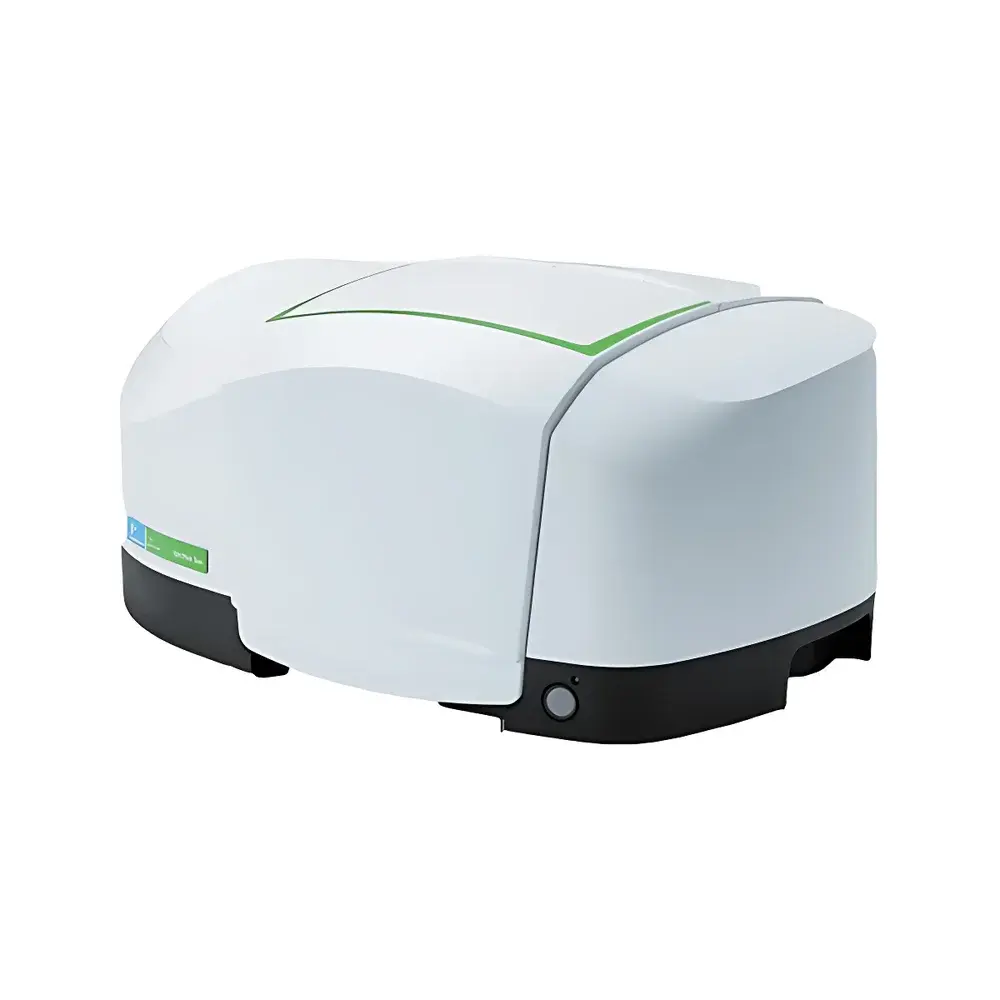
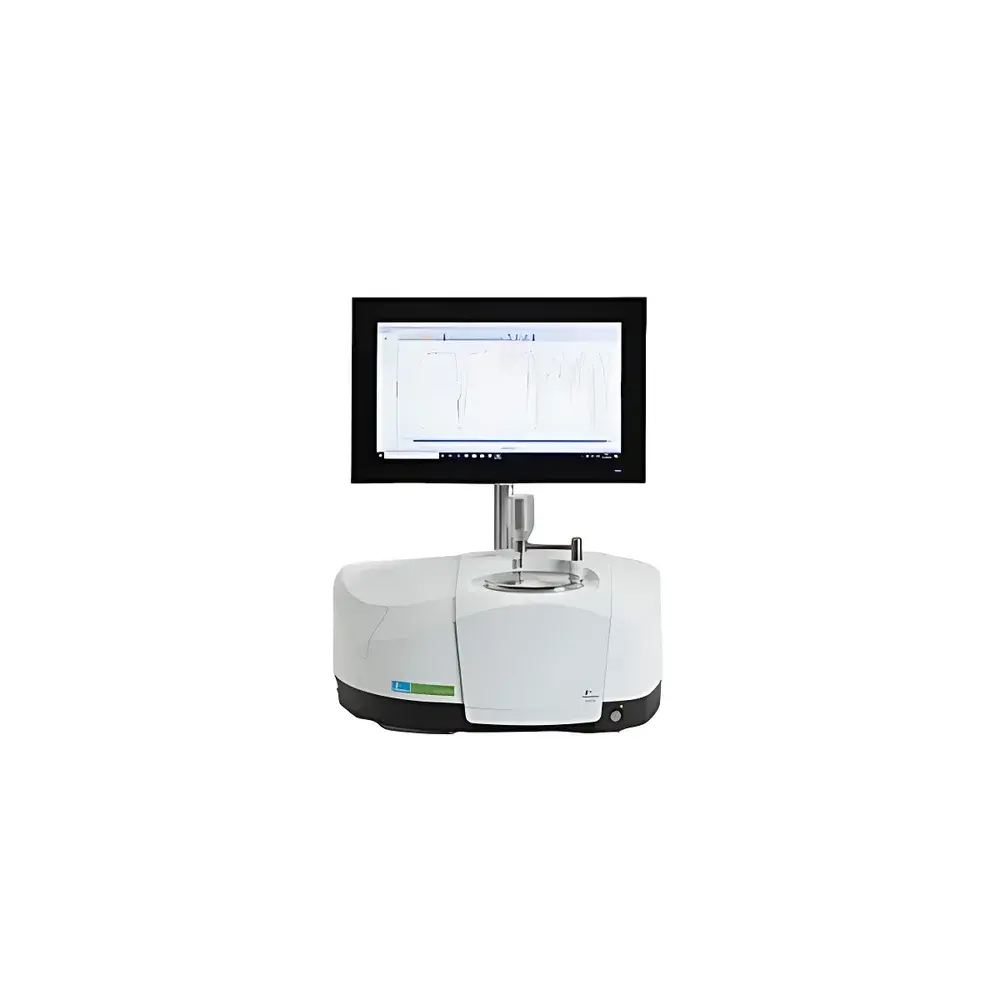
PerkinElmer Spectrum Two FT-IR Spectrometer (L160000A)
| Brand | PerkinElmer |
|---|---|
| Origin | USA |
| Model | L160000A |
| Instrument Type | Benchtop Laboratory FT-IR Spectrometer |
| Wavenumber Range | 350–7500 cm⁻¹ |
| Spectral Resolution | 0.5 cm⁻¹ |
| Wavenumber Accuracy | ±0.1 cm⁻¹ |
| Wavenumber Precision | ±0.01 cm⁻¹ |
| Signal-to-Noise Ratio | 9,300:1 (5 scans, peak-to-peak), 32,000:1 (60 sec scan, peak-to-peak) |
| Detector | High-performance DTGS or optional MCT |
| Interferometer | DynaScan™ permanent alignment, no moving mirrors |
| Beamsplitter | KBr-coated |
| Optical Enclosure | Sealed, desiccated cavity with OpticsGuard™ moisture protection |
| Dimensions | 450 × 300 × 210 mm |
| Weight | 13 kg |
Overview
The PerkinElmer Spectrum Two FT-IR Spectrometer (L160000A) is a compact, benchtop Fourier Transform Infrared spectrometer engineered for high reproducibility, operational robustness, and regulatory-compliant routine analysis in quality control, teaching laboratories, and field-deployable applications. Based on Michelson interferometry with a permanently aligned DynaScan™ interferometer, the system delivers stable spectral acquisition without dynamic mirror misalignment—eliminating recalibration drift and ensuring long-term wavenumber fidelity. Its sealed optical cavity incorporates OpticsGuard™ desiccation technology to maintain sub-1% relative humidity internally, preventing KBr beamsplitter degradation and hygroscopic detector noise. The instrument operates across a standard spectral range of 350–7500 cm⁻¹ with factory-verified wavenumber accuracy of ±0.1 cm⁻¹ and precision of ±0.01 cm⁻¹—meeting ISO 17025 traceability requirements when used with NIST-traceable polystyrene reference films.
Key Features
- DynaScan™ interferometer: Solid-state design with no dynamic mirror offset; zero maintenance over instrument lifetime
- OpticsGuard™ integrated desiccation system: Continuous internal humidity control (<1% RH) without user-replaceable desiccant cartridges
- AVC™ (Automatic Vapor Compensation): Real-time single-beam atmospheric background subtraction during acquisition—enabling rapid measurement without separate background collection
- Sigma-Delta analog-to-digital conversion: 24-bit resolution with oversampling for enhanced dynamic range and low-noise signal digitization
- Modular power architecture: Compatible with AC mains (100–240 V), external DC input (12–24 V), or optional battery pack for true portable operation
- Wireless control capability: Full instrument operation via Wi-Fi-enabled laptop or tablet using Spectrum 10 software
- Compact footprint (450 × 300 × 210 mm) and lightweight chassis (13 kg): Designed for benchtop stability, mobile lab integration, or field deployment with optional ruggedized carry case
Sample Compatibility & Compliance
The Spectrum Two supports universal sampling modalities—including transmission (KBr pellet, liquid cell), reflectance (specular, diffuse), and attenuated total reflectance (ATR)—via interchangeable accessory ports and standardized mounting interfaces. ATR accessories (e.g., diamond, ZnSe, or Ge crystals) enable direct solid/liquid analysis without sample preparation. All configurations comply with ASTM E1421 (Standard Practice for Describing and Measuring Performance of FT-IR Spectrometers), ISO 18383 (FT-IR terminology), and USP (Infrared Absorption Spectrophotometry). Data acquisition and processing meet FDA 21 CFR Part 11 requirements when deployed with Spectrum 10 software configured for electronic signatures, audit trails, and role-based access control—supporting GLP/GMP environments in pharmaceutical and contract research laboratories.
Software & Data Management
Spectrum 10 software provides full instrument control, spectral acquisition, quantitative analysis (including classical least-squares, PLS, and chemometric modeling), and reporting compliant with ISO/IEC 17025 documentation standards. It includes pre-built method templates for ASTM D7066 (hydrocarbon quantitation in water), ASTM D2413 (lubricant oxidation monitoring), and JOAP 0601 (polymer identification). Raw interferogram and spectrum files are stored in vendor-neutral .spa format, supporting third-party spectral libraries (e.g., Sadtler, KnowItAll®) and export to CSV, JCAMP-DX, or XML for LIMS integration. Audit trail logs record all user actions—including parameter changes, calibration events, and report generation—with time-stamped, non-erasable entries.
Applications
- Pharmaceutical raw material identification and counterfeit screening per ICH Q5C and USP
- Quantitative analysis of UV stabilizers, slip agents, and plasticizers in polymer matrices using ATR-FTIR with internal standard calibration
- Environmental monitoring: Rapid detection and semi-quantification of petroleum hydrocarbons (C10–C40) in soil and water extracts per EPA Method 3520C and ASTM D7066
- Teaching laboratories: Curriculum-aligned experiments on functional group identification, reaction monitoring, and polymer degradation kinetics
- Lubricant condition monitoring: Oxidation index, nitration, sulfation, and glycol contamination tracking in used engine oils
- Fuel analysis: Biodiesel blend verification (EN 14078), ethanol content in gasoline (ASTM D4806), and aromatic content profiling
FAQ
Does the Spectrum Two require periodic interferometer alignment?
No. The DynaScan™ interferometer uses a fixed-mirror, solid-state optical path with no moving parts subject to mechanical drift—eliminating the need for user alignment or factory recalibration.
Can the instrument be operated outside a temperature-controlled laboratory?
Yes. With optional battery power and wireless control, it functions in ambient temperatures from 15–30 °C and relative humidity up to 80% non-condensing—provided the OpticsGuard™ system remains active.
Is ATR accessory compatibility standardized across PerkinElmer FT-IR platforms?
Yes. All ATR accessories with 1/4″-20 threaded mounts and 12 mm optical aperture are mechanically and optically interoperable with Spectrum One, Two, and Frontier systems.
What validation documentation is provided for GxP use?
The system ships with Factory Acceptance Test (FAT) report, IQ/OQ protocols (customizable), and a Certificate of Conformance traceable to NIST standards. Full 21 CFR Part 11 compliance requires validated Spectrum 10 configuration and site-specific PQ.
How is spectral reproducibility verified during routine operation?
Users perform daily verification using the built-in polystyrene film test—automatically assessing wavenumber accuracy, resolution (at 1601 cm⁻¹), and %T repeatability per ASTM E1421 Annex A1.
Related Products





