
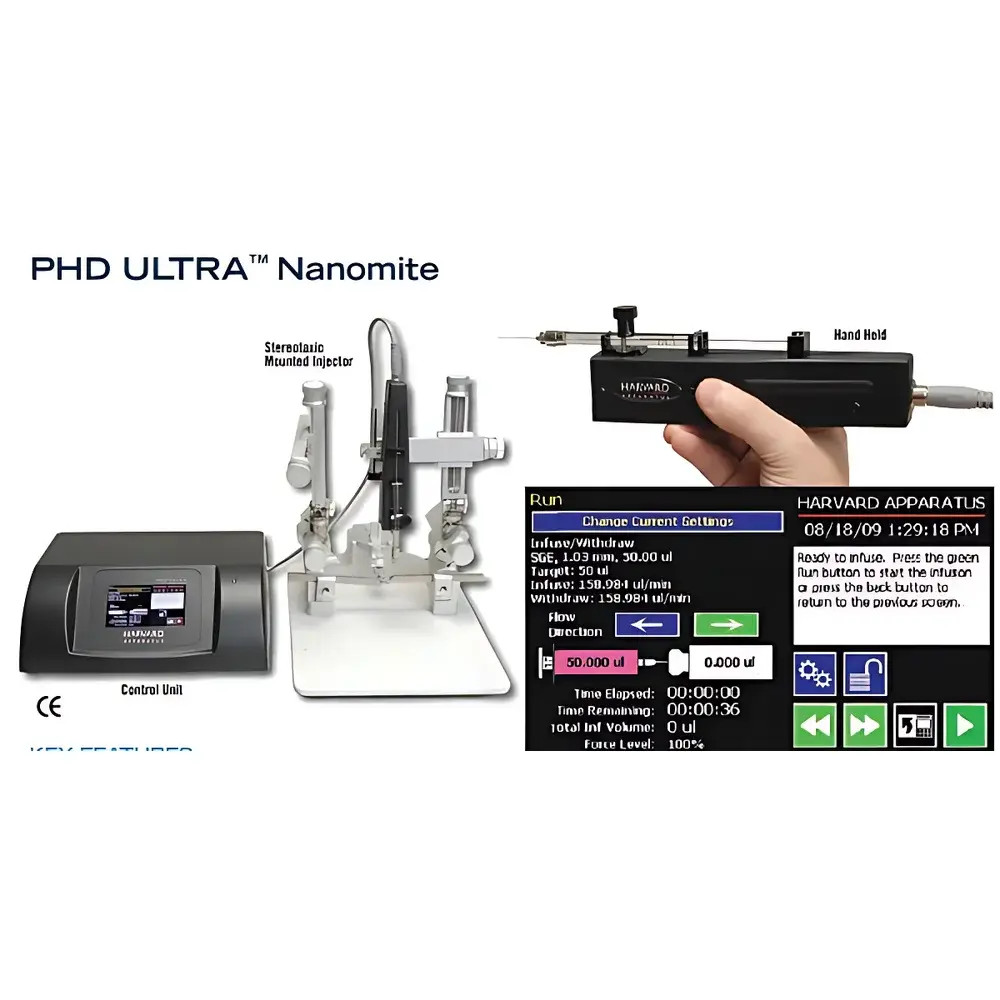
PHD ULTRA™ Nanomite Infusion/Withdrawal Programmable Single Syringe Pump
| Brand | Harvard Apparatus |
|---|---|
| Origin | USA |
| Model | PHD ULTRA™ Nanomite |
| Syringe Capacity | 0.5 µL – 1 mL |
| Minimum Flow Rate | 3.66 pL/min |
| Maximum Flow Rate | 3.82 mL/min |
| Max Linear Force | 5 kg |
| Interface | USB Serial |
Overview
The PHD ULTRA™ Nanomite is a high-precision, single-syringe programmable infusion/withdrawal pump engineered for ultra-low-volume fluid handling in demanding research environments. Designed and manufactured by Harvard Apparatus in the United States, it operates on microstepping motor-driven linear actuation, delivering exceptional resolution and repeatability across an exceptionally wide dynamic flow range—from picoliter-per-minute delivery to milliliter-per-minute displacement. Its core architecture leverages closed-loop positional feedback and calibrated syringe geometry mapping to convert motor step counts into volumetric output with traceable accuracy. This makes the Nanomite particularly suited for applications requiring quantitative, time-resolved delivery or aspiration of minute biological, chemical, or nanomaterial suspensions—such as intracerebral microinjection in neuroscience, microfluidic device priming, single-cell electrophysiology perfusion, and precision calibration of analytical sensors.
Key Features
- Ultra-low flow capability: Programmable down to 3.66 pL/min (picoliters per minute), enabling sub-cellular volume control and long-duration continuous dosing without syringe replacement.
- High-force linear actuator: Delivers up to 5 kg of push/pull force, ensuring reliable operation with high-viscosity fluids or against backpressure encountered in capillary tubing or microfluidic networks.
- Flexible syringe compatibility: Accepts both glass and plastic syringes ranging from 0.5 µL to 1 mL nominal capacity—supporting standard Luer-lock fittings and enabling rapid reconfiguration between experimental protocols.
- Dual-mode operation: Independent, bidirectional programming for infusion-only, withdrawal-only, or alternating infusion/withdrawal sequences with user-defined dwell times and ramp profiles.
- USB serial interface: Provides direct host computer communication for script-based automation via ASCII command protocol; compatible with LabVIEW, MATLAB, Python (pySerial), and custom C++ applications.
- On-device control and monitoring: Integrated OLED display and membrane keypad allow standalone operation, real-time status verification, and emergency stop activation without external software dependency.
Sample Compatibility & Compliance
The Nanomite accommodates a broad spectrum of sample types—including aqueous buffers, organic solvents, polymer solutions, cell suspensions, and nanoparticle dispersions—provided they are chemically compatible with standard borosilicate glass or polypropylene syringes and PTFE/Nitrile seals. No internal wetted surfaces contact the fluid path beyond the syringe barrel and plunger tip, minimizing carryover and simplifying cleaning validation. While the device itself does not carry CE marking for IVD use or FDA 510(k) clearance, its design adheres to general electrical safety principles outlined in IEC 61010-1. When integrated into GLP- or GMP-aligned workflows, the pump supports audit-ready operation through timestamped command logging (when used with compliant host software) and deterministic, repeatable motion profiles that satisfy traceability requirements under ISO/IEC 17025 and USP .
Software & Data Management
Harvard Apparatus provides the free NanoDrive™ software suite for Windows-based configuration, real-time monitoring, and sequence scripting. NanoDrive enables multi-step protocols with conditional logic, flow rate ramping, pause/resume triggers, and synchronized data export in CSV format. For integration into larger automated platforms, the pump responds to standard ASCII commands over USB virtual COM port (VCP), supporting full remote control—including start/stop, direction reversal, speed adjustment, and position readback—with sub-millisecond latency. All communication is stateless and non-proprietary, facilitating interoperability with third-party laboratory information management systems (LIMS) and electronic lab notebooks (ELN) when coupled with middleware adapters. Audit trail functionality requires external logging at the host application layer, consistent with FDA 21 CFR Part 11 expectations for electronic records and signatures.
Applications
- Neuroscience: Stereotactic delivery of viral vectors, pharmacological agents, or dyes into discrete brain nuclei with spatial and temporal fidelity.
- Microfluidics: Priming, flushing, and reagent loading in organ-on-chip and droplet-generation platforms where dead volume and pulsatility must be minimized.
- Electrophysiology: Continuous perfusion of recording chambers during patch-clamp experiments, maintaining stable ion concentrations and temperature.
- Materials science: Controlled deposition of functional nanomaterial inks onto substrates for printed electronics or biosensor fabrication.
- Calibration & metrology: Generation of certified volumetric standards for gravimetric or optical flow sensor validation at ultra-low rates.
FAQ
What syringe sizes are supported?
The PHD ULTRA™ Nanomite accepts syringes from 0.5 µL to 1 mL nominal volume, including both glass and plastic variants with standard Luer-lock connections.
Can the pump operate without a computer?
Yes—it features a local OLED interface and keypad for manual setup, real-time monitoring, and immediate execution of preloaded protocols.
Is backward compatibility maintained with legacy PHD series controllers?
No—the Nanomite uses a dedicated firmware architecture and command set distinct from earlier PHD models; however, its USB interface ensures seamless integration with modern computing environments.
How is flow accuracy verified and maintained?
Accuracy is derived from motor step resolution, lead screw pitch, and calibrated syringe inner diameter input; users are advised to perform periodic gravimetric or fluorometric validation using traceable reference standards.
Does the pump support pressure sensing or feedback control?
No—this is an open-loop volumetric displacement device. Pressure monitoring or closed-loop flow regulation requires external transducers and supervisory control logic implemented at the host system level.



