
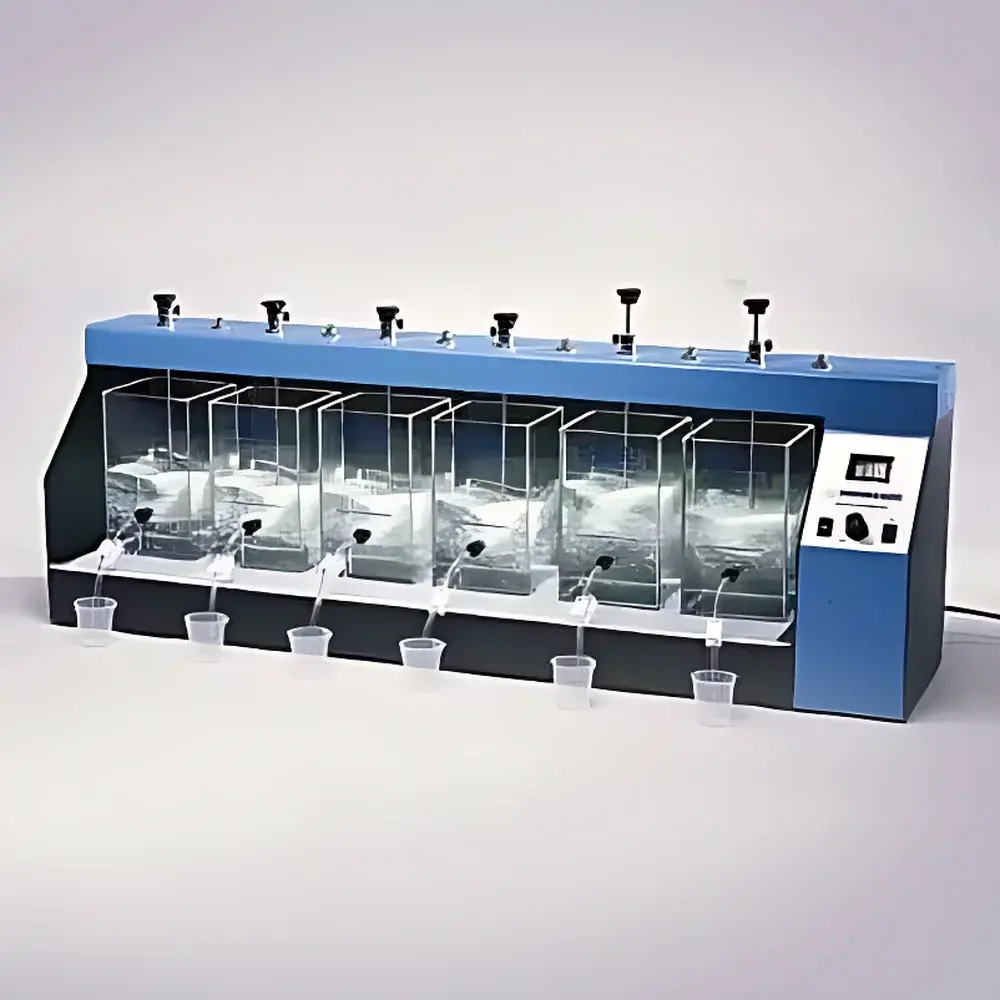
Phipps & Bird Model 7790-712 Six-Vessel Jar Test Stirrer
| Brand | Cole-Parmer |
|---|---|
| Origin | USA |
| Manufacturer Type | Authorized Distributor |
| Import Status | Imported |
| Model | 7790-712 |
| Instrument Type | Motorized Jar Test Stirrer |
| Speed Range | 0–35 rpm (low-speed coagulation) and 30–300 rpm (high-speed flocculation) |
| Timer Range | 1 s to 59 min 59 s (1 s increment) |
| Temperature Control | Not integrated (ambient operation |
| Operating Ambient Temperature | 5°C to 40°C (41°F to 104°F) |
| Relative Humidity | 50–80% non-condensing |
| Power Supply | 220 V, 50/60 Hz, 0.75 A |
| Net Weight | 22.2 kg |
| Dimensions (L×W×H) | 23.5 × 107.3 × 39.4 cm |
| Standard Accessories | Main unit, fluorescent floc illumination lamp, six 1-L acrylic jars (¼" wall thickness), dust cover |
Overview
The Phipps & Bird Model 7790-712 Six-Vessel Jar Test Stirrer is an engineered platform for standardized coagulation and flocculation evaluation in water and wastewater treatment laboratories. Designed in strict accordance with ASTM D2035 – Standard Practice for Coagulation-Flocculation Jar Test of Water – this instrument enables reproducible, multi-parameter assessment of chemical dosing efficacy, floc formation kinetics, and settling behavior across six independent reaction vessels. Its dual-range motorized drive system supports both low-shear coagulation (0–35 rpm) and high-shear flocculation (30–300 rpm), permitting precise simulation of hydraulic conditions encountered in rapid mix basins and flocculation tanks. Unlike generic stirrers, the 7790-712 integrates application-specific mechanical design—including stainless-steel impellers, optically clear acrylic jars, and integrated floc illumination—to support visual and quantitative analysis of floc size, density, and breakage resistance under controlled shear histories.
Key Features
- Dual-speed precision motor drive: independently adjustable 0–35 rpm (coagulation phase) and 30–300 rpm (flocculation phase) with ±1 rpm speed accuracy
- Six synchronized or individually programmable stirring stations, each equipped with a 1-L, ¼”-thick optical-grade acrylic jar optimized for thermal stability and minimal splashing during high-shear operation
- Backlit LCD interface with on-board memory for up to four user-defined test protocols, including speed profiles, timer settings, and repeat-cycle parameters
- Non-volatile memory retention ensures protocol integrity during power interruption (built-in battery-backed RAM)
- Integrated fluorescent illumination module positioned beneath the jar array provides uniform, shadow-free lighting for real-time floc observation and digital imaging compatibility
- Patented jar mounting system with integrated tube clamps allows for non-disruptive sampling from mid-depth or supernatant layers without disturbing settled flocs at the vessel base
- Rugged stainless-steel impeller shafts and corrosion-resistant housing meet long-term operational demands in chloride-rich or chemically aggressive testing environments
Sample Compatibility & Compliance
The 7790-712 is validated for use with aqueous suspensions containing suspended solids, colloidal particles, natural organic matter (NOM), and synthetic polymers—common matrices in potable water, municipal wastewater, and industrial effluent characterization. Its mechanical configuration conforms to the geometric and rotational specifications defined in ASTM D2035, ensuring data comparability across laboratories and regulatory submissions. While the unit itself does not provide active temperature control, its acrylic jar construction exhibits low thermal conductivity and dimensional stability across ambient operating ranges (5–40°C), facilitating integration with external recirculating chillers or heated bath systems where temperature-dependent coagulant performance (e.g., ferric chloride hydrolysis kinetics) must be evaluated. The device complies with IEC 61010-1 safety standards for laboratory electrical equipment and carries CE marking for EMC and low-voltage directive compliance.
Software & Data Management
The 7790-712 operates as a standalone benchtop instrument with no proprietary software dependency. All test parameters are configured and logged locally via the front-panel interface. Timestamped protocol execution records—including start time, speed sequence, duration per step, and cycle count—are retained in non-volatile memory for GLP-aligned audit trails. For laboratories requiring electronic recordkeeping under FDA 21 CFR Part 11 or ISO/IEC 17025, the unit’s deterministic timing engine and unambiguous parameter logging support manual transcription into validated LIMS or ELN platforms. Optional RS-232 or USB-to-serial adapters (sold separately) enable serial data capture of real-time speed and timer status for third-party automation scripting.
Applications
- Optimization of coagulant and flocculant dosing strategies for surface water treatment plants
- Evaluation of alternative coagulants (e.g., polyaluminum chloride, ferrate(VI)) under variable pH and alkalinity conditions
- Assessment of floc strength and regrowth potential following shear reintroduction (breakup-recovery tests)
- Validation of jar test correlations with full-scale clarifier performance
- Research into particle destabilization mechanisms using streaming current detection or turbidimetric endpoint analysis
- Training and proficiency testing for water quality analysts under EPA-approved methodology frameworks
FAQ
Does the 7790-712 include built-in temperature control?
No. It operates at ambient laboratory temperature. External temperature-controlled baths or jacketed jars are required for isothermal testing.
Can individual vessels be operated at different speeds simultaneously?
No. All six vessels rotate at the same selected speed; synchronization ensures hydraulic equivalence across replicate tests per ASTM D2035.
What jar volume options are supported?
The system is calibrated and supplied for 1-L acrylic jars. Use of alternate volumes (e.g., 500 mL or 2-L) is not recommended without recalibration and may compromise ASTM compliance.
Is the fluorescent illumination intensity adjustable?
No. The LED-based floc lamp delivers fixed-intensity, cool-white illumination optimized for contrast enhancement without heating the sample.
How is calibration verified?
Speed accuracy is traceable to NIST-calibrated tachometers. Routine verification is performed using an optical tachometer at three points within each speed range (e.g., 5, 20, and 35 rpm for low range; 60, 150, and 300 rpm for high range).
Related Products



