
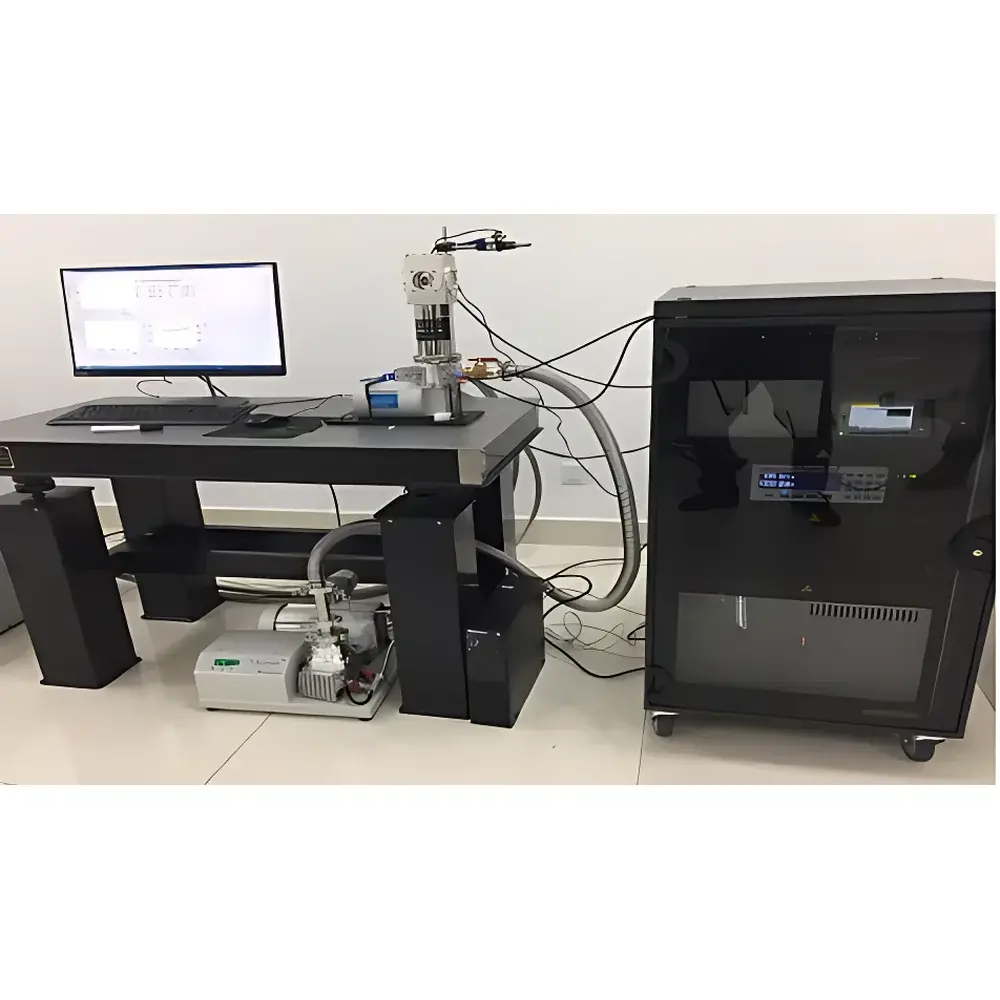
PhysTech HERA-DLTS Deep Level Transient Spectroscopy System
| Origin | Germany |
|---|---|
| Manufacturer Type | Authorized Distributor |
| Origin Category | Imported |
| Model | FT1230 |
| Price Range | USD 14,000 – 28,000 |
Overview
The PhysTech HERA-DLTS is a high-precision deep level transient spectroscopy system engineered for quantitative defect characterization in semiconductor materials and devices. Based on the fundamental physical principle of thermal emission kinetics from electrically active traps in the bandgap, the HERA-DLTS measures transient capacitance (C-DLTS) or current (I-DLTS) responses following controlled carrier injection and subsequent thermal emission under precisely regulated temperature ramps. Introduced in 1990 as the world’s first fully digital DLTS platform, the system leverages real-time computational capabilities to implement advanced mathematical deconvolution techniques—including Fourier-transform DLTS (F-DLTS), Laplace-transform analysis, multi-exponential transient fitting, and Isothermal Transient Spectroscopy (ITS)—enabling unambiguous separation of overlapping trap signals with exceptional energy resolution. Unlike analog predecessors or hybrid systems, HERA-DLTS maintains full digital signal integrity from sensor interface through post-processing, ensuring traceable, reproducible defect profiling across Si, SiC, GaN, GaAs, InP, and emerging wide-bandgap semiconductors.
Key Features
- Automated contact integrity verification prior to each measurement cycle, minimizing false positives from poor Schottky or ohmic contacts
- Digital capacitance compensation over dynamic ranges up to 10 nF, supporting both low-doping bulk crystals and high-capacitance MOS structures
- Triple-terminal FET transient current acquisition with sub-picoampere sensitivity and programmable gate/drain bias sequencing
- Modular hardware architecture enabling seamless integration with cryogenic probe stations (4 K–675 K), closed-cycle coolers, and PID-controlled temperature controllers
- Comprehensive software suite featuring 28 built-in correlation functions—each executable within a single temperature scan—to extract activation energy (ET), capture cross-section (σ), concentration (NT), and electron/hole emission signatures
- Native support for seven operational modes: C-DLTS, CC-DLTS, I-DLTS, DD-DLTS, Zerbst-DLTS, O-DLTS (optical excitation), and FET/MOS-specific analysis workflows
- Direct transient acquisition without analog filtering—preserving full temporal fidelity for subsequent Laplace or wavelet-domain analysis
Sample Compatibility & Compliance
The HERA-DLTS accommodates planar diodes, mesa structures, FETs, MOSCAPs, and epitaxial layers fabricated on silicon, compound semiconductors, and 2D material heterostructures. Its low-noise front-end and adaptive gain staging ensure reliable data acquisition across doping concentrations from 1×1012 cm−3 to >1×1018 cm−3. All firmware and software modules comply with ISO/IEC 17025 requirements for testing laboratories and support audit-ready documentation per GLP and GMP frameworks. Data export formats (CSV, HDF5, MATLAB .mat) are compatible with third-party statistical analysis tools used in semiconductor process development and failure analysis labs.
Software & Data Management
HERA-Control v5.x provides a deterministic, scriptable environment for experiment design, real-time monitoring, and batch processing. Each measurement session automatically generates timestamped metadata including instrument configuration, thermal ramp parameters, bias conditions, and hardware calibration status. The software implements full 21 CFR Part 11 compliance via electronic signatures, role-based access control, and immutable audit trails for all data modifications. Advanced features include ITS signal superposition, temperature-scan signal re-folding (TSCA), Richardson plot generation from I/V(T) sweeps, and PITS (photon-induced transient spectroscopy) mode for optically active defect mapping.
Applications
- Quantitative identification and depth profiling of recombination-active defects in power devices (SiC MOSFETs, GaN HEMTs)
- Correlation of DLTS peaks with minority-carrier lifetime degradation in photovoltaic-grade silicon wafers
- Capture cross-section anisotropy analysis in strained-channel CMOS transistors
- Thermal stability assessment of dopant-related complexes in annealed III–V heterojunctions
- Defect passivation evaluation using hydrogenation or forming gas annealing protocols
- Validation of TCAD simulation parameters against experimentally derived trap energy distributions
FAQ
What cooling systems are certified for use with the HERA-DLTS?
The system is validated for integration with Janis ST-100, BlueFrog CryoSystems, and Cryomech CP2800 closed-cycle refrigerators, as well as liquid nitrogen cryostats equipped with temperature sensors meeting ASTM E220 calibration standards.
Does the software support automated reporting for ISO 17025 accreditation?
Yes—HERA-Control generates compliant PDF reports containing raw transients, fitted spectra, uncertainty estimates (k=2), equipment calibration certificates, and operator authentication logs.
Can the FT1230 model perform simultaneous multi-frequency capacitance-voltage (C-V) sweeps?
No—C-V and C-DLTS are sequential measurement modes; however, C/V(T) datasets can be acquired at discrete temperatures during DLTS thermal scans and exported for Arrhenius or Poole–Frenkel analysis.
Is remote operation supported over secure enterprise networks?
Yes—via TLS-encrypted VNC and REST API endpoints; all remote sessions enforce two-factor authentication and log full command histories for security audits.



