
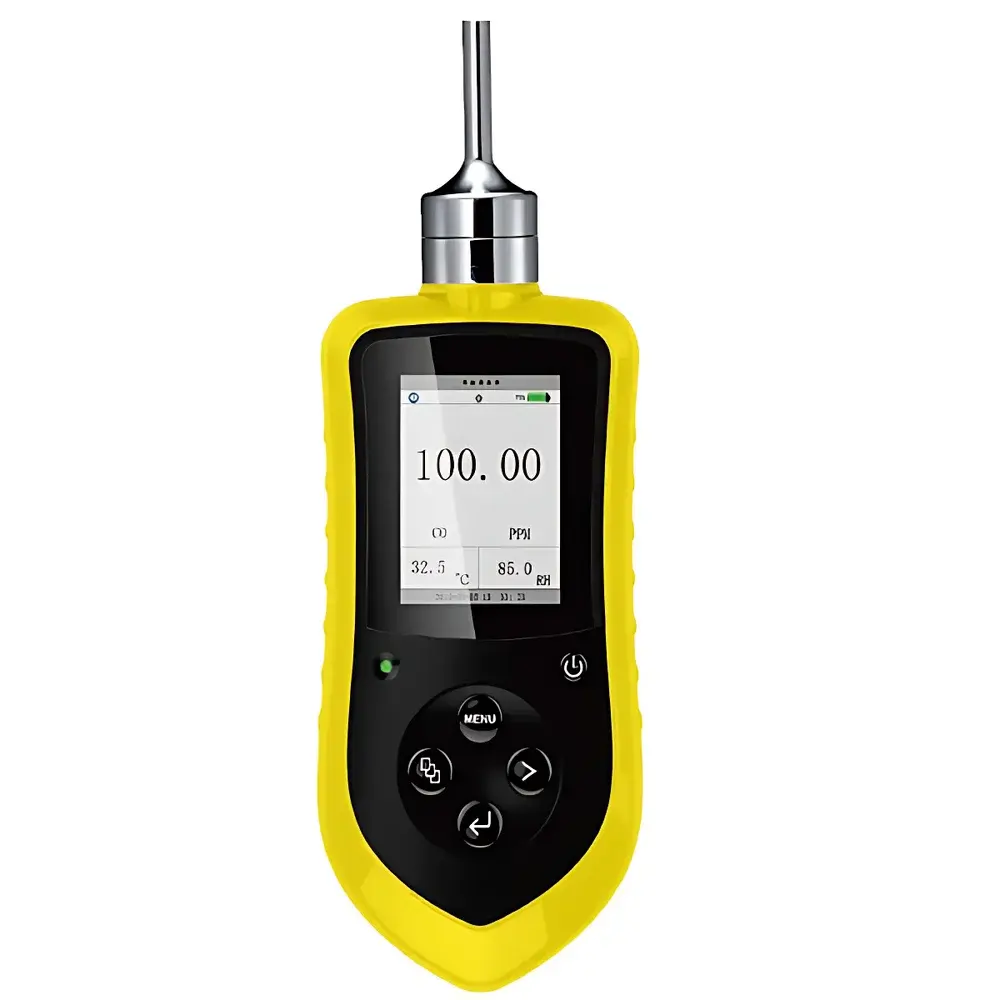
PKSAIR C4 Pump-Aspiration Formaldehyde Gas Detector
| Origin | Beijing, China |
|---|---|
| Manufacturer Type | Authorized Distributor |
| Origin Category | Domestic (China) |
| Model | PKSAIR C4 |
| Price Range | USD 1,400–2,800 (FOB) |
| Detection Principle | Electrochemical Sensor |
| Measurement Range | 0.001–10.000 ppm (equivalent to mg/m³) |
| Resolution | 0.001 ppm (mg/m³) |
| Repeatability | ≤ ±2% of full scale |
| Sampling Method | Integrated pump aspiration (Thomas GmbH micro-vacuum pump) |
| Response Time (T90) | ≤30 s |
| Operating Temperature | −20 °C to +50 °C |
| Operating Humidity | 0–95% RH (non-condensing) |
| Display | 2.4″ color TFT LCD (320 × 240 px) |
| Data Storage | Up to 100,000 records (optional internal memory) |
| Power Supply | 2800 mAh Li-polymer battery (≥20 h continuous operation) |
| Ingress Protection | IP65 |
| Explosion Protection | Ex ib IIC T4 Gb |
| Compliance | GB 50493–2009, GB 12358–2006, GBZ 2.1–2007, GB 3836.1/4–2010 |
Overview
The PKSAIR C4 Pump-Aspiration Formaldehyde Gas Detector is a field-deployable, intrinsically safe electrochemical analyzer engineered for real-time, quantitative measurement of formaldehyde (HCHO) in ambient air and occupational environments. It operates on the principle of selective electrochemical oxidation at a three-electrode sensor cell, where formaldehyde diffuses through a hydrophobic membrane into an aqueous electrolyte, generating a current proportional to gas concentration. The integrated Thomas GmbH micro-vacuum pump ensures consistent, pressure-stabilized sample aspiration at 300–500 mL/min—critical for achieving reliable T90 response times ≤30 seconds and minimizing boundary-layer diffusion artifacts. Designed for compliance with industrial hygiene and process safety requirements, the PKSAIR C4 delivers trace-level detection (0.001 ppm LOD) across its full 0.001–10.000 ppm range, with automatic temperature and humidity compensation applied across the entire operating envelope (−20 °C to +50 °C; 0–95% RH non-condensing). Its intrinsic safety certification (Ex ib IIC T4 Gb) permits deployment in Zone 1 hazardous areas per IEC 60079, while IP65 ingress protection guarantees operational integrity in dusty, humid, or intermittently wet conditions.
Key Features
- Intrinsically safe circuit architecture compliant with GB 3836.4–2010 and IEC 60079-11, rated Ex ib IIC T4 Gb for use in flammable gas atmospheres.
- High-stability electrochemical formaldehyde sensor sourced from a Tier-1 European manufacturer, featuring low cross-sensitivity to common interferents (e.g., CO, NO₂, VOCs), ≤±2% repeatability, and ≤±2% linearity error over full scale.
- Integrated Thomas GmbH precision vacuum pump delivering stable, low-noise aspiration (300–500 mL/min), with anti-clogging protection and automatic flow monitoring.
- 32-bit nanoscale microcontroller paired with 24-bit high-resolution ADC for noise-immune signal acquisition and real-time digital compensation of thermal drift and humidity effects.
- 2.4-inch color TFT LCD (320 × 240 px) with dual-language UI (English/Chinese), configurable alarm thresholds (high/low), zero calibration, pump enable/disable, and audible/visual/text-based alerts.
- Robust housing constructed from flame-retardant ABS+PC polymer (UL94 V-0 rated), resistant to impact, acids, alkalis, and thermal cycling (−20 °C to +50 °C).
- Onboard data logging (optional) supporting up to 100,000 timestamped records—including concentration values, alarm events, fault logs, power cycles—with USB-Micro interface for CSV export and post-processing in Excel or statistical software.
Sample Compatibility & Compliance
The PKSAIR C4 is validated for direct analysis of formaldehyde in unmodified ambient air, indoor air, workplace breathing zones, and exhaust streams from disinfection, fumigation, or manufacturing processes. It exhibits minimal interference from aldehydes (acetaldehyde, propionaldehyde), alcohols, and low-molecular-weight VOCs when operated within specified humidity limits. The instrument meets key regulatory and technical standards applicable to fixed and portable toxic gas monitoring systems, including GB 50493–2009 (petrochemical facility design), GB 12358–2006 (general performance requirements for gas detectors), and GBZ 2.1–2007 (occupational exposure limits for formaldehyde: 0.5 mg/m³, 8-hr TWA). Its intrinsic safety and environmental ratings align with ISO 8573-1 (compressed air purity) sampling interface expectations and support integration into broader occupational health surveillance programs under OHSAS 18001 or ISO 45001 frameworks.
Software & Data Management
Data acquisition and configuration are managed via embedded firmware without external software dependencies. All logged measurements include UTC timestamps, sensor status flags, battery voltage, and environmental compensation parameters. Historical datasets are accessible directly on-device via intuitive menu navigation and exportable via Micro-USB to standard Windows/macOS platforms as UTF-8 encoded CSV files—fully compatible with GLP-compliant audit trails when used with version-controlled laboratory information management systems (LIMS). Optional PC utility software supports graphical trend visualization, statistical summary (mean, SD, min/max), and report generation compliant with FDA 21 CFR Part 11 requirements (electronic signatures, audit logs, user access control) when deployed in regulated pharmaceutical or biotech environments.
Applications
- Occupational hygiene monitoring in wood processing, textile finishing, resin manufacturing, and disinfection facilities.
- Indoor air quality (IAQ) assessment in schools, hospitals, residential buildings, and office complexes following WHO HCHO guidelines (0.1 mg/m³, 30-min average).
- Hazardous area surveillance in petrochemical plants, wastewater treatment off-gas streams, and landfill leachate handling zones.
- Validation of formaldehyde abatement systems (e.g., catalytic oxidation, activated carbon filtration) and fumigation efficacy in cold storage or quarantine chambers.
- Field research in atmospheric chemistry, emission inventory verification, and source apportionment studies requiring portable, pump-aspirated sampling.
- Educational use in university environmental engineering and industrial hygiene laboratories for hands-on sensor calibration and exposure modeling exercises.
FAQ
What formaldehyde detection principle does the PKSAIR C4 employ?
It utilizes a certified electrochemical sensor with a three-electrode configuration and aqueous electrolyte, optimized for selective HCHO oxidation with minimal cross-reactivity.
Is the device suitable for use in explosive atmospheres?
Yes—certified to Ex ib IIC T4 Gb per GB 3836.4–2010, enabling safe operation in Zone 1 classified areas where flammable gases may be present.
Can measurement units be switched between ppm and mg/m³?
Yes—the instrument automatically converts readings using the ideal gas law (at 25 °C, 101.3 kPa), with user-selectable reference conditions.
How is sensor drift compensated during long-term deployment?
Zero calibration is supported manually or via optional automated zero-air purge module; annual sensor replacement is recommended per GB 12358–2006 maintenance guidelines.
Does the PKSAIR C4 support regulatory audit requirements such as 21 CFR Part 11?
When used with the optional PC software and documented SOPs, it supports electronic record integrity, user authentication, and immutable audit logs required for GxP environments.
Related Products







