
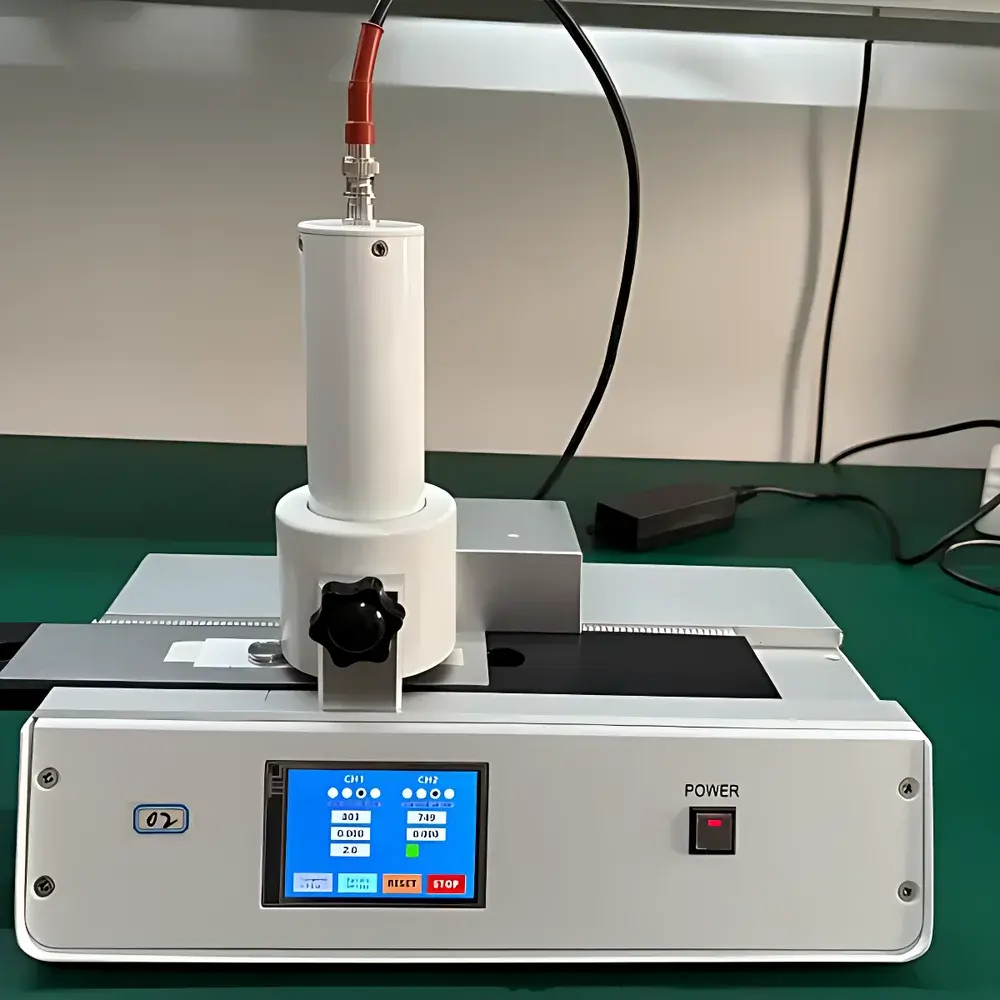
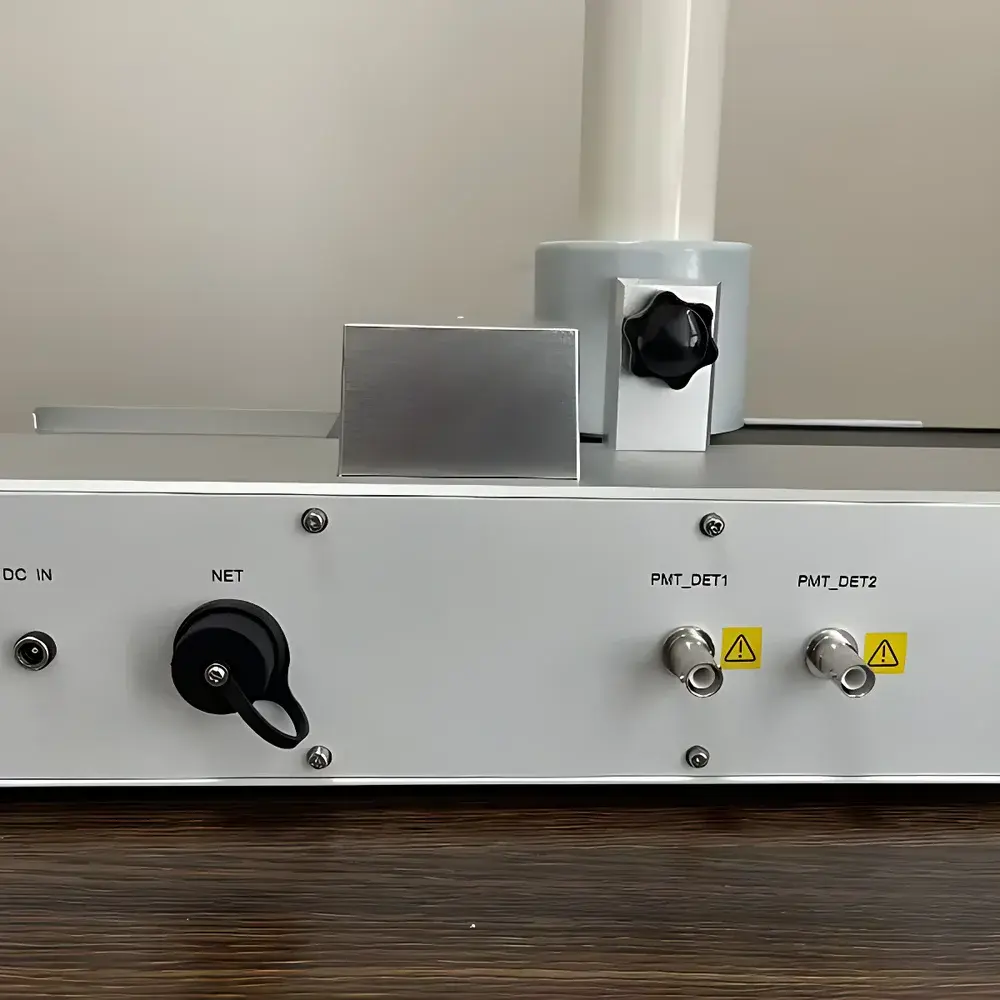
PKSAIR TLC-3000 Radioactive Thin-Layer Chromatography Scanner
| Brand | PKSAIR |
|---|---|
| Model | TLC-3000 |
| Origin | Beijing, China |
| Detector Types | NaI(Tl) γ-detector, β-detector, α-detector |
| PMT Compatibility | Dual-channel, 1-inch end-window, 11-stage photomultiplier tubes |
| High Voltage Range | 0–1025 V (adjustable per channel) |
| Scanning Speed | 0.1, 0.25, 0.5, 1.0, 2.0 mm/sec (step motor controlled) |
| Positioning Accuracy | Sub-millimeter repeatability |
| Front Collimator | Standard 3 mm × 25.4 mm (customizable) |
| ADC Resolution | Integrated real-time 12-bit analog-to-digital converter |
| Data Interface | Ethernet (TCP/IP) |
| Operating Temperature | 0–50 °C |
| Operating Humidity | 10–80 % RH (non-condensing) |
| Storage Conditions | −40 to +60 °C, 5–95 % RH (non-condensing) |
| Detector Dimensions | Ø48 mm × 189 mm |
| Detector Weight | 450 g |
| Shielding | User-provided |
| Typical Background Count Rate | 60 cpm (β-sensitive configuration) |
Overview
The PKSAIR TLC-3000 Radioactive Thin-Layer Chromatography Scanner is a dedicated quantitative imaging system engineered for radiochemical purity assessment and quality control of radiopharmaceuticals. It operates on the principle of spatially resolved radiation detection via scintillation counting—utilizing high-sensitivity photomultiplier tube (PMT)-based detectors coupled with precisely calibrated mechanical scanning. Unlike optical densitometers or UV-based TLC imagers, the TLC-3000 directly quantifies ionizing emissions (α, β, γ) from radiolabeled compounds separated on silica gel or cellulose plates. Its architecture integrates motion control, high-voltage regulation, pulse-height signal conditioning, and real-time analog-to-digital conversion into a single compact platform. Designed for routine use in nuclear pharmacy laboratories, radiopharmaceutical manufacturing facilities, and preclinical radiochemistry labs, the instrument supports regulatory-compliant documentation workflows and aligns with core expectations for traceable, auditable QC data under GLP and GMP frameworks.
Key Features
- Dual independent PMT detector channels (PMT_DET1 and PMT_DET2), each supporting adjustable high-voltage output (0–1025 V) with SHV coaxial connectors (center conductor = positive, shield = ground)
- High-precision stepper motor-driven X-axis translation stage with five selectable linear scan speeds: 0.1, 0.25, 0.5, 1.0, and 2.0 mm/sec—enabling optimized resolution vs. throughput trade-offs
- Resets to mechanical home position upon system reboot, ensuring repeatable alignment across sessions
- Auto-triggered data acquisition initiated at user-defined origin (Rf = 0), eliminating manual start timing errors
- Integrated 12-bit real-time ADC with onboard signal processing—minimizing latency and preserving count-rate fidelity during rapid scans
- Resistive touchscreen HMI with intuitive layout; parameters retained in non-volatile memory (survives power loss)
- Front collimator standard: 3 mm × 1 inch (25.4 mm); optional custom apertures available for enhanced spatial resolution or reduced scatter
- Robust aluminum housing (powder-coated) with thermal stability rated for ≤ ±1 °C/min ambient fluctuation
Sample Compatibility & Compliance
The TLC-3000 is validated for common clinical and research-grade radionuclides including 18F-FDG, 99mTc-labeled agents (e.g., MDP, HMPAO), 131I-sodium iodide, 68Ga-DOTATATE, and 177Lu-PSMA-617. Its β-sensitive plastic scintillator detector (Ø42 mm × 0.5 mm) exhibits optimal response for electrons >30 keV, while optional NaI(Tl) γ-modules support higher-energy isotopes. The system complies with IEC 61000-6-3 (EMC emission standards) and meets mechanical safety requirements per ISO 13857. Though not certified as a medical device under FDA 21 CFR Part 820 or EU MDR, it is routinely deployed in environments adhering to USP , EP 2.2.7, and national pharmacopoeial monographs requiring radiochemical purity verification. Audit trails, parameter logging, and exportable raw count files support ALCOA+ data integrity principles.
Software & Data Management
The native Windows-based application provides full spectral and chromatographic analysis without third-party dependencies. Functions include multi-peak deconvolution using Gaussian fitting algorithms, Rf calculation referenced to solvent front and origin markers, retention time (Rt) annotation, manual integration with baseline correction, and overlay comparison across multiple runs. All processed data—including raw counts, smoothed profiles, peak tables, and annotated chromatograms—are saved in vendor-neutral CSV and PNG formats. The Ethernet TCP/IP interface enables remote monitoring, script-driven batch acquisition (via socket API), and integration into LIMS or electronic lab notebook (ELN) systems. Software enforces user-level access control and maintains immutable timestamps for all acquisition and analysis events—supporting FDA 21 CFR Part 11 readiness when paired with organizational IT policies.
Applications
- Radiochemical purity testing of 18F-, 68Ga-, and 177Lu-labeled peptides and small molecules prior to patient administration
- Stability studies tracking radiolysis or transchelation over time under varying storage conditions
- Synthesis yield optimization by quantifying unreacted precursor vs. product bands
- Quality assurance of commercial radiopharmaceutical kits (e.g., 99mTc-MIBI, 99mTc-tetrofosmin)
- Method validation per ICH Q2(R2) guidelines, including specificity, linearity (5–500 kBq range), and precision (RSD <5% intra-day)
- Educational use in radiochemistry training programs for hands-on detector calibration and decay correction practice
FAQ
What radiation types can the TLC-3000 detect?
It supports α, β, and γ emitters through interchangeable detector modules: plastic scintillators for β/γ (Eβ >30 keV), NaI(Tl) crystals for γ spectroscopy, and ZnS(Ag) screens for α detection.
Is the system compatible with existing LIMS infrastructure?
Yes—via its standardized Ethernet TCP/IP interface and CSV/PNG export functionality, it integrates with major LIMS platforms using custom middleware or RESTful adapters.
Does the instrument require external shielding?
Yes. The detector housing provides no intrinsic lead or tungsten attenuation; users must supply appropriate shielding based on local radiation safety protocols and isotope activity levels.
Can scan parameters be recalled between sessions?
All acquisition settings—including HV, speed, dwell time, and collimator ID—are stored in non-volatile memory and persist after power cycling.
What maintenance is required for long-term operational stability?
Annual verification of PMT gain stability and mechanical homing accuracy is recommended; no consumables are used beyond standard laboratory cleaning protocols.
Related Products







