
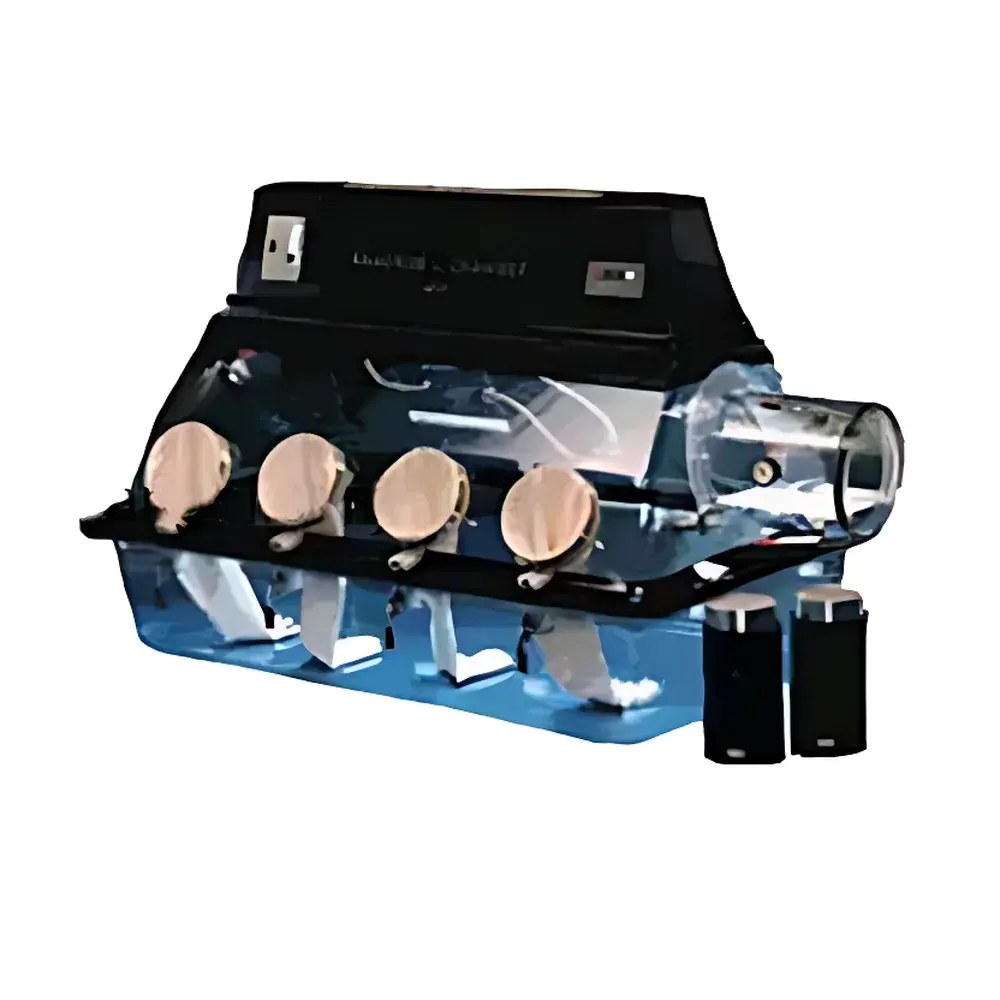
Plas-labs 855-ACB Dual-Operator Anaerobic Glove Box
| Origin | USA |
|---|---|
| Manufacturer Type | Authorized Distributor |
| Origin Category | Imported |
| Model | 855-ACB |
| Application | Research-Grade Anaerobic Workstation |
| Chamber Material | Acrylic (PMMA) |
| Chamber Volume | 1157 L |
| Transfer Lock Volume | 28.3 L (Cylindrical, Ø28 cm × 30.5 cm) |
| Number of Glove Ports | 4 |
| Oxygen Level | <1 ppm (after purification cycle) |
| Water Vapor Content | <1 ppm (post-drying) |
| Temperature Control Range | 35–37 °C (catalyst heater stabilized) |
| Leak Rate | <0.01 vol%/hr (per ASTM E1997-22) |
| Glove Length | 81 cm |
| Glove Material | Hypalon® |
| Catalyst System | Palladium-on-alumina heated bed (2 units in 855-ACB) |
| Desiccant System | Triple-cartridge molecular sieve (3× 1.5 L polyamide canisters, self-sealing quick-connect) |
| Regeneration Temp | 160 °C (320 °F) for 2 hr |
| Power Input | Medical-grade UL/CSA certified, 120 VAC, 60 Hz |
| Dimensions (W×D×H) | 193 × 119 × 107 cm |
| Net Weight | 136 kg |
Overview
The Plas-labs 855-ACB Dual-Operator Anaerobic Glove Box is an engineered environmental isolation system designed to maintain and sustain ultra-low oxygen (<1 ppm) and ultra-low moisture (<1 ppm) atmospheres for sensitive biological, biochemical, and materials science applications. It operates on a closed-loop recirculation principle: internal atmosphere is continuously drawn through a dual-stage purification train—first over a heated palladium-on-alumina catalyst that converts trace O₂ into H₂O vapor, then through a triple-canister molecular sieve desiccant system that adsorbs both water and residual contaminants. The system sustains stable anaerobic conditions without requiring continuous high-purity gas purge, minimizing operational cost and gas consumption while ensuring long-term stability. Its acrylic (PMMA) chamber provides full optical clarity with minimal distortion, enabling real-time visual monitoring under shadow-free fluorescent illumination. Designed for compliance with GLP and ISO 14644-1 Class 5 cleanroom-compatible workflows, the 855-ACB supports rigorous documentation requirements common in regulated research environments.
Key Features
- Dual-operator configuration with four ergonomically positioned Hypalon® gloves (81 cm length), each fitted with stainless-steel O-ring collars (Ø22.3 cm) and reinforced external clamping bands for leak-tight integrity.
- Integrated dual-vacuum membrane pump architecture: one dedicated to main chamber evacuation, another exclusively assigned to the cylindrical transfer lock (Ø28 cm × 30.5 cm, 28.3 L volume), enabling independent pressure management during sample ingress/egress.
- Redundant catalyst heating system: two independently controlled Pd/Al₂O₃ beds (each rated for continuous operation at 35–37 °C), ensuring thermal stability and fail-safe O₂ scavenging even during extended use or partial catalyst saturation.
- Triple-stage molecular sieve desiccation module with quick-connect polyamide cartridges—each containing 1.5 L of 4Å zeolite—allowing cartridge replacement without breaking chamber vacuum or compromising atmospheric purity.
- Medical-grade power distribution (UL/CSA listed), including internal GFCI-protected AC outlets and top-access service hatch for integration of external instrumentation (e.g., microscopes, pipetting robots, or electrochemical analyzers).
- Real-time monitoring interface with analog vacuum gauge, manual isolation valves (4 total), and illuminated control panel compliant with IEC 61000-6-3 EMC standards.
Sample Compatibility & Compliance
The 855-ACB accommodates a broad spectrum of anaerobic sample types—including obligate anaerobes (e.g., Clostridium, Bacteroides), oxygen-sensitive enzymes (e.g., nitrogenase, hydrogenase), reduced metal catalysts, and air-sensitive battery electrode materials. Its PMMA construction resists degradation from common decontamination agents (e.g., 70% ethanol, VHP, and low-concentration hydrogen peroxide vapor), supporting routine sterilization protocols aligned with ISO 15223-1 and USP . Chamber leak integrity is validated per ASTM E1997-22 (Standard Test Method for Leak Rate of Enclosures Using Mass Spectrometer Leak Detectors), with documented performance <0.01 vol%/hr. All electrical components meet UL 61010-1 and CSA C22.2 No. 61010-1 for laboratory equipment safety. Optional audit-trail software modules support 21 CFR Part 11-compliant electronic records when paired with validated data acquisition systems.
Software & Data Management
While the base 855-ACB operates via analog controls, it is fully compatible with Plas-labs’ optional GloveBoxLink™ digital interface—a USB-connected module that logs time-stamped vacuum cycles, catalyst temperature profiles, and desiccant regeneration events. Data export is supported in CSV format for integration with LIMS platforms (e.g., LabWare, STARLIMS). When configured with third-party environmental sensors (O₂, H₂O, temperature), the system enables automated alarm triggers and event-based notifications via Ethernet or RS-485. All firmware updates are delivered via signed binary packages, maintaining traceability per ISO/IEC 17025:2017 clause 7.7.2.
Applications
- Microbiological cultivation of strict anaerobes under defined redox potential (Eh < −300 mV), including gut microbiota isolation and fecal microbiota transplantation (FMT) preparation.
- Preparation and handling of oxygen-sensitive biocatalysts and enzyme-cofactor complexes in structural biology and metabolic engineering workflows.
- Anaerobic cell culture for hematopoietic stem cells and primary neuronal isolates where ambient O₂ induces oxidative stress artifacts.
- Materials synthesis and characterization of Li-metal anodes, solid-state electrolytes, and transition-metal chalcogenides requiring inert-atmosphere glovebox integration.
- Toxicology studies involving anaerobic biotransformation of xenobiotics (e.g., nitroaromatic reduction) under physiologically relevant temperature and humidity control.
FAQ
What is the maximum allowable leak rate for the 855-ACB, and how is it verified?
The system is factory-tested to maintain ≤0.01 vol%/hr leak rate per ASTM E1997-22 using helium mass spectrometry; a certificate of conformance is supplied with each unit.
Can the molecular sieve cartridges be regenerated in situ?
No—cartridges must be removed and thermally regenerated externally at 160 °C for 2 hours; in-chamber regeneration is not supported due to thermal and outgassing constraints.
Is the 855-ACB compatible with hydrogen-containing atmospheres (e.g., 5% H₂/95% N₂)?
Yes—the Pd/Al₂O₃ catalyst and Hypalon gloves are rated for continuous exposure to ≤10% H₂ in inert carrier gases; full compatibility documentation is available upon request.
Does the system include validation documentation for GMP-regulated labs?
The base unit ships with IQ/OQ templates aligned with ISO 13485 and FDA guidance; PQ protocol development requires site-specific risk assessment and is supported by Plas-labs’ Field Applications Engineers.
How often must the catalyst be replaced under typical usage?
Catalyst lifetime exceeds 12 months under continuous operation with <1 ppm inlet O₂; replacement intervals are tracked via cumulative runtime logging in GloveBoxLink™.



