
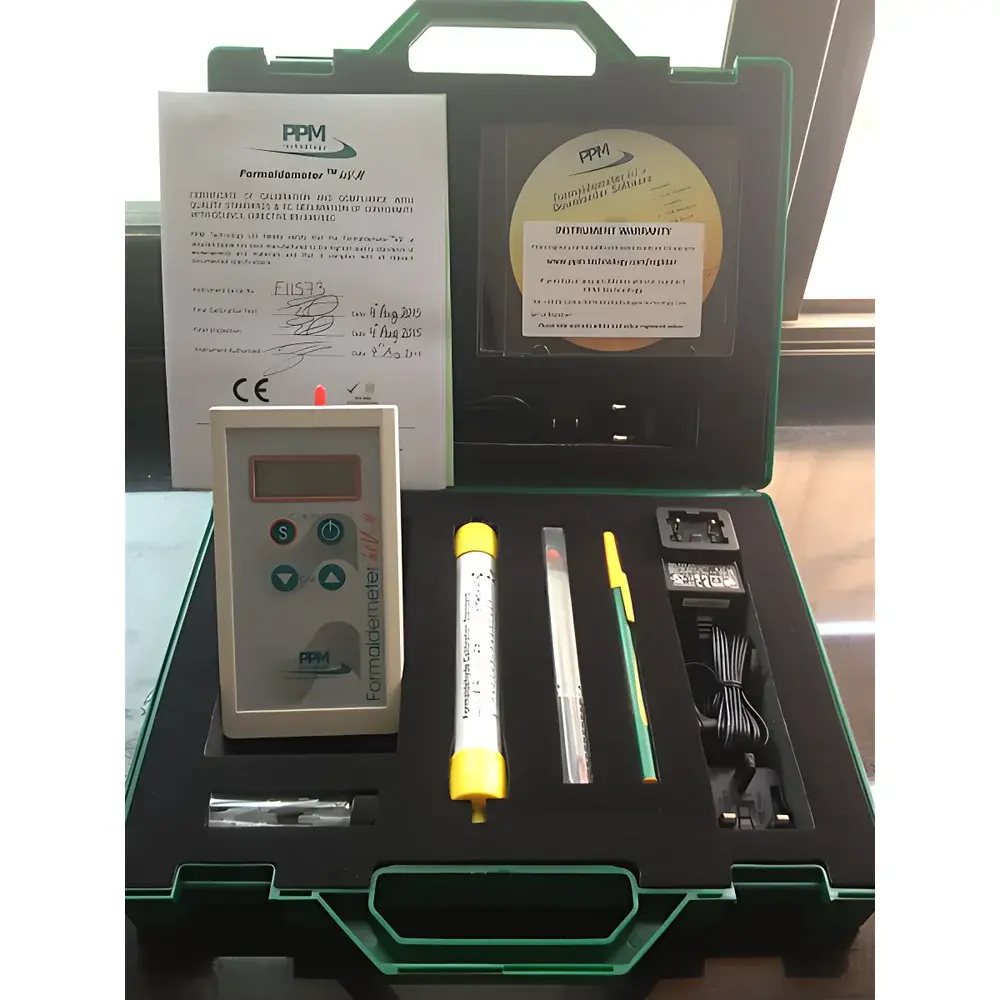
PPM HTV-M Formaldehyde Analyzer
| Origin | Beijing |
|---|---|
| Manufacturer Type | Distributor |
| Origin Category | Domestic |
| Model | PPM HTV-M |
| Price | ¥14,500 |
| Principle | Electrochemical Sensor |
| Dimensions | 150 × 80 × 34 mm |
| Resolution | 0.01 ppm |
| Repeatability | ≤ ±5% |
| Sampling Method | Pump-aspiration (1–15 L/min) |
| Response Time | 1–15 min |
| Operating Temperature | −20–50 °C |
| Humidity Range | 0.00–10.00 ppm |
Overview
The PPM HTV-M Formaldehyde Analyzer is a portable, field-deployable electrochemical gas detection instrument engineered for precise, real-time quantification of formaldehyde (HCHO) in ambient air and indoor environments. Designed and manufactured under ISO 9001:2000 quality management systems and CE-compliant, the HTV-M implements a proprietary electrochemical sensor developed by PPM Technologies (UK), featuring integrated humidity compensation to maintain measurement integrity across variable environmental conditions — particularly critical in high-humidity or thermally unstable settings where conventional sensors exhibit drift or cross-sensitivity. Unlike optical or colorimetric methods, the electrochemical principle provides direct, linear current response proportional to HCHO concentration, enabling stable baseline operation and low-power consumption suitable for extended battery-powered deployment. The device operates within a primary measurement range of 0.00–10.00 ppm (equivalent to 0–13.4 mg/m³ at 0 °C and 101.3 kPa), with optional extended ranges up to 80 ppm. Its compact form factor (150 × 80 × 34 mm, 270 g including battery) supports handheld surveying, fixed-point monitoring, and integration into HVAC commissioning workflows.
Key Features
- Integrated humidity compensation algorithm — mitigates signal drift caused by RH fluctuations between 25% and 70%, validated per NIOSH Method 2016
- Single-button unit switching between ppm and mg/m³ (standardized to 0 °C, 101.3 kPa) — eliminates manual conversion errors
- Onboard real-time clock and non-volatile memory — stores up to 7 days of time-stamped data when powered via AC adapter
- Factory-calibrated electrochemical sensor with NIST-traceable calibration source included (6-month shelf life)
- Built-in phenol filter — suppresses interference from phenolic compounds commonly present in building materials and disinfectants
- Fast response profile: <8 s at low concentrations (<0.5 ppm); <60 s at upper range (10 ppm), meeting NIOSH-defined kinetics criteria
- Repeatability ≤ ±5% RSD; accuracy ±10% at 0.3 ppm under NIOSH-specified test conditions (25–70% RH)
Sample Compatibility & Compliance
The HTV-M is optimized for gaseous sampling of formaldehyde in undiluted ambient air, indoor workplace atmospheres, and ventilation duct streams. It is not intended for liquid-phase or solid-phase extraction analysis. The electrochemical sensor exhibits minimal cross-reactivity with common VOCs (e.g., methanol, acetaldehyde, CO) when used with the supplied phenol filter and calibrated per manufacturer protocol. Regulatory alignment includes verification against NIOSH Method 2016 for formaldehyde sampling and analysis, compliance with EU CE marking directives (2014/30/EU EMC and 2014/35/EU LVD), and adherence to ISO 9001:2000 production controls. While not intrinsically safe for Zone 0/1 hazardous areas, it meets general industrial hygiene monitoring requirements under OSHA 29 CFR 1910.1048 and EU Directive 2004/37/EC (Carcinogens and Mutagens Directive).
Software & Data Management
Data logging is managed internally via embedded flash memory with timestamping enabled by the integrated real-time clock (RTC). When connected to AC power using the optional adapter, the HTV-M supports continuous acquisition at user-selectable intervals (10–90 s), generating sequential .CSV-compatible records exportable via USB interface. No proprietary software is required: logged files are human-readable and compatible with Excel, MATLAB, or LIMS platforms. Audit trails — including calibration events, zero checks, and battery status logs — are retained in non-volatile memory and support GLP-aligned documentation practices. Firmware updates are delivered via secure PPM-hosted portal, ensuring traceability and version control compliant with FDA 21 CFR Part 11 principles for electronic records.
Applications
- Indoor air quality (IAQ) assessment in residential, commercial, and educational buildings post-construction or renovation
- Compliance monitoring in wood-processing, textile finishing, and resin manufacturing facilities subject to formaldehyde exposure limits
- Validation of HVAC system performance and air exchange efficiency in healthcare settings (hospitals, clinics, laboratories)
- Field evaluation of formaldehyde abatement technologies (e.g., photocatalytic oxidation units, activated carbon filters)
- Source identification and emission profiling of composite wood products, adhesives, insulation foams, and coated furnishings
- Occupational hygiene surveys supporting OEL verification (e.g., ACGIH TLV® = 0.3 ppm TWA; EU IOELV = 0.3 ppm)
FAQ
What is the recommended calibration frequency for the HTV-M?
Calibration should be performed before each day’s use if deployed in regulatory-critical applications; otherwise, a minimum of once per week is advised. Field calibration uses the included NIST-traceable formaldehyde permeation source (0.5 ppm nominal output, 6-month stability).
Can the HTV-M measure formaldehyde in high-humidity environments (>70% RH)?
Yes — its proprietary humidity compensation algorithm maintains accuracy within specification up to 70% RH. For sustained operation above 70% RH, periodic zero checks and recalibration are recommended.
Is the sensor replaceable by the end user?
Yes — the electrochemical sensor module is field-replaceable using standard Torx tools. Replacement sensors are supplied with factory calibration certificates and NIST-traceable verification data.
Does the HTV-M meet FDA or EPA regulatory requirements for environmental testing?
While not EPA-certified under TO-11A or Method 32, the HTV-M satisfies performance criteria outlined in NIOSH 2016 and is widely accepted for screening-level IAQ assessments in FDA-regulated facilities (e.g., pharmaceutical cleanrooms, medical device manufacturing) when used per documented SOPs.
How is data integrity ensured during long-term unattended logging?
All stored measurements include UTC timestamps, sensor ID, battery voltage, and ambient temperature/humidity readings. Memory write cycles are error-checked via CRC-16, and power-loss recovery preserves the last valid record sequence.







