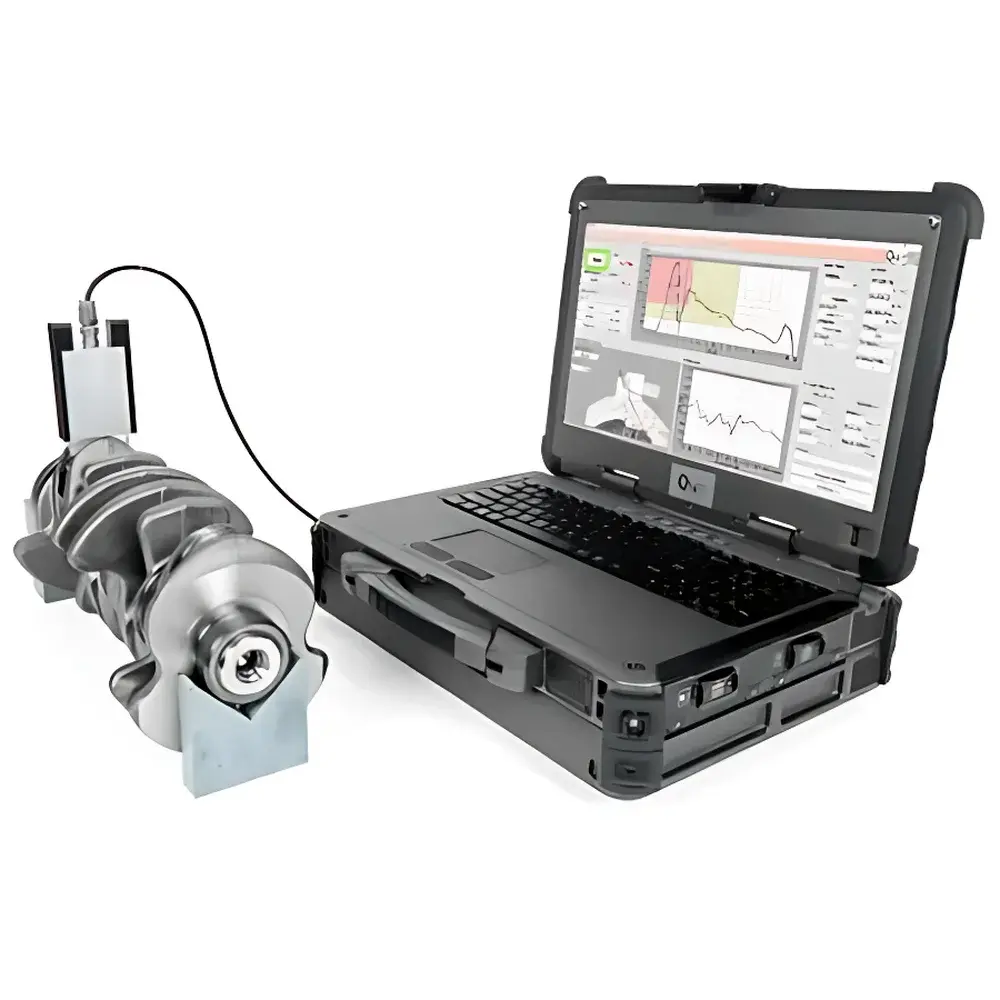
QNET P3123 Surface Hardening Depth (SHD) Ultrasonic Tester
| Brand | QNET |
|---|---|
| Origin | Germany |
| Model | P3123 |
| Detection Frequency | 5–25 MHz |
| Measurement Repeatability | ±0.2 mm |
| Channels | 4 Ultrasonic Channels |
| Enclosure Rating | IP65 |
| Application | Non-Destructive SHD Measurement for Induction-Hardened Components |
Overview
The QNET P3123 Surface Hardening Depth (SHD) Ultrasonic Tester is an industrial-grade, non-destructive evaluation (NDE) instrument engineered for precise, repeatable quantification of case depth in induction-hardened and surface-hardened metallic components. Unlike conventional destructive metallographic cross-sectioning—requiring sample sectioning, mounting, polishing, etching, and optical microscopy—the P3123 employs high-frequency ultrasonic pulse-echo techniques based on acoustic impedance contrast between the hardened case and underlying core material. This physical principle enables real-time, in-situ SHD assessment without part damage or process interruption. The system is calibrated to detect the subsurface transition zone where microstructural changes (e.g., martensite fraction gradient) produce measurable shifts in longitudinal wave velocity and attenuation. Designed for integration into high-mix manufacturing environments, it supports rapid verification of heat treatment consistency across batches, enabling closed-loop feedback for furnace or induction coil parameter optimization.
Key Features
- Four independent ultrasonic channels for multi-angle interrogation and signal redundancy, enhancing measurement robustness on curved or asymmetric geometries
- Adjustable detection frequency range (5–25 MHz) to optimize resolution vs. penetration depth trade-offs across steel grades (e.g., C45, 42CrMo4, 100Cr6) and case depths from 0.3 mm to 5.0 mm
- IP65-rated ruggedized housing for reliable operation in shop-floor conditions—including coolant mist, metal dust, and temperature fluctuations (10–40 °C ambient)
- Real-time A-scan visualization with dynamic gate positioning, allowing manual or automated identification of the case-core interface echo amplitude drop-off
- Ergonomic handheld probe with interchangeable contact shoes and low-profile wedge designs, enabling measurements on radii as small as 3 mm and in undercut regions inaccessible to conventional hardness testers
- Integrated touchscreen interface with preconfigured calibration templates for common alloy/heat-treatment combinations, reducing setup time to under 90 seconds per part family
Sample Compatibility & Compliance
The P3123 is validated for use on ferrous alloys subjected to induction hardening, flame hardening, carburizing, and nitriding—provided the case exhibits sufficient acoustic contrast relative to the core (minimum hardness differential ≥150 HV). It accommodates complex geometries including gear teeth, shaft shoulders, bearing races, cam lobes, and spline sections. Surface roughness must not exceed Ra 3.2 µm; minor surface scale or light oxide layers are tolerable due to adaptive gain compensation. The instrument complies with EN 12680-3 (Ultrasonic examination of steel castings — Part 3: Steel castings for general purposes) for methodology traceability and supports audit-ready documentation per ISO 9001:2015 and IATF 16949 requirements. Data export formats (CSV, XML) ensure compatibility with enterprise MES/QMS platforms.
Software & Data Management
The embedded QNET SHD Studio software provides full lifecycle data handling: acquisition, analysis, reporting, and long-term archival. Each measurement includes timestamp, operator ID, part serial number, sensor position coordinates (via optional encoder-integrated scanning), and raw RF waveform storage. Statistical process control (SPC) charts (X̄-R, Cpk) are auto-generated for batch-level SHD trend analysis. Customizable report templates support company-specific branding and regulatory fields (e.g., AS9100 revision blocks, FDA 21 CFR Part 11 electronic signature readiness via optional PKI module). All results are stored in a local SQLite database with SHA-256 hash integrity verification; remote backup to network drives or cloud repositories (AWS S3, Azure Blob) is configurable. Re-evaluation of archived waveforms with updated gating algorithms is fully supported without re-scanning.
Applications
- Automotive: In-line verification of induction-hardened transmission gears, CV joint housings, and brake caliper pins
- Energy: Quality assurance of wind turbine main shaft splines and generator rotor journals after surface hardening
- Hydraulic & Construction Equipment: Monitoring case depth uniformity on excavator bucket teeth and hydraulic piston rods
- Aerospace: Acceptance testing of landing gear components following low-pressure carburizing cycles
- Tooling & Dies: Rapid validation of surface hardness gradients on cold-work tool steels (e.g., D2, H13) post-nitriding
FAQ
Does the P3123 require reference standards for daily calibration?
Yes—traceable SHD reference blocks (certified per ISO 17025) with known case depths are required for initial setup and periodic verification (recommended every 8 operational hours or per shift change).
Can the system measure SHD on parts with coatings or plating?
No—surface coatings (e.g., Zn, Cr, Ni, DLC) attenuate high-frequency ultrasound and obscure the case-core interface; coating removal at test locations is mandatory.
Is operator certification required to operate the P3123?
Operators must complete QNET’s Level 1 Ultrasonic SHD Testing training (8-hour course), aligned with ISO 9712 principles, to ensure consistent gating and interpretation of velocity-transition signatures.
What is the minimum case depth the P3123 can reliably resolve?
Under optimal conditions (smooth surface, homogeneous base material, 20 MHz transducer), the lower limit of reliable detection is 0.25 mm, with measurement uncertainty ±0.2 mm as specified per manufacturer validation protocol P3123-VER-04.
How does the system handle varying part temperatures during production?
The instrument includes real-time temperature compensation using an integrated RTD sensor in the probe body; velocity corrections are applied using empirically derived steel-specific thermal coefficients (e.g., −1.2 m/s/°C for AISI 4140).