
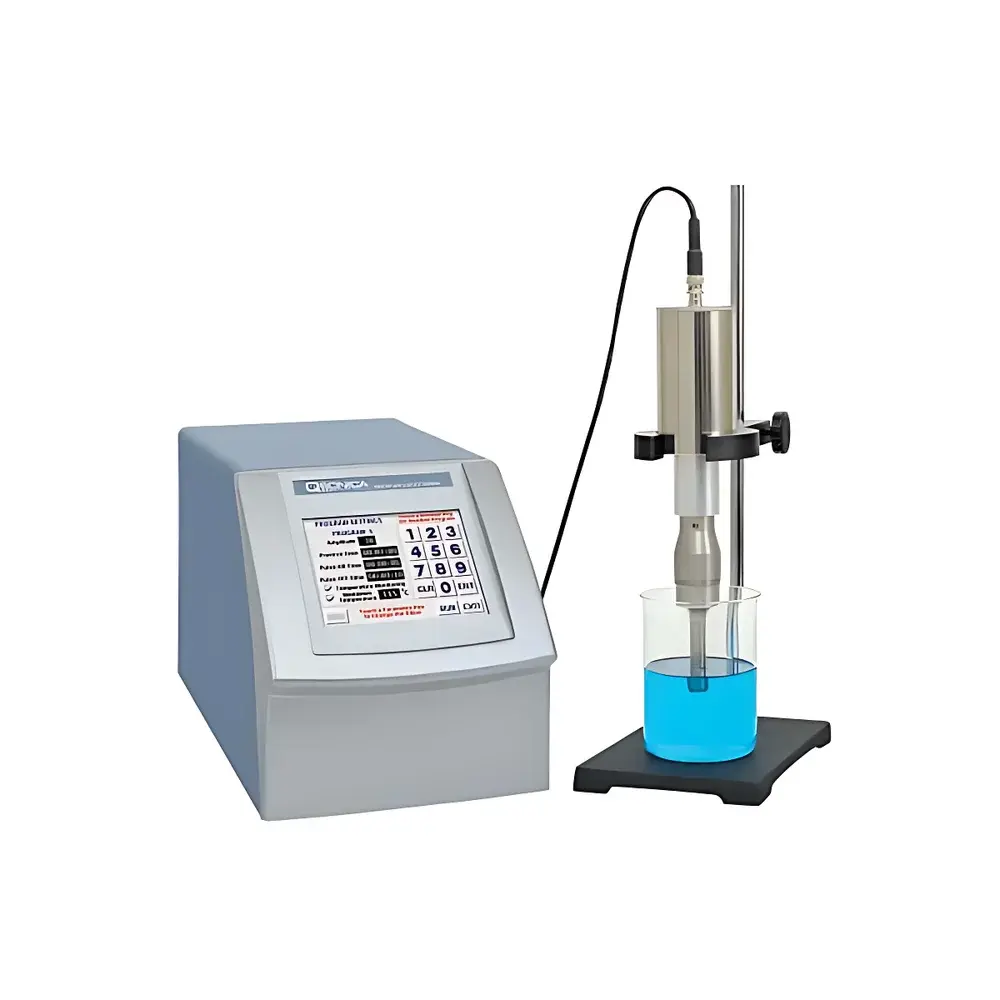
Qsonica Q700 High-Performance Ultrasonic Sonicator (700 W)
| Brand | Cole-Parmer |
|---|---|
| Origin | USA |
| Manufacturer Type | Authorized Distributor |
| Product Category | Imported Instrument |
| Model | Q700 |
| Instrument Type | Ultrasonic Cell Disruptor |
| Ultrasonic Power Output | 700 W |
| Operating Frequency | 20 kHz |
| Temperature Monitoring Range | 0–100 °C (with optional probe) |
| Sample Volume Capacity | 0.1 mL–1 L (batch) |
| Dimensions (W×D×H) | 20 × 39 × 22 cm |
| Maximum Continuous Operation Time | 72 hr |
| Pulse Duration Range | 1 s–24 hr |
| Probe Amplitude Range | 0–99.99% (digitally controlled) |
| Compliance | UL, CE, CSA, RoHS |
Overview
The Qsonica Q700 High-Performance Ultrasonic Sonicator is an advanced benchtop ultrasonic cell disruptor engineered for reproducible, high-efficiency sample homogenization, lysis, and dispersion in life science and bioprocessing laboratories. Based on piezoelectric transduction at a fixed resonant frequency of 20 kHz, the Q700 delivers controlled acoustic energy directly into liquid samples via interchangeable titanium alloy probes (horns), generating intense cavitation fields that mechanically shear cellular membranes, chromatin, nanoparticles, and aggregated macromolecules. Unlike analog sonicators, the Q700 employs a fully digital signal processing architecture—enabling precise amplitude modulation, real-time feedback control, and adaptive frequency tuning—to maintain consistent energy delivery across varying load impedances and thermal conditions. Its design reflects over six decades of ultrasonic instrumentation expertise inherited from Misonix, now consolidated under Qsonica LLC, and is widely deployed in academic research, pharmaceutical development, and contract manufacturing organizations (CMOs) requiring GLP-compliant, traceable, and repeatable disruption protocols.
Key Features
- Fully digital touchscreen interface (7-inch capacitive display) with intuitive navigation, multilingual support, and context-sensitive on-screen guidance
- Programmable multi-step protocols: up to 10 user-defined sequences per method, each configurable with amplitude (%), duration, pulse-on/off timing, and temperature thresholds
- Real-time monitoring of critical operational parameters: output amplitude, delivered energy (J), transducer temperature, probe tip temperature (with optional sensor), and elapsed time
- Auto-tuning circuitry dynamically adjusts drive frequency ±50 Hz around 20 kHz to maintain resonance as probe loading or temperature changes—ensuring optimal power transfer and minimizing harmonic distortion
- Integrated safety systems: over-temperature cutoff (transducer and probe), over-current protection, emergency stop, and automatic shutdown upon probe detachment or impedance mismatch
- Energy-efficient solid-state amplifier design reduces internal heat generation, extending component lifetime and supporting extended unattended operation (up to 72 hours continuous)
- Comprehensive self-diagnostic suite with fault logging, error code reporting, and guided troubleshooting prompts displayed directly on screen
Sample Compatibility & Compliance
The Q700 accommodates diverse sample formats—including microcentrifuge tubes (0.2–5 mL), standard Eppendorf tubes (0.5–15 mL), culture flasks (up to 1 L), and flow-through chambers (0.5–20 L/min)—via a modular probe ecosystem. Standard probes include tapered titanium horns (1/16″ to 1″ diameter), replaceable tips, solid-end and threaded-end configurations, and chemically resistant sapphire-coated variants for aggressive solvents or abrasive suspensions. Optional accessories include rack-based multi-probe holders (e.g., 4559 Quad Horn, 4525 Dual Horn), cryogenic-compatible temperature probes (stainless steel or PTFE-sheathed), and acoustic enclosures (431MPX, 432B) meeting OSHA-recommended noise exposure limits (<85 dBA at 1 m). The instrument complies with UL 61010-1, IEC 61000-6-3 (EMC), EN 61000-6-2, CSA C22.2 No. 61010-1, and RoHS 3 directives. When paired with validated software and audit-trail-enabled configurations, it supports FDA 21 CFR Part 11 compliance for regulated environments.
Software & Data Management
While the Q700 operates autonomously via its embedded firmware, it supports external data capture through RS-232 and USB-B ports for integration with laboratory information management systems (LIMS) or custom scripting environments (e.g., Python, LabVIEW). All method parameters, run logs, energy metrics, and timestamped event records (including alarms and manual interventions) are stored internally with non-volatile memory retention (>10,000 entries). Optional Q-Connect software (sold separately) enables remote configuration, batch method deployment, PDF report generation with digital signatures, and export to CSV or XML for traceability audits. Raw energy output (joules) and cumulative amplitude exposure are logged per cycle—critical for SOP adherence in QC/QA workflows governed by ISO 17025 or USP .
Applications
The Q700 is routinely applied in molecular biology for nuclear lysis and chromatin shearing prior to ChIP-seq; in protein biochemistry for inclusion body solubilization and membrane protein extraction; in nanomaterial synthesis for carbon nanotube dispersion and liposome formation; and in industrial biotechnology for yeast and bacterial cell disruption in recombinant enzyme recovery. It is also employed in environmental microbiology for soil DNA isolation, in forensic toxicology for tissue homogenization, and in catalysis research for sonochemical activation of metal-organic frameworks (MOFs). Its programmable pulsing capability (1 s–24 hr intervals) minimizes thermal degradation during sensitive nucleic acid fragmentation, while flow-cell configurations enable scalable, closed-system processing compliant with cGMP guidelines.
FAQ
What is the maximum recommended sample volume for batch processing with the standard 1/2″ probe?
For optimal cavitation efficiency and thermal control, the 1/2″ probe (part #4220 or #4219) is rated for 10–250 mL volumes; exceeding 250 mL may reduce lysis uniformity and increase localized heating.
Can the Q700 be integrated into automated liquid handling platforms?
Yes—via TTL-compatible footswitch input (FS-3) or RS-232 command protocol, enabling synchronization with robotic arms, autosamplers, or PLC-controlled bioreactor systems.
Is probe calibration required before use?
No routine calibration is needed; however, amplitude verification using a calibrated laser vibrometer (e.g., Polytec OFV-5000) is recommended annually or after probe replacement to ensure traceable performance against ISO 20488.
Does the Q700 support temperature-controlled sonication?
Yes—when used with optional temperature probes (4102 stainless steel or 4103 PTFE-sheathed) and external chillers connected to flow-through cells (e.g., 4583), real-time temperature feedback can trigger amplitude reduction or duty-cycle modulation to maintain setpoint stability.
How does the auto-tuning function improve reproducibility across different operators or labs?
By continuously compensating for mechanical wear, solvent viscosity shifts, and ambient temperature drift, auto-tuning ensures consistent resonant coupling between transducer and probe—eliminating manual tuning variability and reducing inter-operator CVs in energy delivery to <±2.3% (per ASTM E2810-22).




