
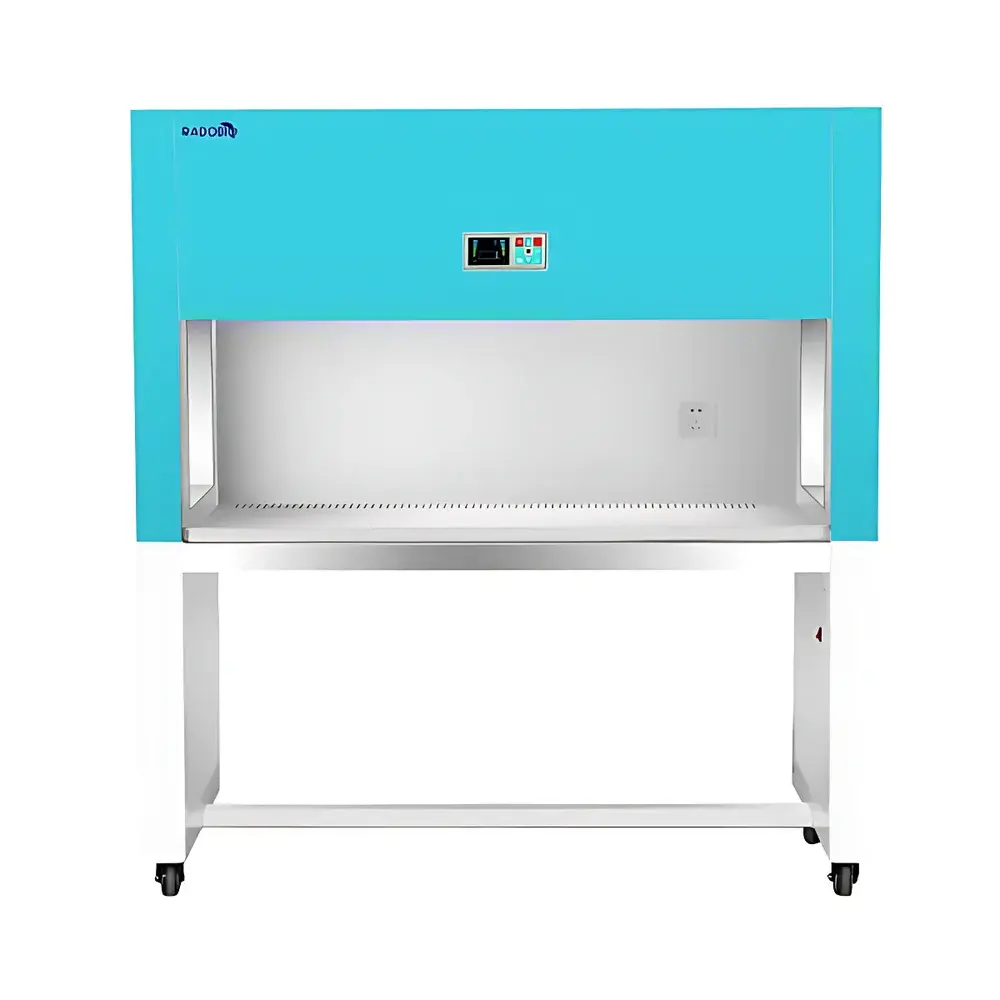
RADOBIO AirGuard1500 Dual-Operator Single-Face Laminar Flow Clean Bench
| Brand | RADOBIO |
|---|---|
| Origin | Shanghai, China |
| Manufacturer Type | Authorized Distributor |
| Country of Origin | China |
| Model | AirGuard1500 |
| Price | Upon Request |
| Cleanliness Class | ISO 5 (Class 100) |
| Noise Level | ≤62 dB(A) |
| Operator Capacity | Dual-Operator, Single-Face Configuration |
Overview
The RADOBIO AirGuard1500 is a dual-operator, single-face laminar flow clean bench engineered for precision-controlled, particle-free working environments in research and production laboratories. It operates on the principle of unidirectional, vertical laminar airflow—generated by a low-turbulence centrifugal blower and conditioned through a certified HEPA filter (≥99.995% @ 0.3 µm)—to deliver ISO 5 (Class 100) air quality within the work area. This airflow architecture ensures continuous downward displacement of ambient contaminants, protecting both samples and personnel from airborne microbial and particulate intrusion. Designed for compliance with international cleanroom performance standards—including ISO 14644-1 for airborne particle concentration and ISO 14644-3 for testing methodologies—the AirGuard1500 serves as a critical primary containment solution where sterile manipulation, aseptic processing, or low-bioburden handling is required without full enclosure (e.g., biosafety cabinets). Its application scope spans upstream bioprocessing, cell culture, pharmaceutical QC, diagnostic assay preparation, microelectronics assembly, and agricultural tissue culture.
Key Features
- Vertically oriented laminar airflow system with real-time adjustable velocity (0.3–0.6 m/s), calibrated via integrated anemometric feedback and displayed on a color LCD interface
- Intuitive touch-control panel with three-speed fan settings, live monitoring of airflow velocity, elapsed operation time, ambient temperature, and UV lamp status
- Smart UV scheduling: programmable auto-on/auto-off cycles with visual confirmation and audible end-of-cycle alert
- Manually operated, counterbalanced 5 mm tempered glass sash with infinite-position suspension—enabling stable, hands-free height retention across full travel range
- Interlocked lighting and UV sterilization circuits: physical and electronic interlocks prevent concurrent activation to eliminate operator exposure risk
- Work surface fabricated from seamless 304 stainless steel (electropolished finish); outer housing constructed from cold-rolled steel with antimicrobial epoxy-powder coating
- Full-perimeter side and rear acrylic/glass panels for enhanced visibility, uniform illumination (≥300 lux at work surface), and optical clarity during extended procedures
- Integrated pre-filter with washable aluminum mesh—designed to capture coarse particulates (>5 µm) and extend HEPA service life per ISO 14644-3 maintenance guidelines
- Four heavy-duty swivel casters with locking brakes—enabling controlled mobility and stable positioning on level laboratory flooring
- Dedicated GFCI-protected AC outlet (220 V, 50 Hz) with built-in power-loss memory and automatic restart delay upon voltage recovery
Sample Compatibility & Compliance
The AirGuard1500 supports non-hazardous, non-volatile biological and material samples requiring localized particulate control. It is not suitable for use with volatile organic compounds, radioactive materials, or pathogenic agents requiring biosafety level 2 (BSL-2) or higher containment. The unit complies with IEC 61000-6-3 (EMC emissions), IEC 61000-6-1 (immunity), and meets structural safety requirements per IEC 61010-1 for laboratory electrical equipment. While not certified under NSF/ANSI 49 (as it lacks inward airflow and negative pressure containment), its ISO 5 performance has been validated using standard microbiological settle plate assays (Φ90 mm Petri dishes; ≤0.5 CFU/plate·hour) and particle counters per ISO 21501-4. Routine verification aligns with GLP-aligned internal SOPs and supports audit readiness for ISO 9001, ISO 13485, and FDA 21 CFR Part 11–governed environments when paired with documented calibration and maintenance logs.
Software & Data Management
The AirGuard1500 employs embedded firmware—not cloud-connected software—with local data persistence for operational parameters. All user inputs (UV schedule, fan speed, runtime) are stored in non-volatile memory and retained during power interruption. The control interface logs cumulative UV exposure time and provides predictive alerts for HEPA filter replacement based on total operational hours and pre-filter condition indicators. Audit trail functionality includes timestamped event records for UV activation/deactivation, sash position changes, and fault conditions—exportable via USB port for integration into laboratory quality management systems (QMS). No remote access, network connectivity, or third-party API is provided, ensuring data integrity and minimizing cybersecurity exposure in regulated settings.
Applications
- Aseptic transfer of mammalian or microbial cultures in academic and industrial cell biology labs
- Preparation of media, reagents, and master mixes for PCR, ELISA, and next-generation sequencing workflows
- Handling of sterile components in medical device assembly and packaging validation studies
- Quality control testing of raw materials and finished products in food microbiology and nutraceutical manufacturing
- Micropropagation and explant handling in plant biotechnology and horticultural R&D
- Assembly and inspection of high-precision optical and semiconductor subcomponents under low-particulate conditions
FAQ
What is the recommended HEPA filter replacement interval?
HEPA filter service life depends on ambient air quality and daily usage duration. Under typical laboratory conditions (8 hrs/day, ISO 8 background environment), replacement is advised every 18–24 months—validated by upstream pre-filter inspection and downstream particle challenge testing.
Can the AirGuard1500 be installed in a non-air-conditioned room?
Yes, but ambient temperature must remain between 15–30°C and relative humidity below 70% RH to ensure consistent airflow stability and prevent condensation on internal surfaces.
Is UV intensity measurement included in routine qualification?
No—radiometric verification of UV-C output (254 nm) requires external calibrated radiometer. RADOBIO recommends annual third-party irradiance mapping per ISO 15195 guidelines for sterilization efficacy validation.
Does the unit meet GMP documentation requirements?
It supports GMP compliance through configurable audit trails, password-protected parameter locks, and traceable maintenance records—provided users implement site-specific IQ/OQ protocols aligned with Annex 15 and EU GMP Annex 1.
What electrical infrastructure is required for installation?
A dedicated 220 V ±10%, 50 Hz circuit with minimum 16 A breaker and proper grounding is mandatory. Voltage fluctuations exceeding ±5% may trigger protective shutdown or affect fan speed regulation accuracy.



