
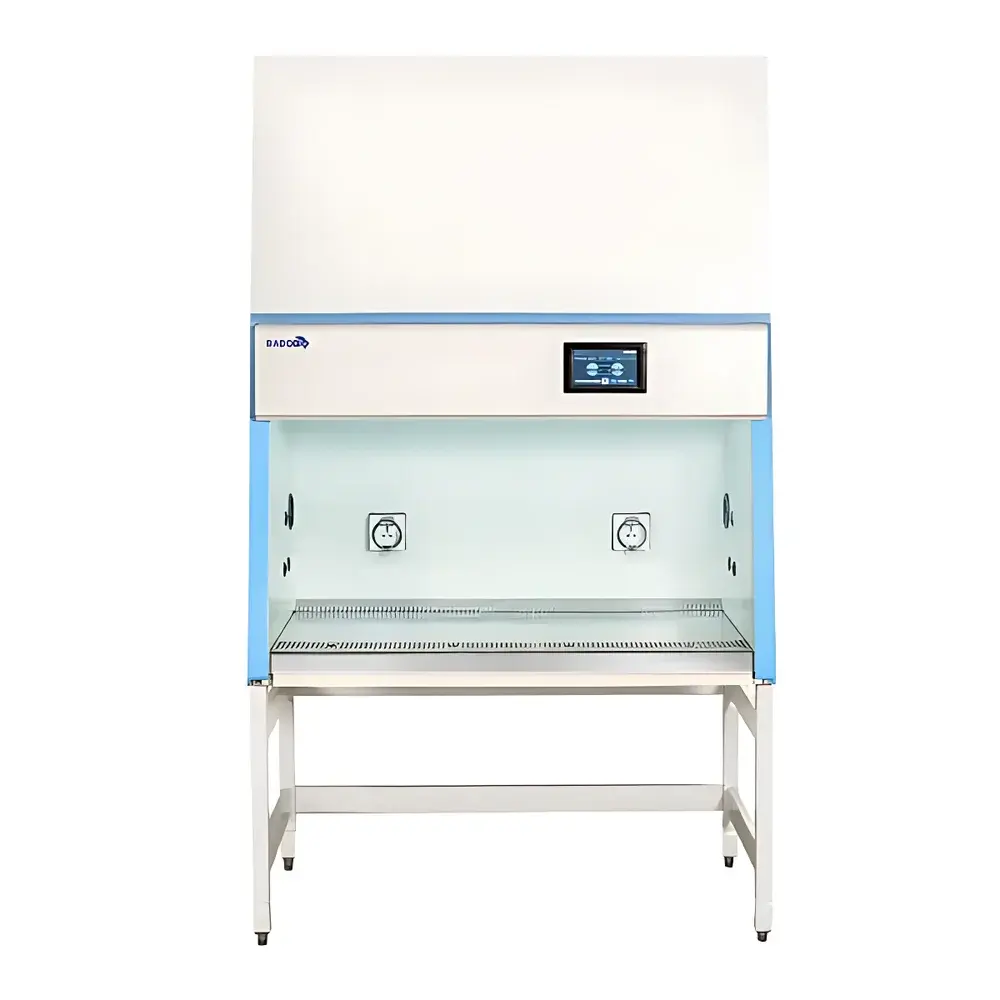
RADOBIO AirSafe 1800A2 Class II Type A2 Biological Safety Cabinet
| Brand | RADOBIO |
|---|---|
| Origin | Shanghai, China |
| Manufacturer Type | Authorized Distributor |
| Product Category | Domestic (PRC) |
| Model | AirSafe 1800A2 |
| Cabinet Class | Class II, Type A2 |
| External Dimensions (L×W×H) | 1800 × 810 × 2290 mm |
| Internal Dimensions (L×W×H) | 1680 × 580 × 798 mm |
| Filter Efficiency | ≥99.9995% @ 0.3 µm |
| Supply & Exhaust Filter Type | ULPA |
| Air Cleanliness Class | ISO 4 (equivalent to Federal Standard 209E Class 10) |
| Inflow Velocity | 0.55 m/s |
| Downflow Velocity | 0.35 m/s |
| Noise Level | <65 dB(A) |
| Vibration at Work Surface Center | ≤5 µm |
| Personnel Protection | ≤10 CFU/plate (impactor), ≤5 CFU/plate (slit sampler) |
| Product Protection | ≤5 CFU/plate |
| Cross-Contamination Protection | ≤2 CFU/plate |
| Rated Power (excl. outlet) | 0.33 kW |
| Max. Power (incl. outlet) | 1.65 kW |
| Lighting | 18 W LED, ≥900 lx |
| UV Lamp | 30 W |
| Construction | Cold-rolled steel exterior (ivory white epoxy powder coating), 304 stainless steel work surface |
| Weight | 366 kg |
| Compliance | YY 0569–2011, GB 4793.1–2018, GB/T 18268.1–2018 |
Overview
The RADOBIO AirSafe 1800A2 is a certified Class II, Type A2 biological safety cabinet engineered for containment of low-to-moderate risk biological agents (BSL-1, BSL-2, and select BSL-3 applications with appropriate risk assessment). It operates on the principle of laminar airflow management—drawing ambient air through a front intake grille, passing ~70% of total airflow across the work surface as downward laminar flow (downflow), and recirculating ~30% after dual-stage ULPA filtration. The remaining ~30% is exhausted externally via dedicated ducting or thimble connection, ensuring operator, product, and environmental protection per internationally recognized biosafety engineering standards. Designed for sustained reliability in high-throughput academic, clinical, and pharmaceutical laboratories, the AirSafe 1800A2 integrates aerodynamic optimization, real-time sensor feedback, and energy-conscious architecture to meet evolving demands for safety integrity, operational efficiency, and regulatory traceability.
Key Features
- 7-inch capacitive touchscreen HMI with intuitive navigation: displays real-time status of sash position, fan runtime, ULPA filter life (% remaining), UV lamp service interval, lighting state, and power outlet control; logs all user actions and system events with timestamped audit trail.
- Brushless DC constant-volume blower system: delivers stable inflow (0.55 m/s) and downflow (0.35 m/s) velocities regardless of filter loading; reduces energy consumption by up to 60% versus conventional AC motor systems and lowers thermal load in controlled environments.
- Intelligent standby mode: automatically transitions to low-speed recirculation upon sash closure—maintaining ISO 4 cleanroom-grade air quality in the work area without full shutdown; resumes nominal operation within seconds upon sash reopening.
- Power-loss recovery function: retains last operational configuration (sash height, fan speed, lighting, UV status) and restores it automatically upon power restoration—critical for maintaining containment continuity during unexpected outages.
- ULPA filtration system with leak-resistant sealing: both supply and exhaust filters achieve ≥99.9995% efficiency at 0.3 µm particle size; low-pressure-drop, high-strength borosilicate glass fiber media extends service life while meeting ISO 4 (Class 10) clean air certification requirements.
- Ergonomic workstation design: 730 mm optimal working height; integrated handrests; seamless 304 stainless steel monolithic work surface; tilt-adjustable sash with smooth counterbalance mechanism; dedicated sash cleaning position to minimize maintenance downtime.
Sample Compatibility & Compliance
The AirSafe 1800A2 supports routine handling of cell cultures, primary tissues, recombinant DNA constructs, diagnostic specimens, and non-aerosol-generating microbiological procedures. It is not intended for volatile toxic chemicals or radionuclides requiring chemical fume hood-level containment. All performance validation—including personnel, product, and cross-contamination protection—was conducted in accordance with YY 0569–2011 (Chinese national standard aligned with NSF/ANSI 49–2022), GB 4793.1–2018 (safety requirements for electrical equipment), and GB/T 18268.1–2018 (EMC compliance). Certification documentation includes full test reports for airflow velocity mapping, smoke pattern visualization, microbial challenge testing (using Bacillus atrophaeus spores), and structural integrity verification under static and dynamic load conditions.
Software & Data Management
The embedded microcontroller firmware supports GLP-compliant data logging: all critical parameters—including sash position, airflow velocity, filter differential pressure, UV exposure time, and alarm events—are recorded with UTC timestamps and stored locally for ≥12 months. Audit trail entries are write-protected and non-erasable without administrative credentials. Optional RS485/Modbus RTU interface enables integration into centralized laboratory infrastructure monitoring systems (e.g., LabVantage, Siemens Desigo, or custom SCADA platforms). While the unit does not natively support FDA 21 CFR Part 11 electronic signature functionality, its event log structure complies with ALCOA+ principles (Attributable, Legible, Contemporaneous, Original, Accurate, Complete, Consistent, Enduring, Available) for regulated QC/QA environments.
Applications
- Cell culture expansion and passaging under sterile conditions
- Preparation of monoclonal antibodies and viral vectors (AAV, lentivirus)
- Molecular biology workflows including plasmid transfection, CRISPR editing, and RNA handling
- Clinical microbiology specimen processing and susceptibility testing
- Pharmaceutical aseptic technique training and media fill simulations
- Biomanufacturing support for upstream process development (seed train expansion, bioreactor inoculation)
FAQ
What is the difference between Type A2 and Type B2 cabinets?
Type A2 cabinets recirculate filtered air back into the lab environment (~30%) and exhaust ~70% externally; Type B2 (total exhaust) cabinets vent 100% of air externally and require dedicated ductwork. The AirSafe 1800A2 is designed for flexible installation where external ducting is available but not mandatory.
Can this cabinet be used for handling chemotherapy agents?
No. The AirSafe 1800A2 is not certified for hazardous drug compounding. For cytotoxic agents, a certified ventilated containment isolator or negative-pressure CSTD-compatible hood meeting USP and requirements is required.
How often must the ULPA filters be replaced?
Filter replacement intervals depend on usage intensity and ambient particulate load. Under typical BSL-2 lab conditions, supply and exhaust ULPA filters are rated for 5–7 years; the HMI provides real-time filter life estimation based on cumulative pressure drop and runtime.
Is third-party certification available?
Yes. RADOBIO provides factory-issued test certificates compliant with YY 0569. Independent verification by CNAS-accredited laboratories (e.g., SGS, TÜV Rheinland) can be arranged upon request, subject to additional validation protocol alignment.
Does the unit support remote monitoring via Ethernet or Wi-Fi?
Standard configuration includes RS485 Modbus RTU only. Ethernet/Wi-Fi connectivity requires optional gateway hardware and custom integration; contact RADOBIO Technical Support for OEM interface specifications and API documentation.






