
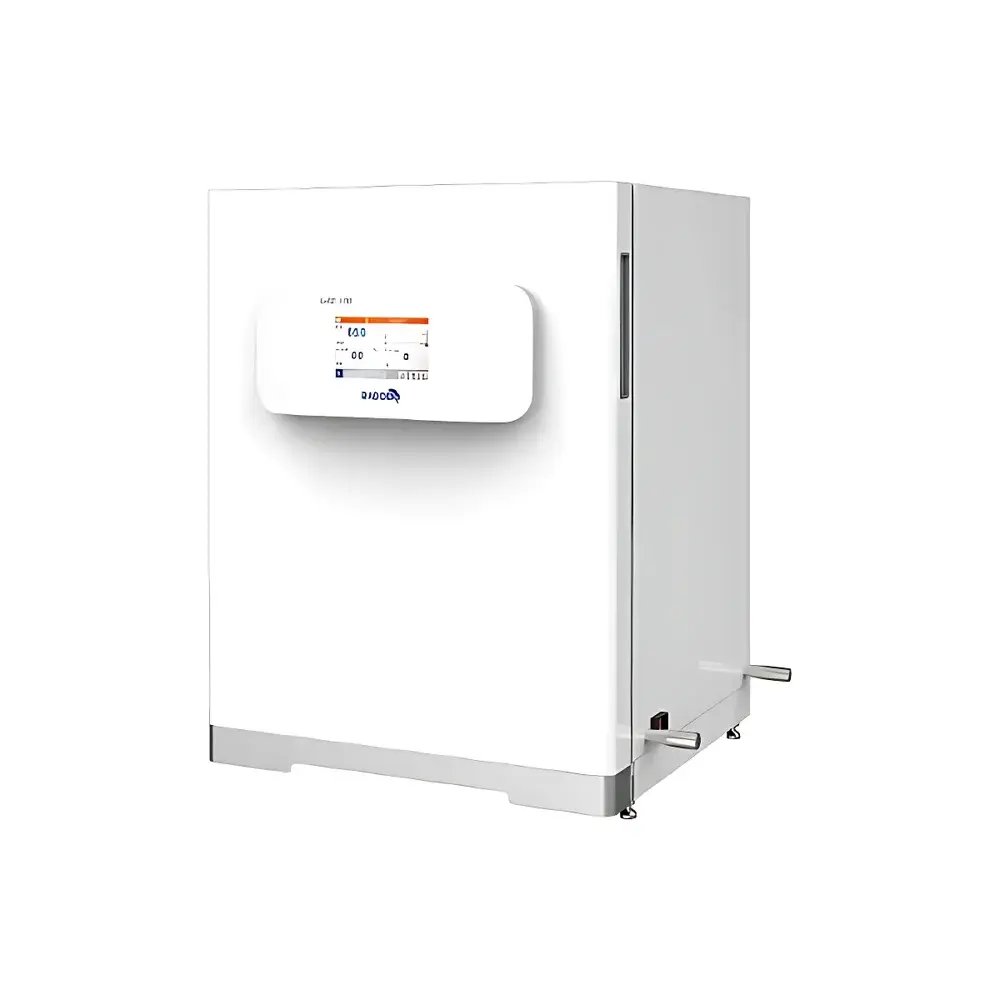
RADOBIO CellX 170 CO₂ Incubator
| Brand | RADOBIO |
|---|---|
| Origin | Shanghai, China |
| Instrument Type | Air-jacketed CO₂ Incubator |
| CO₂ Detection | Infrared (IR) Sensor |
| Temperature Control Range & Accuracy | Ambient +4°C to 60°C, ±0.1°C setpoint resolution |
| Temperature Uniformity | ±0.2°C (at 37°C, ambient 25°C, empty chamber) |
| CO₂ Concentration Control Range & Accuracy | 0–20%, ±0.1% setpoint resolution |
| Chamber Capacity | 170 L |
| External Dimensions (L×W×H) | 702 × 690 × 896 mm (including base) |
| Key Configuration | PID control algorithm, 6-face direct-heating air jacket, 180°C dry-heat sterilization cycle |
Overview
The RADOBIO CellX 170 CO₂ Incubator is an air-jacketed, fanless incubation system engineered for precision cell culture under physiologically relevant conditions. It maintains tightly regulated CO₂ concentration, temperature, and humidity—critical parameters for mammalian cell proliferation, stem cell expansion, and hybridoma maintenance. Its measurement architecture relies on dual closed-loop control: an infrared (IR) CO₂ sensor provides real-time, humidity-compensated gas concentration feedback, while a distributed 6-face heating system—integrated into all interior chamber surfaces—enables rapid thermal equilibration and exceptional spatial uniformity. Unlike forced-air designs, the absence of internal circulation fans eliminates mechanical vibration and turbulent airflow, thereby reducing media evaporation, minimizing CO₂ consumption, and preserving monolayer integrity during long-term culture. The incubator operates within a validated environmental envelope (10–30°C ambient), supporting ISO 13485-aligned workflows and GLP-compliant cell banking applications.
Key Features
- 6-face direct-heating air jacket: Uniform thermal distribution across all chamber walls ensures ±0.2°C temperature uniformity (measured at 37°C, empty, 25°C ambient) and ≤5-minute temperature recovery after 30-second door opening.
- 180°C dry-heat sterilization cycle: Fully automated, software-guided high-temperature decontamination eliminates bacteria, yeasts, molds, and mycoplasma without disassembly; validated per ISO 14644-1 Class 5 cleanroom-compatible protocols.
- Fanless convection design: Passive, algorithm-driven thermal gradient circulation eliminates vibration-induced shear stress on adherent cultures and reduces media evaporation by up to 40% compared to fan-assisted systems.
- Infrared (IR) CO₂ sensing: Dual-wavelength IR detector delivers stable, drift-free CO₂ measurement across variable humidity and transient thermal conditions—critical for frequent-access labs and time-lapse imaging setups.
- Electropolished 304 stainless steel chamber: Seamless, weld-free interior with removable stainless steel shelves (tool-free 30-second installation) enables rapid cleaning, autoclave compatibility, and resistance to corrosion from repeated alcohol or hydrogen peroxide vapor exposure.
- 7-inch capacitive touchscreen interface: Real-time graphical display of temperature/CO₂/humidity trends; configurable data logging interval (1–9999 min); immutable audit trail with USB export capability compliant with FDA 21 CFR Part 11 requirements.
Sample Compatibility & Compliance
The CellX 170 accommodates standard T-flasks (up to T225), multiwell plates (6–96-well), Petri dishes, roller bottles, and custom bioreactor inserts. Its humidity management system—featuring a 4 L 304 stainless steel water pan—maintains ≥95% RH at 37°C without condensation formation on optical viewing windows or sensor housings. The incubator meets IEC 61010-1 safety standards for laboratory equipment and supports compliance with ISO 5 (Class 100) cleanroom practices when integrated into controlled environments. All firmware operations—including sterilization cycles, parameter changes, and data exports—generate timestamped, user-attributed audit logs required for GMP/GLP documentation and regulatory inspections.
Software & Data Management
Embedded microcontroller firmware implements PID-based multivariable control with adaptive learning for dynamic load compensation. Historical data—covering temperature, CO₂, humidity (optional probe), door status, and alarm events—is stored locally (2.5 million entries) with write-once-read-many (WORM) protection. Export via USB 2.0 yields CSV-formatted files compatible with LIMS integration and statistical process control (SPC) platforms. Six programmable profiles—each supporting up to 60 segmented steps—enable unattended overnight differentiation protocols or circadian rhythm studies. Remote monitoring is supported via optional Ethernet module (not included), enabling SNMP-based alerting and centralized fleet management.
Applications
- Mammalian cell line maintenance (HEK293, CHO, HeLa, iPSCs)
- Primary cell isolation and expansion (fibroblasts, neurons, PBMCs)
- Embryonic stem cell culture under low-oxygen priming conditions (when paired with optional O₂ module)
- Monoclonal antibody production in hybridoma systems
- 3D organoid development requiring minimal mechanical perturbation
- Regulatory-grade cell banking where traceability, sterility assurance, and environmental stability are mandated
FAQ
What is the maximum allowable ambient temperature for continuous operation?
The incubator is rated for continuous use in environments between 10°C and 30°C, as specified in IEC 60068-2-1 and IEC 60068-2-2 test conditions.
Does the IR CO₂ sensor require periodic calibration?
No field calibration is required; the sensor is factory-calibrated with NIST-traceable reference gases and features automatic baseline correction during sterilization cycles.
Can the 180°C sterilization cycle be validated with biological indicators?
Yes—validated spore strips (e.g., Geobacillus stearothermophilus ATCC 7953) may be placed at five standardized locations (corners + center) to confirm lethal thermal dose (F0 ≥ 15 min at 121°C equivalent) across the chamber volume.
Is humidity actively controlled or passively maintained?
Humidity is passively sustained via the 4 L stainless steel water pan; active humidification is not implemented to avoid condensation risk and microbial growth in mist-generation systems.
How is data integrity ensured during power interruption?
Non-volatile flash memory retains all logged parameters and event timestamps; upon power restoration, the system resumes operation without data loss and triggers an integrity-check alert if checksum mismatches are detected.



