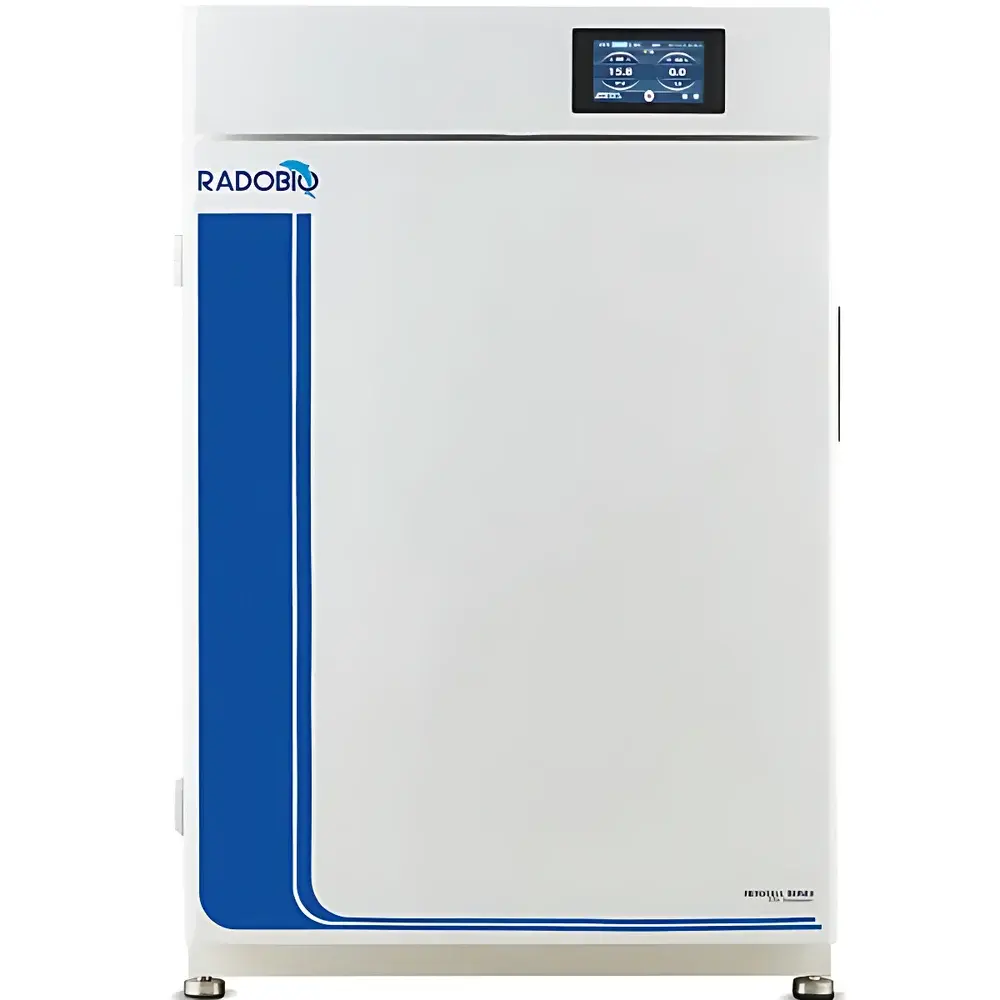
RADOBIO HC180 Medical-Grade CO₂ Incubator
| Brand | RADOBIO |
|---|---|
| Origin | Shanghai, China |
| Instrument Type | Air-Jacketed CO₂ Incubator |
| CO₂ Detection | Infrared (IR) Sensor |
| Temperature Control Range & Accuracy | Ambient +4 °C to 60 °C, ±0.1 °C setpoint resolution |
| Temperature Uniformity | ±0.2 °C (at 37 °C, empty chamber, ambient 25 °C) |
| CO₂ Concentration Control Range & Accuracy | 0–20%, ±0.1% setpoint resolution |
| Chamber Volume | 185 L |
| Internal Dimensions (L×W×H) | 535 × 526 × 675 mm |
| External Dimensions (L×W×H, incl. base) | 660 × 652 × 1000 mm |
| Sterilization Method | 140 °C Dry-Heat Sterilization |
| Humidification | Removable 304 Stainless Steel Water Pan (4 L capacity) |
| Air Filtration | Integrated HEPA Filter (≥99.99% @ 0.3 µm) |
| Control Interface | 5-inch Capacitive Touch LCD Display with Data Logging |
| Data Storage | 250,000 records, USB export, write-protected archival |
Overview
The RADOBIO HC180 Medical-Grade CO₂ Incubator is an air-jacketed, microprocessor-controlled environmental chamber engineered for clinical laboratories, GMP-compliant cell therapy facilities, and regulated biomedical research environments. It maintains precise physiological conditions—temperature, CO₂ concentration, and relative humidity—required for the reliable expansion of primary human cells, stem cell lines, hybridomas, and sensitive co-cultures. Its measurement architecture is grounded in dual independent feedback loops: a high-stability platinum resistance thermometer (PT100) for temperature regulation and a non-dispersive infrared (NDIR) CO₂ sensor with temperature/humidity compensation, ensuring long-term drift-free gas monitoring even under frequent door access. The chamber employs six-sided direct-heating technology—where heating elements are embedded into all interior stainless-steel surfaces—to eliminate thermal gradients and deliver exceptional spatial uniformity (±0.2 °C at 37 °C). Designed and validated in accordance with ISO 13485:2016 and compliant with IEC 61010-1 safety standards, the HC180 is registered as a Class II medical device in China (NMPA registration available), supporting traceability requirements under GLP and clinical-grade manufacturing protocols.
Key Features
- Six-surface direct-heating air jacket system ensures rapid thermal recovery (≤4 min after 30-sec door opening at 25 °C ambient) and superior temperature homogeneity across the full 185 L working volume.
- 140 °C dry-heat sterilization cycle—fully automated, programmable, and thermally mapped—eliminates bacterial endospores, mycoplasma, yeasts, and molds without chemical residues or chamber disassembly.
- Integrated HEPA filtration (≥99.99% efficiency at 0.3 µm) operates continuously during incubation and achieves full chamber air exchange within 5 minutes post-door-opening, minimizing airborne contamination risk.
- Capacitive 5-inch LCD touchscreen interface supports real-time trend visualization, configurable data logging intervals (30–9999 sec), and immutable USB-exportable audit trails compliant with FDA 21 CFR Part 11 data integrity principles.
- Polished 304 stainless-steel inner chamber with radius-rounded corners and tool-free removable shelves enables efficient cleaning validation and reduces microbial harborage points.
- Passive humidification via a 4 L stainless-steel water pan sustains >95% RH at 37 °C without condensation formation on upper chamber surfaces, preserving sample integrity and optical clarity for time-lapse microscopy.
Sample Compatibility & Compliance
The HC180 accommodates standard T-flasks (up to 175 cm²), multi-well plates (6–96-well), Petri dishes, roller bottles, and custom bioreactor inserts. Its uniform airflow profile—generated by a low-turbulence internal fan—prevents localized desiccation and ensures consistent O₂/CO₂/H₂O vapor exchange across all shelf levels. The incubator meets ISO 14644-1 Class 5 (ISO Class 5) cleanroom air quality requirements when operated with HEPA filtration active. It supports compliance with USP , ASTM E2924-21 (standard guide for cell culture incubators), and EU Annex 1 (2022) recommendations for aseptic processing environments. All firmware and calibration records adhere to ALCOA+ principles (Attributable, Legible, Contemporaneous, Original, Accurate, Complete, Consistent, Enduring, Available).
Software & Data Management
The embedded control system logs temperature, CO₂ concentration, relative humidity, door-open events, sterilization cycles, and alarm states with timestamped entries. Data storage capacity exceeds 250,000 records; logs are write-protected upon generation and exportable via USB 2.0 as CSV files with SHA-256 hash verification. The interface supports user-level access control (three-tier permission: operator, supervisor, administrator), electronic signature capture for critical actions (e.g., sterilization initiation), and configurable alarm thresholds with both audible (≤50 dB[A]) and visual notifications. Audit trail functionality complies with 21 CFR Part 11 Subpart B requirements for electronic records and signatures, including operator ID linkage, action timestamps, and change history.
Applications
- Expansion of human mesenchymal stromal cells (hMSCs) and induced pluripotent stem cells (iPSCs) under cGMP-aligned conditions.
- Long-term maintenance of primary neuronal cultures and organoid systems requiring stable pH buffering via 5% CO₂.
- Monoclonal antibody production using CHO and hybridoma cell lines where batch consistency depends on microenvironmental stability.
- In vitro fertilization (IVF) labs performing embryo culture under strict temperature and gas control per ESHRE guidelines.
- Regulatory submissions requiring documented environmental validation—supported by built-in temperature mapping ports and CO₂ linearity verification routines.
FAQ
Does the HC180 support IQ/OQ/PQ documentation packages?
Yes—RADOBIO provides standardized qualification templates aligned with ASTM E2500-21 and ISO/IEC 17025, including test protocols for temperature uniformity mapping, CO₂ accuracy verification, and HEPA filter integrity testing.
Is remote monitoring supported?
The HC180 does not include Ethernet or Wi-Fi connectivity; however, its USB data export enables integration with third-party LIMS or ELN systems via scheduled offline transfer.
What CO₂ supply pressure is required?
Optimal inlet pressure is 0.05–0.1 MPa (0.5–1 bar); a pressure regulator and particulate/moisture filter are recommended upstream of the 1.5 m supplied CO₂ inlet hose.
Can the incubator operate without the water pan?
Yes—humidity control is optional; the chamber will maintain temperature and CO₂ setpoints in dry mode, though RH will fall below 50% at 37 °C without active humidification.
How often must the HEPA filter be replaced?
Under typical laboratory use (≤10 door openings/day), the HEPA filter service interval is 12 months; replacement is indicated when differential pressure across the filter exceeds 250 Pa or after each 140 °C sterilization cycle exceeding five occurrences.