
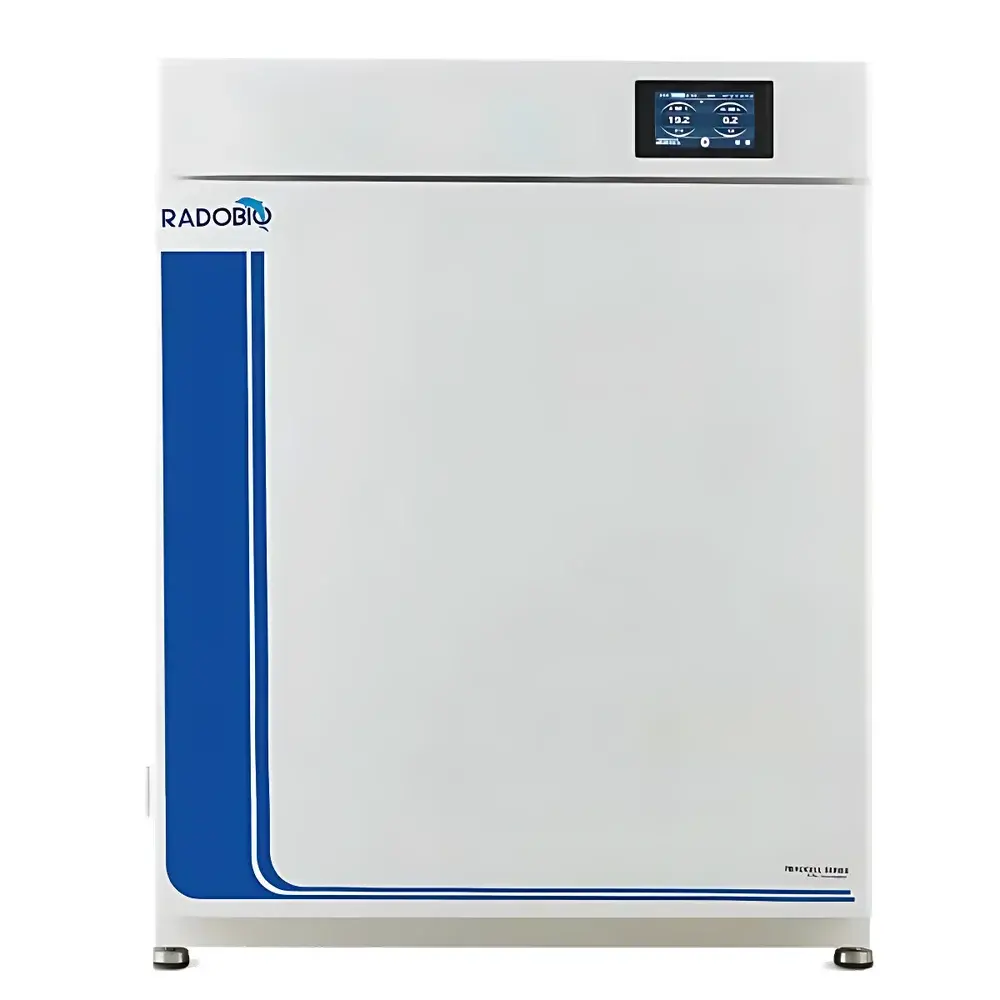
RADOBIO HC240 Medical-Grade CO₂ Incubator
| Brand | RADOBIO |
|---|---|
| Origin | Shanghai, China |
| Instrument Type | Air-Jacketed CO₂ Incubator |
| CO₂ Detection | Infrared (IR) Sensor |
| Temperature Control Range & Resolution | Ambient +4 °C to 60 °C, 0.1 °C |
| Temperature Uniformity | ±0.2 °C (at 37 °C, empty chamber, ambient 25 °C) |
| CO₂ Concentration Control Range & Resolution | 0–20%, 0.1% |
| Chamber Volume | 248 L |
| Internal Dimensions (L×W×H) | 674 × 526 × 675 mm |
| External Dimensions (L×W×H) | 800 × 652 × 1000 mm (including base) |
| Standard Configuration | PID temperature control, 6-surface direct-heating air-jacket design, 140 °C dry-heat sterilization cycle |
Overview
The RADOBIO HC240 Medical-Grade CO₂ Incubator is an ISO 13485-aligned, CE-marked, and China NMPA-registered Class II medical device engineered for clinical laboratories, biobanking facilities, and GMP-compliant cell therapy manufacturing environments. Designed around core physiological requirements for mammalian cell culture—including precise CO₂ partial pressure maintenance, stable thermal homogeneity, and sterile air integrity—the HC240 employs a true air-jacketed architecture with six-face direct heating elements to eliminate thermal gradients across the entire 248 L working chamber. Its infrared (IR) CO₂ sensor operates independently of humidity and transient door-opening events, ensuring long-term calibration stability per ISO 8573-1 and ASTM E2919-20 standards for gas concentration monitoring in regulated life science workflows. The system meets essential performance criteria for USP , ISO 14644-1 Class 5 cleanroom-compatible operation, and supports audit-ready documentation under FDA 21 CFR Part 11 when paired with validated data management protocols.
Key Features
- Six-surface air-jacketed heating system delivering ±0.2 °C temperature uniformity at 37 °C (empty), verified per ISO 15378 Annex B and EN 285:2015 Annex C test methodology
- 140 °C dry-heat sterilization cycle—validated to achieve ≥6-log reduction of bacterial endospores (Bacillus atrophaeus), mycoplasma, and fungal contaminants per ISO 14937 and EU GMP Annex 1 requirements
- Integrated HEPA (H14 class, 99.995% @ 0.1 µm) recirculation system with continuous filtration; full chamber air exchange completed within ≤5 minutes post-door opening, minimizing contamination risk during routine access
- Stainless steel (AISI 304) seamless interior with radius-rounded corners and tool-free removable shelves—designed for compatibility with ethanol, hydrogen peroxide vapor (HPV), and VHP® decontamination cycles
- Capacitive 5-inch LCD touchscreen interface with real-time trend visualization, configurable alarm thresholds (audible/visual), and tamper-evident event logging
- Passive humidity control via 4 L capacity stainless steel water pan—maintains >95% RH at 37 °C without condensation formation on optical surfaces or culture vessels
Sample Compatibility & Compliance
The HC240 accommodates standard SBS-format multiwell plates (6–1536-well), T-flasks (T-25 to T-225), roller bottles, and custom bioreactor cartridges up to 12 cm in height. Its chamber geometry and airflow profile are optimized for adherent and suspension cultures—including iPSCs, primary neurons, hybridomas, and CAR-T expansion protocols. The incubator complies with IEC 61010-1:2010 safety standards for laboratory equipment and satisfies electromagnetic compatibility (EMC) requirements per EN 61326-1:2013. For regulatory submissions, it supports traceable calibration using NIST-traceable reference probes (optional), and its sterilization cycle validation package includes thermocouple mapping reports compliant with ISO 17025-accredited testing laboratories.
Software & Data Management
All operational parameters—including chamber temperature, CO₂ concentration, relative humidity, door-open events, sterilization cycle status, and alarm history—are logged at user-defined intervals (30–9999 seconds) with immutable timestamping. The internal memory retains up to 250,000 data points, accessible via the front-panel interface or exported in CSV format via USB 2.0 port for integration into LIMS or ELN platforms. Audit trails include operator ID (if network-authenticated), parameter change history, and firmware version metadata—enabling full compliance with ALCOA+ principles (Attributable, Legible, Contemporaneous, Original, Accurate, Complete, Consistent, Enduring, Available). Optional Ethernet connectivity enables remote monitoring through secure HTTPS API endpoints compatible with enterprise IT infrastructure.
Applications
- Good Manufacturing Practice (GMP)-compliant expansion of autologous and allogeneic cell therapies under Annex 1 (EU) and 21 CFR Part 211
- Clinical-grade stem cell banking with strict adherence to ISCT minimal criteria and FACT-JACIE standards
- Regulatory submission support for IND/IMPD dossiers requiring documented environmental control during preclinical toxicology studies
- High-throughput drug screening using phenotypic assays sensitive to CO₂ drift or thermal heterogeneity (e.g., calcium flux, mitochondrial membrane potential)
- Long-term co-culture models involving stromal and epithelial compartments where spatial uniformity directly impacts paracrine signaling fidelity
FAQ
Does the HC240 meet FDA 21 CFR Part 11 requirements for electronic records?
Yes—when operated with enabled audit trail logging and user authentication (via optional network integration), the system satisfies predicate rule requirements for record retention, electronic signatures, and change control.
What is the validation support provided for IQ/OQ/PQ protocols?
RADOBIO supplies a comprehensive validation toolkit including URS templates, DQ checklists, factory-verified temperature/CO₂ mapping reports, and sterilization cycle development protocols aligned with ISO 13485 Clause 7.5.2.
Can the incubator be integrated into a centralized building management system (BMS)?
Via optional Modbus TCP or BACnet/IP gateway module, enabling real-time status telemetry and alarm forwarding to facility-wide SCADA platforms.
Is the IR CO₂ sensor field-replaceable without recalibration?
Yes—the sensor module is designed as a plug-and-play component with embedded calibration coefficients; replacement requires no external recalibration tools or service engineer intervention.
What is the expected service life of the HEPA filter under continuous operation?
Under typical lab conditions (≤30 door openings/day), the H14 filter maintains ≥99.995% efficiency for ≥12 months; replacement interval is tracked automatically and displayed on the main screen.



