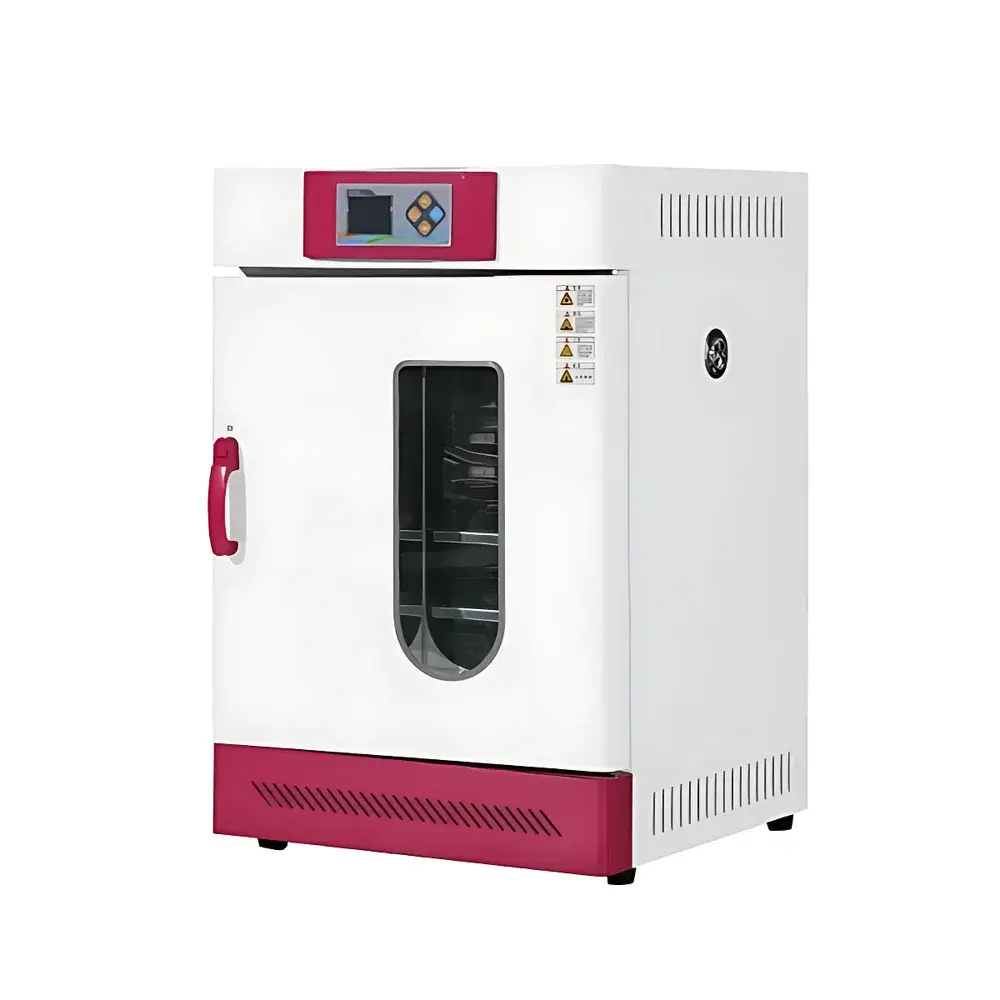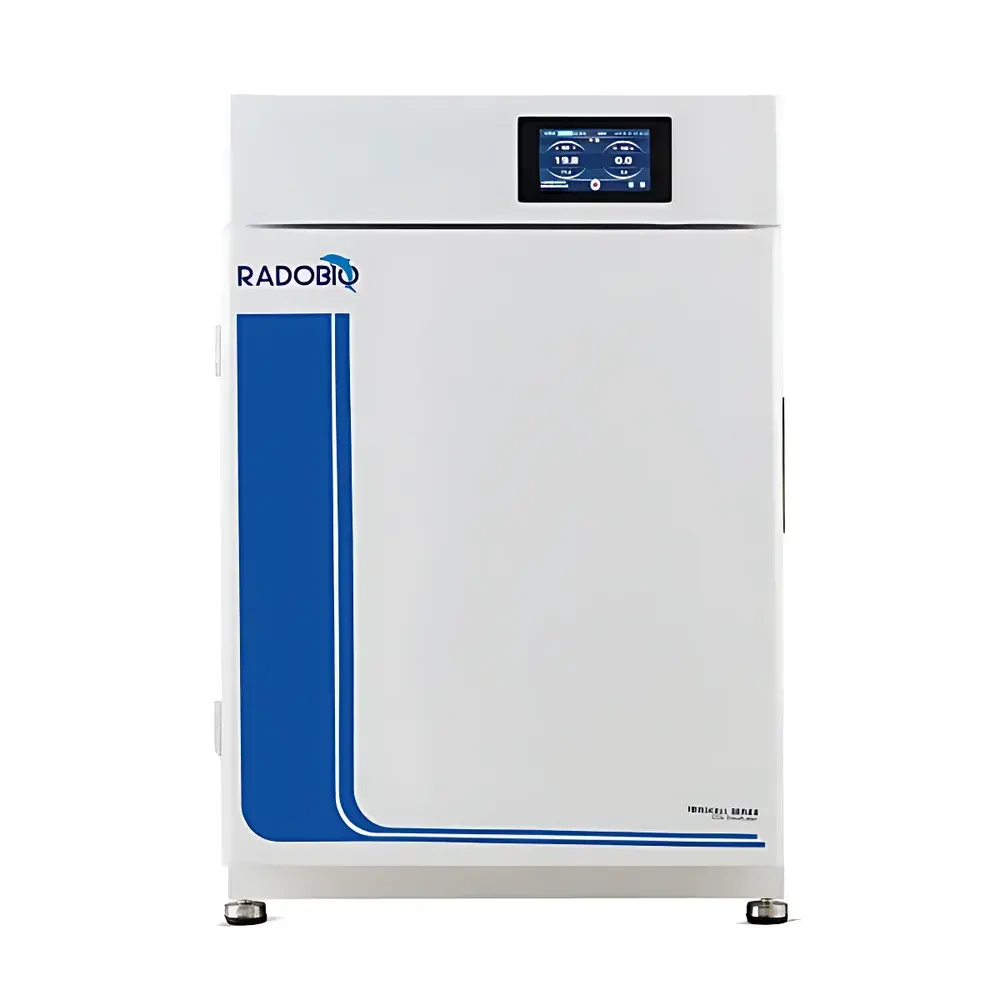
RADOBIO Herocell 180P CO₂ Incubator
| Brand | RADOBIO |
|---|---|
| Origin | Shanghai, China |
| Model | Herocell 180P |
| Instrument Type | Air-jacketed CO₂ Incubator |
| CO₂ Detection | Infrared (IR) Sensor |
| Temperature Control Range & Resolution | Ambient +4°C to 60°C, 0.1°C |
| Temperature Uniformity | ±0.2°C (at 37°C, empty chamber, ambient 25°C) |
| CO₂ Concentration Control Range & Resolution | 0–20%, 0.1% |
| Chamber Capacity | 185 L |
| External Dimensions (L×W×H) | 660 × 652 × 1000 mm (including base) |
| Key Configuration | PID control algorithm, 6-sided direct-heating air jacket, 180°C dry-heat sterilization cycle |
Overview
The RADOBIO Herocell 180P is a precision-engineered air-jacketed CO₂ incubator designed for demanding mammalian cell culture applications in academic research laboratories, biopharmaceutical process development, and clinical diagnostic facilities. It operates on the fundamental principle of maintaining a tightly regulated triad of environmental parameters—temperature, CO₂ concentration, and relative humidity—to replicate physiological conditions essential for robust and reproducible cell proliferation. The unit employs a 6-sided direct-heating air jacket architecture, eliminating thermal gradients commonly observed in water-jacketed or single-wall designs. This configuration ensures rapid thermal recovery (<5 min after a 30-second door opening at 25°C ambient), high spatial uniformity (±0.2°C at 37°C), and minimal drift during extended operation. CO₂ concentration is continuously monitored and controlled via a calibrated non-dispersive infrared (NDIR) sensor, delivering stable setpoint maintenance even under frequent access conditions—critical for labs performing routine passaging, transfection, or co-culture experiments.
Key Features
- 6-sided direct-heating air jacket system with distributed high-efficiency heating elements across all interior surfaces, enabling superior temperature homogeneity and dynamic stability
- 180°C dry-heat sterilization cycle—fully programmable, validated, and executed without disassembly; eliminates bacterial, fungal, mycoplasmal, and viral contaminants from stainless-steel chamber surfaces
- Integrated ISO Class 5 HEPA filtration system with continuous recirculation; achieves cleanroom-grade air quality (≤3,520 particles/m³ ≥0.5 µm) within 5 minutes post-door opening
- Capacitive 5-inch LCD touchscreen interface with real-time graphical display of temperature, CO₂, and humidity trends; supports user-defined data logging intervals (30 s to 9999 s)
- Passive humidity control via stainless-steel humidification pan; delivers up to 95% RH at 37°C without ultrasonic misting or external water reservoirs
- Robust 304 stainless-steel interior with seamless, polished corners and removable perforated shelves—designed for autoclavable compatibility and residue-free cleaning
- Dual redundant safety systems: independent over-temperature cut-off probe and software-enforced upper limit lockout
Sample Compatibility & Compliance
The Herocell 180P accommodates standard tissue culture formats—including T-flasks (up to T225), multi-well plates (6–96-well), Petri dishes, roller bottles, and custom bioreactor vessels—within its 185 L working volume. Its chamber geometry (535 × 526 × 675 mm internal) permits flexible shelf stacking while preserving laminar airflow distribution. All materials in contact with the incubation environment comply with USP Class VI biocompatibility standards. The system supports GLP- and GMP-aligned workflows through audit-trail-capable data logging (immutable USB-exported records), configurable alarm thresholds, and password-protected parameter modification. While not pre-certified to ISO 13485 or FDA 21 CFR Part 11 out-of-the-box, the firmware architecture allows integration into validated environments via documented IQ/OQ protocols and third-party electronic signature validation.
Software & Data Management
Data acquisition and visualization are handled natively by the embedded microcontroller, eliminating dependency on external PCs. Historical datasets—including timestamped temperature, CO₂, and humidity values—are stored onboard (capacity: 250,000 entries) with automatic overwrite protection. Export is performed via standard USB-A interface using FAT32-formatted drives; output files are CSV-compliant and compatible with Excel, MATLAB, and LIMS platforms. The interface supports one programmable multi-segment protocol (5 steps maximum), suitable for circadian rhythm studies or staged differentiation protocols. No proprietary drivers or cloud connectivity are required—ensuring full data sovereignty and network isolation per institutional IT security policies.
Applications
This incubator is routinely deployed in primary cell isolation, induced pluripotent stem cell (iPSC) maintenance, monoclonal antibody production, 3D organoid culture, CRISPR-Cas9 editing workflows, and microbiological co-culture assays requiring strict CO₂-dependent pH regulation. Its rapid gas recovery and HEPA-replenished atmosphere make it especially suited for shared-core facilities where throughput and contamination resilience are prioritized. The 180°C sterilization function significantly reduces turnaround time between sensitive experiments—e.g., moving from feeder-dependent embryonic stem cell lines to feeder-free neural progenitor cultures—without cross-contamination risk.
FAQ
What is the difference between air-jacketed and water-jacketed CO₂ incubators?
Air-jacketed systems use insulated chambers with perimeter heating elements, offering faster temperature recovery, lower energy consumption, and no risk of water leakage or microbial growth in jackets. Water-jacketed units provide greater thermal inertia but require periodic maintenance and decontamination.
Can the Herocell 180P be validated for GMP compliance?
Yes—its deterministic control logic, traceable sensor calibration paths, and immutable data export support formal qualification (IQ/OQ/PQ) when executed with documented procedures and third-party thermocouple mapping.
Is the IR CO₂ sensor factory-calibrated and field-serviceable?
The NDIR sensor is pre-calibrated against certified reference gas and includes built-in zero-point auto-compensation. Field recalibration is possible using a certified 5% CO₂ standard gas kit (optional accessory).
Does the incubator support remote monitoring via Ethernet or Wi-Fi?
No—the Herocell 180P operates as a standalone instrument with local touchscreen and USB data export only, aligning with cybersecurity best practices for lab equipment in regulated environments.
What maintenance is required for the HEPA filter?
The ISO 5 HEPA filter should be replaced every 12 months under typical usage (8 hrs/day, 5 days/week); replacement interval may shorten in high-particulate environments or following extended sterilization cycles.