
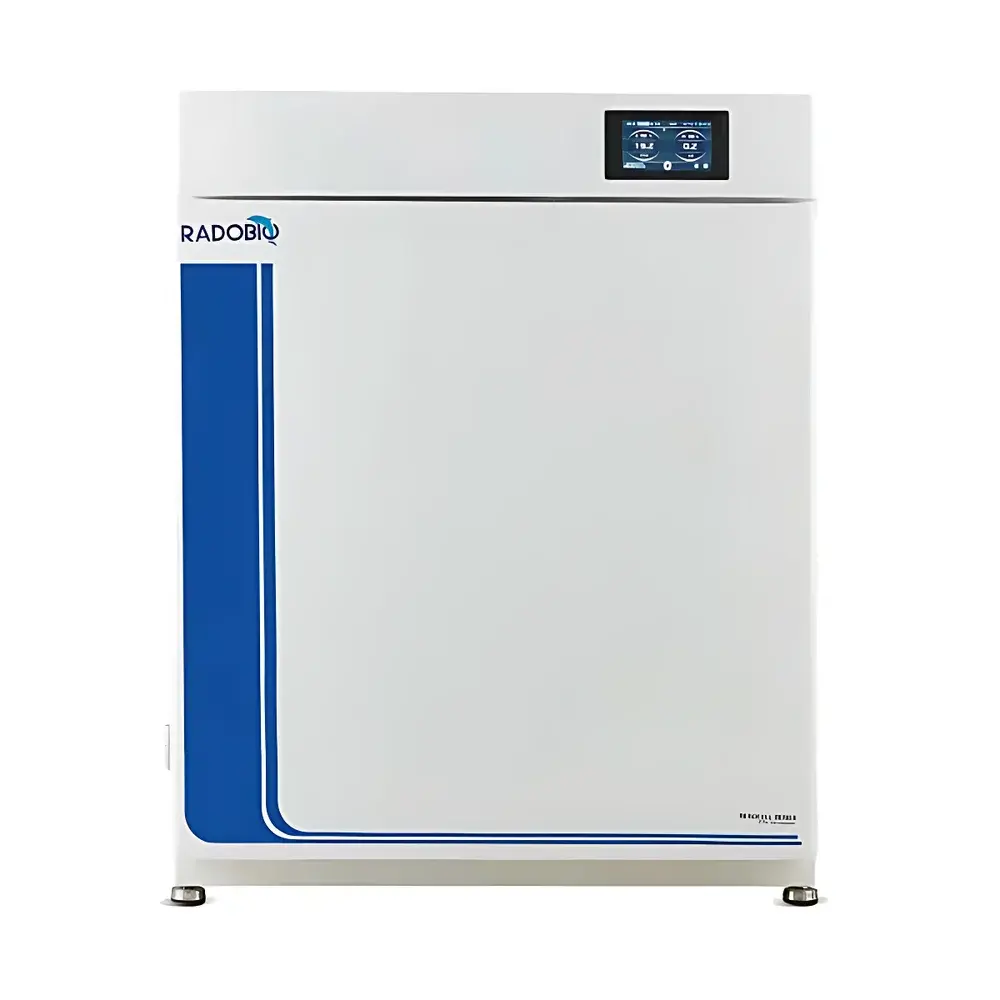
RADOBIO Herocell 240 CO₂ Incubator
| Brand | RADOBIO |
|---|---|
| Origin | Shanghai, China |
| Instrument Type | Air-jacketed CO₂ Incubator |
| CO₂ Detection | Infrared (IR) Sensor |
| Temperature Control Range & Accuracy | Ambient +4 °C to 60 °C, ±0.1 °C |
| Temperature Uniformity | ±0.2 °C (at 25 °C ambient, 37 °C setpoint, empty chamber) |
| CO₂ Concentration Control Range & Accuracy | 0–20 %, ±0.1 % |
| Chamber Volume | 248 L |
| Internal Dimensions (L×W×H) | 674 × 526 × 675 mm |
| External Dimensions (L×W×H, including base) | 800 × 652 × 1000 mm |
| Key Configuration | PID control algorithm, 6-surface direct-heating air jacket, 140 °C dry-heat sterilization cycle |
Overview
The RADOBIO Herocell 240 CO₂ Incubator is an air-jacketed, microprocessor-controlled environmental chamber engineered for precision cell culture applications in academic research laboratories, biopharmaceutical QC facilities, and clinical cell therapy suites. It maintains physiologically relevant conditions—primarily 37 °C temperature, 5% CO₂, and ≥95% relative humidity—by integrating three tightly coupled control systems: independent PID-regulated heating across all six internal surfaces, infrared (IR) CO₂ sensing with real-time feedback correction, and passive humidification via a large-capacity 304 stainless steel water pan. Unlike water-jacketed designs, the air-jacket architecture enables rapid thermal recovery (<5 min after a 30-second door opening at 25 °C ambient), minimizes condensation risk through uniform wall temperature distribution, and eliminates microbial reservoirs associated with liquid-filled jackets. The chamber’s structural integrity derives from a seamless, electropolished 304 stainless steel interior with radius-rounded corners—designed not only for ease of cleaning but also to prevent biofilm accumulation at crevices.
Key Features
- 6-Surface Direct-Heating Air Jacket: Heating elements embedded in all interior walls deliver uniform thermal energy distribution, achieving ±0.2 °C temperature uniformity (measured per ISO 13940:2009 Annex A at 37 °C, empty chamber, 25 °C ambient). This architecture avoids hot/cold spots common in single-wall or bottom-heated incubators.
- 140 °C Dry-Heat Sterilization Cycle: A validated, programmable high-temperature decontamination protocol eliminates bacteria, yeasts, molds, and mycoplasma from all internal surfaces—including gaskets and sensor housings—without disassembly. No autoclaving or chemical fumigation is required between experiments.
- Infrared (IR) CO₂ Sensing Technology: Non-dispersive infrared detection provides long-term stability and immunity to humidity drift, enabling accurate CO₂ monitoring even during frequent access cycles. Calibration is traceable to NIST-certified reference gases.
- Integrated HEPA Filtration System: A Class II, H14-rated HEPA filter continuously recirculates chamber air at ≥60 air changes per hour. Following door opening, >99.995% particle removal (≥0.3 µm) is achieved within 5 minutes—meeting ISO 14644-1 Class 5 requirements for critical environments.
- Passive Humidification Design: A removable 4 L 304 stainless steel humidity pan operates without ultrasonic misting or steam generators, eliminating mineral deposits and minimizing condensation formation on optical surfaces or culture vessels.
- 5-Inch Capacitive Touchscreen Interface: Displays real-time and historical trends for temperature, CO₂, and system status. Data logging interval is configurable from 30 seconds to 9999 seconds; up to 250,000 records are stored onboard with write-protected archival integrity.
Sample Compatibility & Compliance
The Herocell 240 accommodates standard tissue culture formats—including T-flasks (up to T225), multiwell plates (6–96-well), Petri dishes, roller bottles, and bioreactor vessels—within its 248 L chamber volume. Its stainless steel construction complies with ISO 13485:2016 for medical device manufacturing environments. For regulated workflows, the system supports ALCOA+ data integrity principles: audit trails record user ID, timestamp, parameter changes, and alarm events; USB export generates CSV files compatible with LIMS integration. While not pre-certified to FDA 21 CFR Part 11, the firmware architecture permits configuration for electronic signature enforcement and role-based access control—enabling qualification under GxP (GLP/GMP) frameworks when deployed with documented SOPs and IQ/OQ/PQ protocols.
Software & Data Management
Data acquisition occurs at user-defined intervals (30 s–9999 s) and is stored in non-volatile memory with immutable timestamps. The touchscreen interface displays overlayed trend graphs for temperature and CO₂ concentration, with zoom and scroll functionality. All logged data—including alarms, sterilization cycles, and door-open events—are exportable via USB 2.0 to encrypted FAT32-formatted drives. No proprietary software is required for data review; exported CSV files are directly importable into Excel, GraphPad Prism, or laboratory informatics platforms. Optional humidity sensing (0–100% RH, ±2% accuracy) may be added as a calibrated probe module for applications requiring explicit moisture validation.
Applications
The Herocell 240 serves primary human and animal cell lines (e.g., HEK293, CHO-K1, MCF-7), stem cell expansion (mesenchymal, iPSC-derived), co-culture systems, and 3D organoid models where environmental fidelity directly impacts phenotypic stability and assay reproducibility. Its rapid gas recovery kinetics make it suitable for high-throughput screening labs performing daily medium changes or transfection workflows. In regenerative medicine settings, the 140 °C sterilization cycle satisfies ISO 20387:2018 requirements for biosafety in cell banking operations. The absence of water jackets also reduces maintenance burden in cleanroom-adjacent installations where liquid containment failure poses contamination risks.
FAQ
What CO₂ supply pressure is recommended?
A regulated inlet pressure of 0.05–0.1 MPa (0.5–1 bar) is required for stable gas blending; a dedicated CO₂ pressure regulator with dual-stage filtration is advised.
Is the incubator compatible with hypoxia studies?
No—the Herocell 240 is configured exclusively for CO₂/O₂/N₂ tri-gas control; hypoxic operation requires optional O₂ sensor integration and separate nitrogen supply, available under custom configuration.
Can the HEPA filter be replaced by the user?
Yes—filter replacement is tool-free and guided by on-screen prompts; replacement intervals are tracked automatically and trigger visual alerts at 6,000 operating hours.
Does the system support remote monitoring?
Local Ethernet connectivity is not included; however, the USB data export capability enables integration with third-party building management or lab automation systems via scheduled file transfer scripts.
What validation documentation is provided?
Each unit ships with a Factory Acceptance Test (FAT) report including as-tested temperature uniformity, CO₂ accuracy, and sterilization cycle thermography—traceable to internal metrology standards calibrated against NIST-traceable references.




