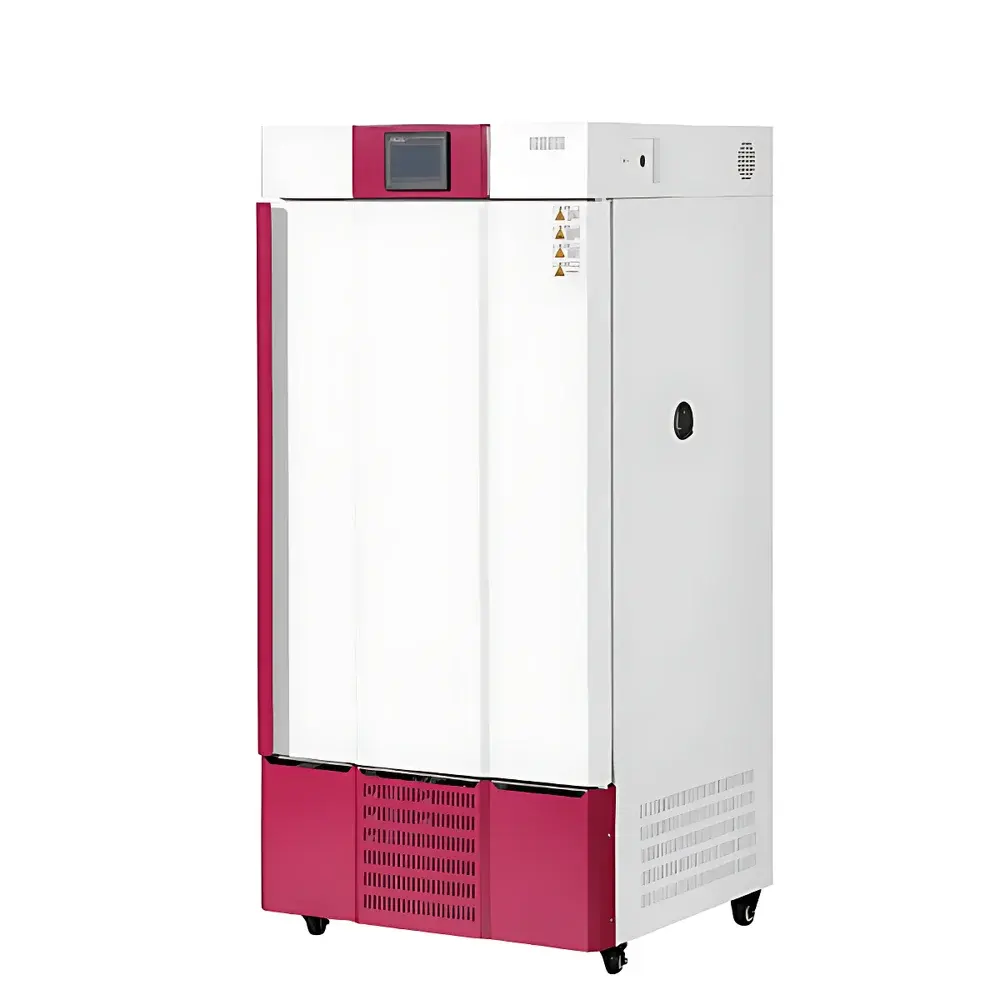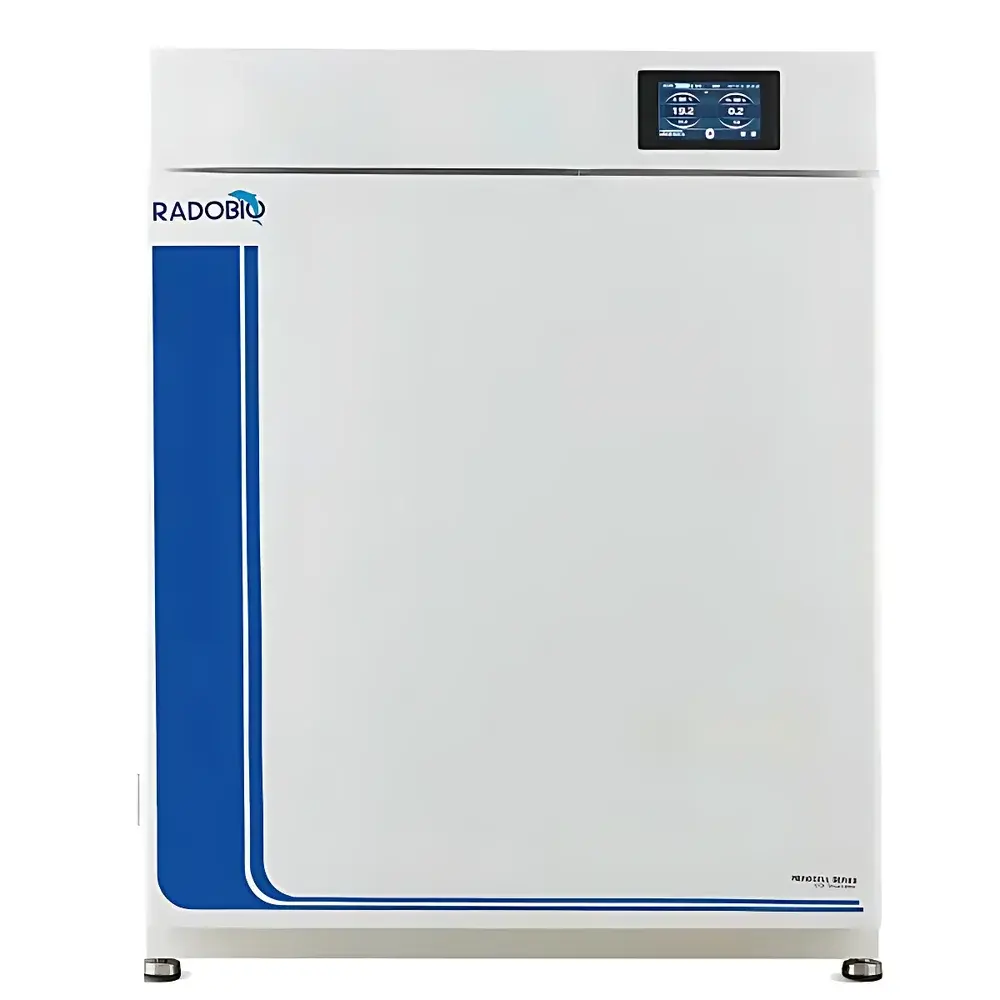
RADOBIO Herocell 240P Carbon Dioxide Incubator
| Brand | RADOBIO |
|---|---|
| Origin | Shanghai, China |
| Instrument Type | Air-jacketed CO₂ Incubator |
| CO₂ Detection | Infrared (IR) Sensor |
| Temperature Control Range & Resolution | Ambient +4°C to 60°C, 0.1°C |
| Temperature Uniformity | ±0.2°C (at 37°C, empty chamber, ambient 25°C) |
| CO₂ Concentration Control Range & Resolution | 0–20%, 0.1% |
| Chamber Capacity | 248 L |
| External Dimensions (L×W×H) | 800 × 652 × 1000 mm (including base) |
| Key Configuration | PID control, 6-sided direct-heating air jacket, 180°C dry-heat sterilization |
Overview
The RADOBIO Herocell 240P is a precision-engineered air-jacketed carbon dioxide incubator designed for reliable, contamination-controlled mammalian cell culture in academic research laboratories, biopharmaceutical development facilities, and quality control environments. It operates on the fundamental principle of maintaining physiologically relevant conditions—specifically, tightly regulated temperature (via six-sided uniform heating), CO₂ concentration (via non-dispersive infrared sensing), and relative humidity (via stainless-steel humidification pans)—to replicate the in vivo microenvironment required for optimal cell proliferation and viability. Unlike water-jacketed systems, the air-jacketed architecture enables rapid thermal recovery (<5 min after a 30-second door opening at 25°C ambient), reduced energy consumption, and elimination of condensation-related contamination risks. The chamber’s ISO Class 5 HEPA filtration system continuously recirculates and purifies internal air, achieving cleanroom-grade air quality within five minutes post-door-opening—a critical feature for high-sensitivity primary cell lines and stem cell cultures.
Key Features
- Six-Sided Direct-Heating Air Jacket: Independent heating elements embedded across all interior surfaces—including floor, ceiling, and four walls—deliver exceptional thermal uniformity (±0.2°C at 37°C, empty) and stability (±0.1°C). This architecture eliminates cold spots and ensures consistent growth conditions regardless of shelf position.
- 180°C Dry-Heat Sterilization Cycle: A validated, single-step thermal decontamination protocol that eradicates bacteria, fungi, yeasts, and mycoplasma from all internal stainless-steel surfaces without disassembly. No autoclaving, chemical wiping, or component reinstallation is required—reducing downtime and operator exposure risk.
- Infrared (IR) CO₂ Sensor: High-stability, humidity-compensated IR detection provides long-term accuracy (0.1% resolution) and immunity to drift caused by frequent door openings or ambient humidity fluctuations—essential for longitudinal experiments and remote monitoring workflows.
- ISO 5-Class HEPA Filtration System: Integrated recirculating airflow passes continuously through a medical-grade HEPA filter (≥99.995% @ 0.3 µm), delivering cleanroom-equivalent air quality inside the chamber. Recovery to ISO 5 compliance occurs within 5 minutes following door closure.
- Intuitive 5-inch Capacitive Touchscreen Interface: Displays real-time and historical trends for temperature, CO₂, and humidity. Supports user-defined data logging intervals (30 s to 9999 s), stores up to 250,000 data points, and enables tamper-resistant USB export compliant with ALCOA+ data integrity principles.
- Optimized Airflow Management: Low-turbulence, fan-assisted circulation distributes pre-humidified, filtered air uniformly—minimizing localized desiccation while ensuring homogeneous gas exchange across all culture vessels, including flasks, dishes, and multiwell plates.
Sample Compatibility & Compliance
The Herocell 240P accommodates standard tissue culture formats—including T-25 to T-225 flasks, 6–96-well plates, Petri dishes, roller bottles, and cryogenic storage boxes—within its 248 L stainless-steel chamber (674 × 526 × 675 mm internal). All wetted surfaces feature electropolished, radius-cornered 304 stainless steel for seamless cleaning and resistance to corrosion from ethanol, hydrogen peroxide vapor, and common disinfectants. The system supports GLP- and GMP-aligned operations through configurable audit trails, password-protected parameter locking, and electronic records meeting FDA 21 CFR Part 11 requirements when integrated with compliant LIMS or ELN platforms. It conforms to IEC 61010-1 (safety) and IEC 61326-1 (EMC) standards; CO₂ control performance aligns with ASTM E1758-22 for incubator validation protocols.
Software & Data Management
Data acquisition is managed via an embedded microcontroller with non-volatile memory. The touchscreen interface logs timestamped values for temperature, CO₂, and humidity at user-selectable intervals (default: 60 s), retaining up to 250,000 entries. All stored data are write-once, read-many (WORM), preventing post-acquisition modification. Export is performed via USB-A port to FAT32-formatted drives in CSV format—compatible with Excel, GraphPad Prism, and LabArchives. Optional Ethernet or RS-485 interfaces (available upon request) enable integration into centralized building management systems (BMS) or environmental monitoring platforms compliant with Annex 1 (EU GMP) and USP analytical instrument qualification guidelines.
Applications
- Mammalian cell line maintenance (e.g., CHO, HEK293, HeLa, MCF-7)
- Stem cell expansion and differentiation assays under low-oxygen or dual-gas conditions (when retrofitted with O₂ module)
- Primary neuron and organoid culture requiring strict pH and humidity stability
- Regulatory-compliant QC testing of biologics, vaccines, and cell therapies
- Long-term time-lapse imaging studies where thermal and gaseous consistency directly impact morphological interpretation
- Teaching laboratories requiring robust, low-maintenance infrastructure for undergraduate and graduate coursework
FAQ
What is the recommended CO₂ supply pressure?
A regulated inlet pressure of 0.05–0.1 MPa (0.5–1.0 bar) is required for stable gas blending and optimal IR sensor response.
Does the incubator support external monitoring via network protocols?
Standard configuration includes USB data export; optional RS-485 or Ethernet modules enable Modbus TCP or BACnet MS/TP integration for facility-wide environmental surveillance.
How frequently must the HEPA filter be replaced?
Under typical use (≤10 door openings/day), the HEPA filter is rated for 12 months; replacement interval should be verified per site-specific risk assessment and documented in the equipment maintenance log.
Is the 180°C sterilization cycle validated per ISO 14644 or similar?
While the cycle achieves >6-log microbial reduction on stainless-steel surfaces, users are responsible for performing installation qualification (IQ), operational qualification (OQ), and performance qualification (PQ) per ISO 13485 or internal SOPs.
Can humidity be actively controlled, or is it passively maintained?
Humidity is passively maintained via stainless-steel water reservoirs; maximum achievable RH is ~95% at 37°C. For applications requiring dynamic RH control (e.g., air-liquid interface cultures), external humidification modules are available as accessories.