
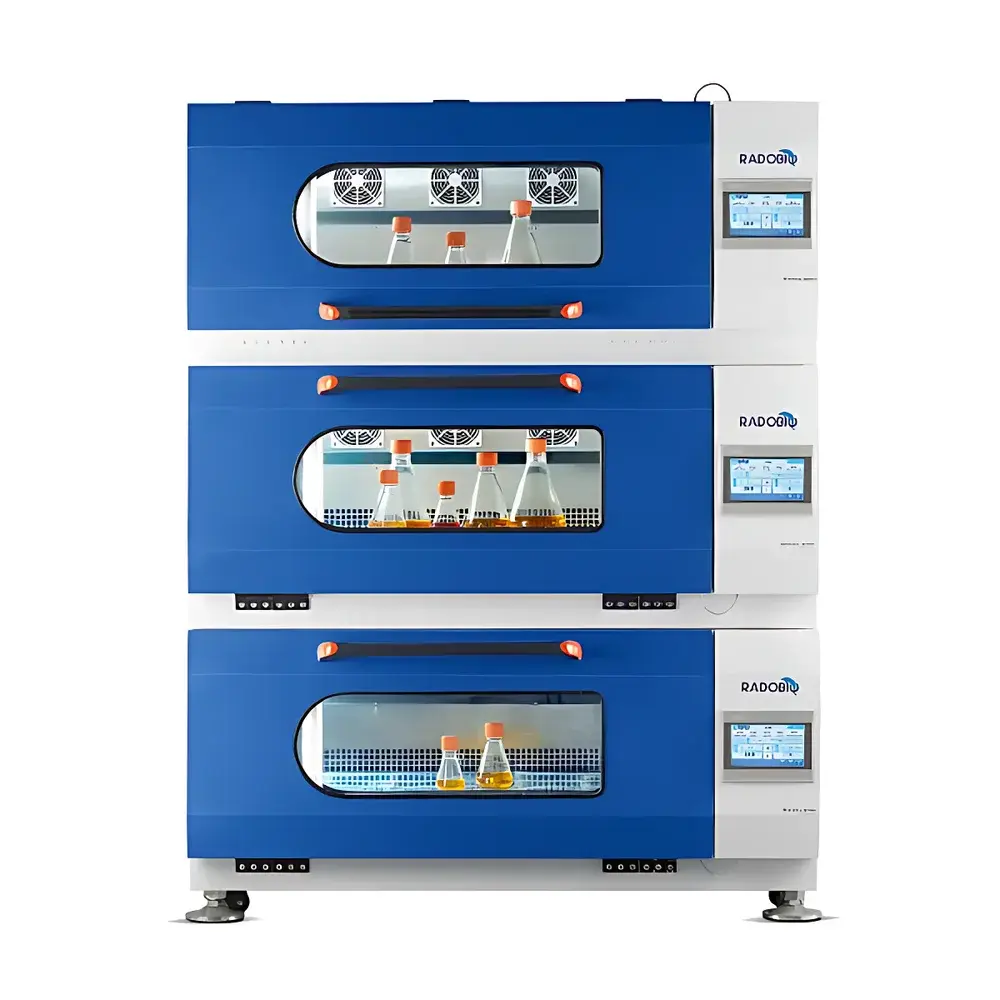
RADOBIO Herocell C1 Advanced CO₂ Orbital Shaker Incubator
| Brand | RADOBIO |
|---|---|
| Origin | Shanghai, China |
| Model | Herocell C1 |
| Instrument Type | CO₂-Regulated Orbital Shaker Incubator |
| Temperature Range | 4–60 °C |
| Timing Range | 0–999.9 h |
| Orbit Diameter Options | 25 mm / 26 mm / 50 mm (custom orbits available) |
| Display | 7″ LCD Touchscreen |
| CO₂ Control Range | 0–20% (IR sensor) |
| CO₂ Accuracy | ±0.1% |
| Temp Uniformity | ±0.3 °C at 37 °C |
| Max Load Capacity | 50 kg per deck |
| Power | 1300 W |
| Internal Volume | 365 L |
| Dimensions (W×D×H) | 1330×820×620 mm (single unit, incl. base) |
| Weight | 220 kg (single unit) |
Overview
The RADOBIO Herocell C1 Advanced CO₂ Orbital Shaker Incubator is an integrated platform engineered for high-fidelity suspension cell culture under precisely controlled environmental conditions. It combines orbital shaking mechanics with active CO₂ regulation, temperature stabilization, and programmable humidity management—enabling reproducible cultivation of sensitive mammalian, insect, and hybridoma cell lines prior to bioreactor scale-up. The system operates on a dual-control principle: CO₂ concentration is continuously monitored and adjusted via a non-dispersive infrared (NDIR) sensor, while temperature is maintained through a PID-regulated heating system coupled with a heat-free, waterproof axial fan that ensures uniform thermal distribution without introducing parasitic heat load. This architecture eliminates cold spots and minimizes gradient deviation across the 365 L chamber volume—critical for maintaining consistent pH in bicarbonate-buffered media and supporting long-term, multi-day culture protocols.
Key Features
- 7-inch capacitive touchscreen interface with intuitive icon-based navigation, multi-segment program editor (up to 30 steps per program), and real-time parameter overlay (temperature, RPM, CO₂ %, elapsed time)
- Orbital motion with selectable orbit diameters (25 mm, 26 mm, or 50 mm) and speed range of 2–300 rpm (±1 rpm resolution), driven by a maintenance-free brushless DC motor and precision-ground bearing assembly ensuring low-vibration, near-silent operation—even during stacked configurations
- Dual-layer tempered safety glass door with integrated anti-fog heating element, enabling uninterrupted visual monitoring under high-humidity or large ΔT conditions
- Modular stacking architecture: supports single-unit floor placement, two-tier (Herocell C1-2), or three-tier (Herocell C1-3) configurations; each unit operates independently with full parameter autonomy
- UV-C sterilization system with multiple strategically positioned lamps and interlocked door safety cutoff (optional), validated to deliver ≥99.9% microbial reduction across all internal surfaces including corners and airflow ducts
- Patented stainless-steel oscillating deck (8 mm thick anodized aluminum with brushed chrome finish), fully retractable for ergonomic vessel loading, and compatible with either reusable eco-adhesive pads or rigid stainless-steel clamps
- Full-chamber environmental uniformity: ±0.3 °C temperature deviation at setpoint (measured at nine points per ICH Q5A Annex 2 protocol), ±0.1% CO₂ accuracy over full 0–20% range, and <±3% RH variation (with optional humidity module)
Sample Compatibility & Compliance
The Herocell C1 accommodates standard laboratory vessels—including Erlenmeyer flasks (125–2000 mL), roller bottles, multi-well plates, and tube racks—without mechanical reconfiguration. Its 520 × 880 mm deck supports up to 77 × 125 mL flasks or 15 × 2000 mL vessels per layer. All internal surfaces are constructed from electropolished 316L stainless steel with seamless radius-curved corners, permitting autoclave-compatible cleaning agents, hydrogen peroxide vapor (HPV), and routine liquid disinfection. The system complies with ISO 13485 design controls for medical device manufacturing environments and supports audit-ready data integrity when paired with optional remote access modules. Data logging adheres to ALCOA+ principles: attributable, legible, contemporaneous, original, accurate—with timestamped entries, user ID tagging, and tamper-evident USB export (800,000 records, configurable interval 30–9999 s). Optional firmware enables 21 CFR Part 11-compliant electronic signatures and role-based access control.
Software & Data Management
The embedded firmware provides local data acquisition at 30-second intervals, storing temperature, CO₂, RPM, and alarm status in non-volatile memory. Historical trend curves are viewable directly on-screen with zoom/pan functionality and exportable as CSV via rear-panel USB-A port. For networked environments, the optional Ethernet/Wi-Fi module enables secure HTTPS-based remote access through a browser-based dashboard—supporting real-time parameter adjustment, live video feed (via external IP camera integration), and automated daily report generation. Audit trails record all configuration changes, user logins, and alarm events with immutable timestamps. Firmware updates are delivered via signed package files, verified cryptographically before installation to ensure system integrity.
Applications
The Herocell C1 serves as a critical upstream tool in biopharmaceutical process development, particularly for transient transfection, monoclonal antibody production, viral vector expansion, and stem cell differentiation studies. Its stable CO₂ environment maintains physiological pH in serum-free and chemically defined media formulations, while precise orbital agitation promotes oxygen transfer and prevents sedimentation in high-density cultures. Common use cases include CHO-K1 and HEK293 suspension adaptation, baculovirus expression system (BEVS) optimization in Sf9 cells, and fed-batch seed train preparation compliant with ICH Q5D guidance. The system is routinely deployed in GLP-compliant toxicology labs, GMP-aligned pilot facilities, and academic core facilities requiring traceable, repeatable, and scalable culture workflows.
FAQ
What CO₂ supply pressure is required for optimal performance?
A regulated inlet pressure of 0.05–0.1 MPa (0.5–1.0 bar) is recommended; higher pressures may cause valve wear or inaccurate IR readings.
Can the Herocell C1 operate at 4 °C with CO₂ enabled?
Yes—the refrigeration-free cooling system achieves 4 °C ambient stabilization using Peltier-assisted heat exchange; CO₂ control remains functional across the full 4–60 °C range.
Is UV sterilization safe for polycarbonate or PETG vessels placed inside?
UV-C exposure is limited to chamber surfaces only; no direct irradiation of samples occurs during routine cycles. Vessels remain unaffected if not exposed to UV for >30 minutes continuously.
How does the system handle power interruption?
All setpoints and runtime state are retained in EEPROM; upon restoration, the unit resumes operation at the exact prior condition and logs the event with timestamp and duration.
What validation documentation is provided with the instrument?
Each unit ships with Factory Acceptance Test (FAT) report, IQ/OQ templates aligned with ASTM E2500, and calibration certificates for CO₂ sensor and PT100 temperature probes.




