
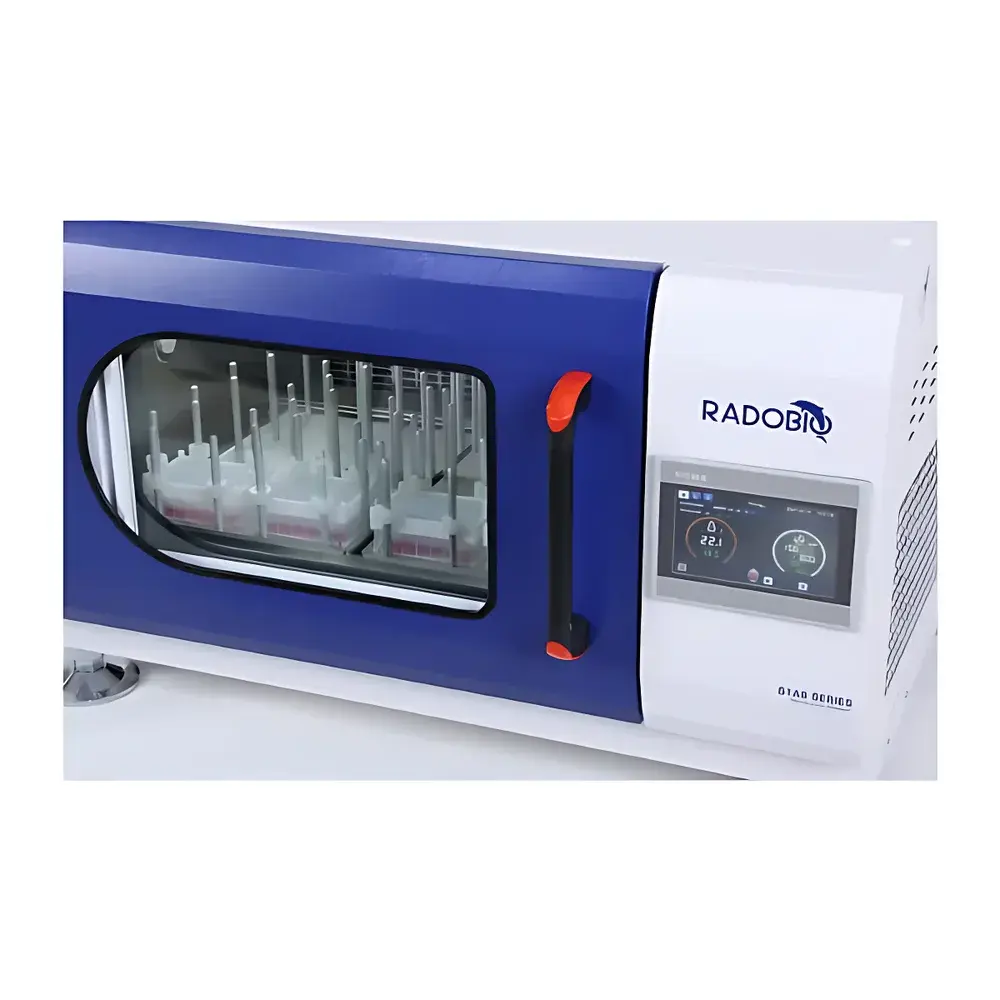
RADOBIO Hispeed CS3 Dual-Motor High-Speed CO₂ Orbital Shaker Incubator
| Brand | RADOBIO |
|---|---|
| Origin | Shanghai, China |
| Model | Hispeed CS3 |
| Instrument Type | Stacked Temperature-Controlled CO₂ Shaker Incubator |
| Timer Range | 0–999.9 h |
| Oscillation Amplitude | 3 mm |
| Temperature Range | 4°C to 60°C |
| Number of Shaking Platforms | 2 |
| Max Speed | 1000 rpm |
| CO₂ Control Range | 0–20% (IR sensor) |
| CO₂ Stability | <1% deviation over 2 years |
| Platform Dimensions | 288 × 404 mm |
| Max Load per Platform | 15 kg |
| Display | 7-inch LCD touchscreen |
| Data Storage Capacity | 800,000 records |
| UV Sterilization System | Dual-position IR-safe UV lamps with door-interlocked safety cutoff |
| Chamber Volume | 215 L |
| Power Supply | 220–240 V, 50–60 Hz |
| Weight (single unit) | 160 kg |
Overview
The RADOBIO Hispeed CS3 Dual-Motor High-Speed CO₂ Orbital Shaker Incubator is an engineered platform for simultaneous temperature-, gas-, and motion-controlled cultivation of suspension-adapted mammalian cells, microbial cultures, and high-throughput screening assays in microplates and shake flasks. It integrates orbital shaking mechanics (3 mm amplitude, 2–1000 rpm range) with precise CO₂ regulation (0–20%, infrared detection), active humidity management (optional), and programmable thermal control (4°C–60°C) within a sealed, sterile chamber. Unlike conventional shakers or standalone incubators, the Hispeed CS3 employs a dual-motor architecture—each motor independently driving one oscillating platform—enabling concurrent experiments under distinct mechanical and environmental conditions. Its design complies with core operational requirements for GLP-compliant cell culture workflows, including traceable parameter logging, alarm-triggered event recording, and power-failure recovery with auto-resume functionality.
Key Features
- Dual independent motor–platform system: Enables simultaneous operation at different speeds (2–1000 rpm), facilitating comparative studies or multi-condition screening without cross-contamination or mechanical coupling.
- 7-inch capacitive touchscreen interface: Supports multi-segment programming (up to 5 programs, each with 30 steps) for temperature, CO₂ concentration, shaking speed, and duration; real-time overlay of trend curves for all monitored parameters.
- Optimized thermal architecture: PID-controlled heating/cooling with ±0.5°C uniformity (at 37°C, ambient 25°C, empty chamber); door-heating function prevents condensation on double-glazed observation window.
- UV sterilization system: Dual-position ultraviolet lamps (254 nm) mounted at top and rear walls; automatic deactivation upon door opening per IEC 61000-4-11 safety compliance.
- Hygienic chamber construction: Seamless, fully welded 304 stainless-steel interior with radius-corner forming; IPX4-rated external housing isolates drive electronics and motors from internal humidity exposure.
- Noise-optimized drivetrain: Precision-ground bearings and balanced counter-rotating mass design achieve ≤52 dB(A) acoustic emission during full-load 1000 rpm operation.
- Modular stacking capability: Units support up to three vertically stacked configurations (CS3, CS3-2, CS3-D2); each layer operates autonomously with independent parameter sets and data logs.
Sample Compatibility & Compliance
The Hispeed CS3 accommodates standard ANSI/SLAS-format microplates (96-, 384-, and 1536-well), deep-well plates (up to 32 per platform), Erlenmeyer flasks (50–2000 mL), and tube racks via optional adhesive silicone mats or stainless-steel clamping fixtures. All internal materials—including chamber gaskets, UV-resistant glass, and silicone-based adhesion pads—are certified non-cytotoxic per ISO 10993-5 and compliant with USP Class VI biocompatibility standards. The CO₂ sensing module meets ASTM D6193 specifications for infrared gas analyzers used in biological incubation systems. Data integrity adheres to FDA 21 CFR Part 11 requirements when paired with audit-trail-enabled software (optional remote module). Environmental testing follows IEC 61000-6-3 (EMC emissions) and IEC 61000-6-2 (immunity).
Software & Data Management
Local control and data acquisition are managed through an embedded Linux-based firmware supporting configurable logging intervals (30 s to 9999 s). Each unit stores up to 800,000 timestamped records—including temperature, CO₂ %, RPM, and alarm status—with cyclic overwrite protection. USB-A port enables encrypted export of CSV-formatted datasets compatible with MATLAB, Python pandas, or LIMS integration. Optional Ethernet/WiFi remote module provides HTTPS-secured access for parameter adjustment, live monitoring, and historical curve replay. All modifications generate immutable audit trails containing operator ID, timestamp, and pre-/post-change values—satisfying ALCOA+ principles for regulated environments.
Applications
- High-density suspension cell culture (CHO, HEK293, Sf9) under controlled pH (via CO₂ buffering) and shear stress (via tunable rpm).
- Microbial growth kinetics and metabolic profiling across combinatorial carbon/nitrogen source arrays.
- Antibody production optimization using 96-well plate formats with parallel agitation and gas modulation.
- Stem cell expansion protocols requiring low-shear orbital motion and strict CO₂ stability (±0.5% over 72 h).
- Enzyme immobilization and biocatalysis screening where mixing efficiency directly impacts reaction yield.
- Long-term stability studies of biologics under accelerated temperature–humidity–agitation stress conditions.
FAQ
What is the minimum operating temperature when refrigeration is engaged?
The unit achieves 4°C minimum setpoint under standard ambient conditions (25°C); performance may vary slightly depending on chamber load and ventilation clearance.
Can both platforms run at different CO₂ concentrations simultaneously?
No—CO₂ concentration is regulated at the chamber level; however, independent temperature and shaking profiles are fully supported per platform.
Is the UV sterilization cycle validated per ISO 15883?
While the UV lamp output and placement follow ISO 15883-1 guidance for surface disinfection, formal validation must be performed in situ by the end user per their SOPs.
Does the system support third-party LIMS integration?
Yes—via RESTful API (available with remote module license) and standardized CSV export; schema documentation provided upon request.
What maintenance is required for long-term CO₂ sensor accuracy?
Annual zero-point calibration using certified 0% CO₂ gas is recommended; factory recalibration service available through RADOBIO authorized centers.



