
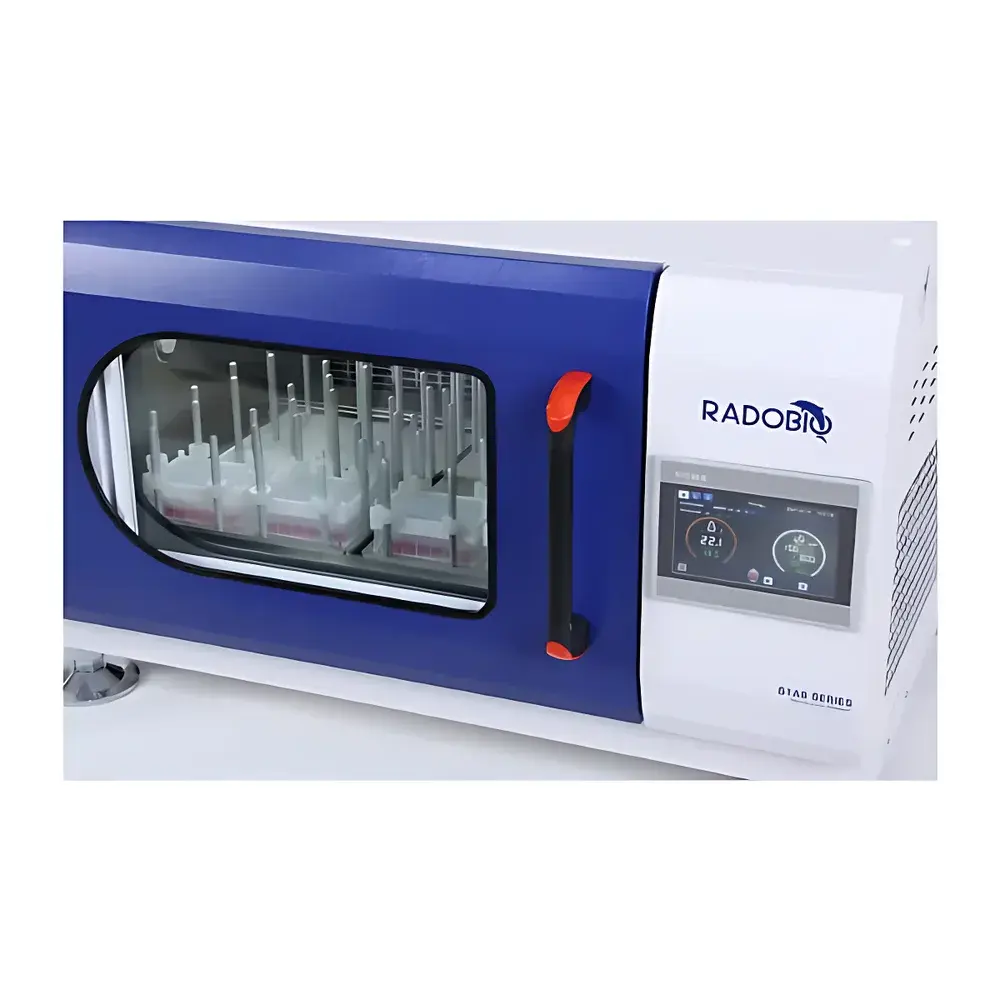
RADOBIO HiSpeed S3 Dual-Motor High-Speed Temperature-Controlled Orbital Shaker Incubator
| Brand | RADOBIO |
|---|---|
| Origin | Shanghai, China |
| Model | HiSpeed S3 |
| Instrument Type | Stackable Temperature-Controlled Shaker |
| Timer Range | 0–999.9 h |
| Oscillation Amplitude | 3 mm |
| Temperature Range | 4 °C to 60 °C |
| Number of Shaking Platforms | 2 |
| Speed Range (Empty Load) | 2–1000 rpm |
| Speed Accuracy | ±1 rpm |
| Temperature Setting Resolution | 0.1 °C |
| Temperature Uniformity | ±0.5 °C (at 37 °C, ambient 25 °C, empty) |
| Platform Dimensions | 288 × 404 mm |
| Max Load per Platform | 15 kg |
| Deep-Well Plate Capacity | 32 plates |
| Internal Volume | 215 L |
| Power Consumption | 1550 W |
| External Dimensions (Single Unit) | 1000 × 725 × 620 mm (L×W×H, incl. base) |
| Net Weight | 160 kg |
| Interface | 7-inch horizontal LCD touchscreen |
| Data Logging | 250,000 records, interval adjustable from 30 s to 9999 s |
| Programs | 5 user-defined, up to 30 segments each |
| Compliance | Designed for GLP-compliant labs |
Overview
The RADOBIO HiSpeed S3 is a dual-motor, high-speed temperature-controlled orbital shaker incubator engineered for precision bioprocess development and high-throughput microbial or mammalian cell culture. It operates on the principle of controlled orbital shaking—generating uniform circular motion at precisely regulated speeds—to ensure optimal oxygen transfer, suspension homogeneity, and nutrient distribution in liquid cultures. Unlike single-motor shakers, the HiSpeed S3 integrates two independent brushless DC motors, each driving a dedicated shaking platform. This architecture eliminates mechanical coupling between platforms and enables simultaneous operation under distinct speed, temperature, and timing profiles—critical for comparative studies, media optimization, or parallel strain screening. Its temperature control system employs adaptive PID algorithms with real-time thermal compensation, maintaining stability across the full 4 °C to 60 °C range—even during rapid ramping or prolonged incubation. The unit’s stainless-steel chamber, double-glazed door with anti-fog heating (optional), and UV-C sterilization module support sterile, reproducible, and contamination-minimized workflows in academic, pharmaceutical, and biotech laboratories.
Key Features
- Dual independent motor–platform system: Enables concurrent experiments at different agitation speeds (2–1000 rpm, ±1 rpm accuracy) without cross-interference.
- 7-inch horizontal capacitive touchscreen interface: Intuitive navigation with color-coded soft keys, multi-segment programmability (up to 30 segments per program), and real-time graphical display of temperature, speed, and elapsed time.
- Robust chamber design: Seamless brushed stainless-steel interior with radius-rounded corners, IPX1-rated water resistance, and external mounting of all heat-sensitive electronics—including motors and power supplies—to prevent condensation-related failure in humid environments.
- Enhanced thermal management: Low-heat, waterproof centrifugal blower ensures uniform air circulation and minimizes parasitic heat load, extending effective operating range without refrigeration assist.
- Integrated safety architecture: Automatic soft-stop/soft-start upon door opening/closing; power-loss recovery with parameter retention and event logging; over-temperature, over-speed, and deviation-triggered audible/visual alarms.
- Modular footprint: Single-unit configuration (1000 × 725 × 620 mm) supports floor-standing or benchtop use; compatible with HiSpeed S3-2 stacked configuration (1000 × 725 × 1170 mm) for space-constrained labs.
Sample Compatibility & Compliance
The HiSpeed S3 accommodates standard microtiter formats—including 96-well, 384-well, and deep-well plates—as well as Erlenmeyer flasks (up to 2 L), test tubes, and custom vessels secured via column-type clamps (32 deep-well plates per platform). Its 3 mm orbital amplitude delivers efficient mixing for low-viscosity suspensions while minimizing shear stress on sensitive eukaryotic cells. The unit complies with IEC 61010-1 for laboratory equipment safety and incorporates design elements aligned with FDA 21 CFR Part 11 requirements—namely, password-protected parameter modification, electronic audit trails for all critical events (e.g., door openings, setpoint changes, alarm triggers), and timestamped USB-exportable datasets with checksum integrity verification. Optional UV-C irradiation (254 nm) operates only when the door is fully closed and interlocked, supporting routine decontamination between runs in GLP/GMP environments.
Software & Data Management
All operational parameters—including temperature, speed, timer, and alarm thresholds—are configured and monitored through the embedded Linux-based firmware. Historical data is recorded at user-defined intervals (30 s to 9999 s), with up to 250,000 entries stored onboard. Each record includes timestamp, setpoints, actual values, and system status flags. Data exports via USB 2.0 port generate CSV files compatible with Excel, MATLAB, or LIMS integration. No proprietary software installation is required: exported logs contain header metadata (model, serial number, firmware version) and adhere to ISO/IEC 17025 traceability conventions. Remote monitoring is supported via optional Ethernet/Wi-Fi module (HiSpeed Connect Kit), enabling secure HTTPS access to live metrics and historical charts through standard web browsers—without exposing internal lab networks.
Applications
- High-throughput microbial growth profiling under varied aeration and agitation conditions.
- Transient transfection optimization in suspension-adapted CHO or HEK293 cells.
- Enzyme kinetics assays requiring precise temperature–agitation coordination.
- Fermentation seed train scaling, including inoculum expansion and pre-culture conditioning.
- Antibiotic susceptibility testing using broth microdilution in 96-well plates.
- Protein expression screening in E. coli BL21(DE3) variants across gradient temperatures and shaking intensities.
FAQ
Can the two platforms operate at different temperatures?
No—the entire chamber maintains a single uniform temperature. However, each platform can run at independently programmed speeds and timers within that shared thermal environment.
Is the UV-C lamp certified to international disinfection standards?
The 254 nm UV-C source meets ISO 15858 requirements for surface decontamination efficacy when operated per manufacturer guidelines (≥30 min exposure, clean quartz window, chamber empty). Validation reports are available upon request.
Does the system support 21 CFR Part 11-compliant electronic signatures?
While the device provides audit-trail-capable logging and user-access controls, full Part 11 compliance requires integration with a validated third-party LIMS or ELN platform that manages role-based permissions and digital signature workflows.
What is the maximum allowable ambient temperature for continuous 60 °C operation?
Rated for uninterrupted use at ambient temperatures ≤35 °C. At higher room temperatures, sustained 60 °C setpoints may trigger thermal derating or intermittent cooling fan activation to preserve compressor longevity.
Are replacement parts—such as platform clamps or UV lamps—available separately?
Yes. All consumables and wear components—including UV-C bulbs (GPH160TQ), column clamps (S3-CLAMP-KIT), and silicone gaskets—are stocked globally and shipped with serialized calibration certificates where applicable.
Related Products




