
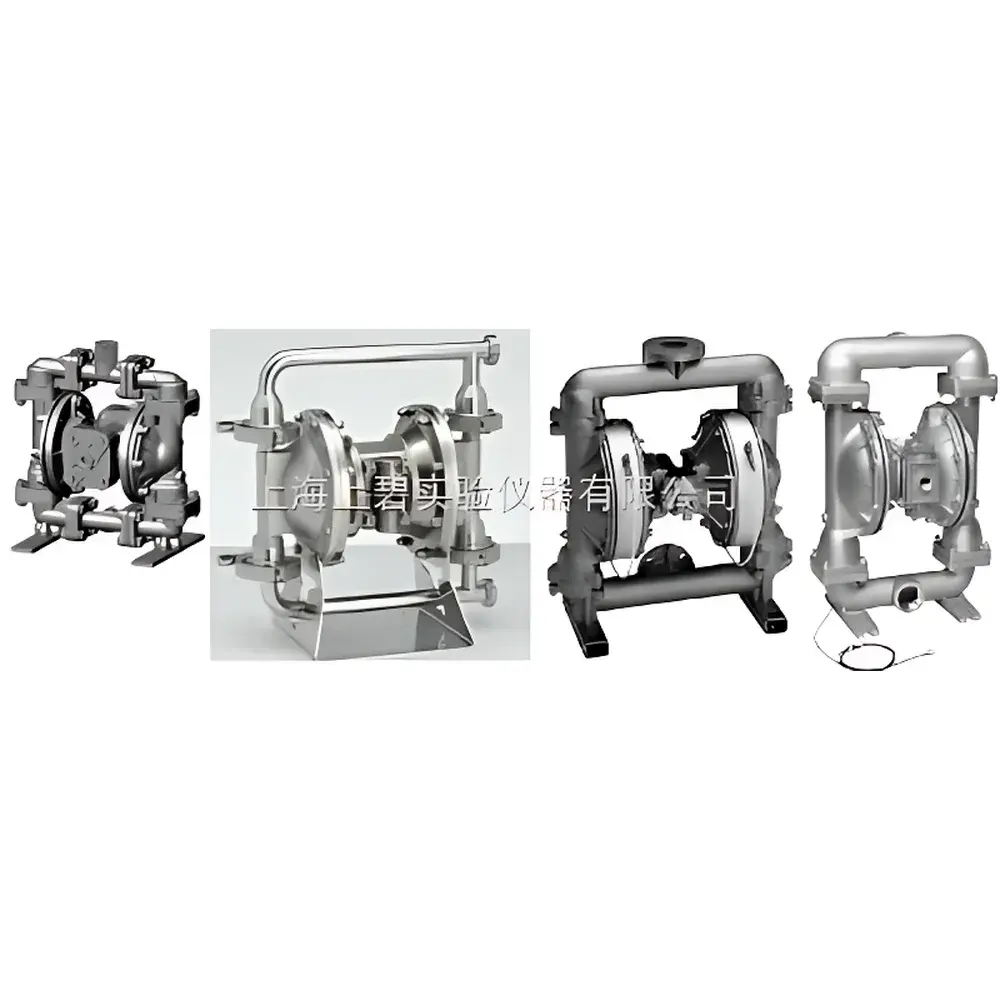
SANDPIPER A-Series and Standard Series Air-Operated Double-Diaphragm (AODD) Pumps by Warren Rupp, Inc.
| Origin | USA |
|---|---|
| Manufacturer Type | Authorized Distributor |
| Origin Category | Imported |
| Model Series | SANDPIPER A-Series & Standard Series |
| Pump Type | Oil-Free Air-Operated Double-Diaphragm (AODD) Pump |
| Key Specifications | Max Discharge Pressure: 8.6 bar (metal) |
| Max Particle Size Handling | Up to 18 mm |
| Flow Rate Range | 15–901 L/min |
| Port Sizes | 0.25″–3″ |
| Diaphragm Materials | Santoprene®, Hytrel®, EPDM, PTFE, Conductive Polypropylene |
| Air Inlet | NPT or BSP |
| Compliance | Designed for ANSI/ASME B16.5, ISO 8502-3, ATEX Zone 1/21 (optional), IECEx, UL/cUL Listed (Class I Div 1, Groups C/D) |
Overview
The SANDPIPER A-Series and Standard Series Air-Operated Double-Diaphragm (AODD) Pumps are engineered for robust, maintenance-resilient fluid transfer in demanding laboratory, pilot-scale, and industrial process environments. Developed by Warren Rupp, Inc.—a U.S.-based manufacturer with over 55 years of specialization in positive displacement pumping technology—these pumps operate on compressed air without electricity, eliminating spark hazards and enabling safe deployment in Class I Division 1 hazardous locations. The core operating principle relies on reciprocating diaphragms actuated by alternating air pressure across dual chambers, generating self-priming suction and positive displacement discharge. This architecture inherently avoids shaft seals, mechanical seals, or lubricated gearboxes, making SANDPIPER AODD pumps ideal for handling abrasive slurries, shear-sensitive biologics, high-viscosity pastes, and chemically aggressive media where contamination, degradation, or downtime must be minimized.
Key Features
- True dry-run capability: Continuous operation without fluid present causes no internal damage—critical for intermittent dosing or low-level sump evacuation.
- Zero leakage design: Dual elastomeric diaphragms isolate process fluid from air circuit; no dynamic seals or packing glands required.
- Adjustable flow control: Precise metering via throttling the air supply pressure (typically 1–7 bar) without need for external bypass or recirculation valves.
- Full self-priming: Capable of lifting fluid up to 6.7 m (22 ft) vertically and evacuating lines up to 9.1 m (30 ft) long without manual priming.
- Modular external air valve system: Simplified field maintenance—valve assembly can be serviced without disassembling wet-end components or removing piping.
- Material flexibility: Wetted path options include aluminum, stainless steel 316, polypropylene, PVDF, and conductive thermoplastics; diaphragms available in EPDM, Viton®, Santoprene®, Hytrel®, and PTFE-laminated composites.
- No electrical power required: Eliminates explosion risk in flammable atmospheres and enables use in remote, mobile, or battery-constrained lab setups.
Sample Compatibility & Compliance
SANDPIPER AODD pumps accommodate a broad spectrum of challenging samples encountered in analytical labs and QC/QA workflows—including ceramic slurries (alumina, silica), pigment dispersions, polymer emulsions, pharmaceutical suspensions, food-grade viscous syrups, wastewater biosolids, and acid/base reagents. Their design conforms to key international safety and performance frameworks: compliant with UL/cUL Listing for Class I, Division 1, Groups C & D (explosion-proof air distribution); optional ATEX/IECEx certification available for Zone 1/21 installations; construction adheres to ASME B16.5 flange standards; materials meet FDA 21 CFR §177.2400 and USP Class VI requirements for selected polymer variants. All metal-bodied models support GMP-aligned cleaning-in-place (CIP) protocols when paired with compatible diaphragm and ball-check materials.
Software & Data Management
While inherently analog in actuation, SANDPIPER AODD pumps integrate seamlessly into automated lab infrastructure via optional digital air pressure regulators (e.g., Parker IQ+ series) and pneumatic flow meters (e.g., Brooks Instrument thermal mass flow sensors). When coupled with PLC-controlled air manifolds and IO-Link–enabled pressure transducers, real-time air consumption, cycle count, and estimated volumetric throughput can be logged into LIMS or MES platforms. Audit trails for pump runtime and air pressure settings support GLP/GMP documentation requirements. No proprietary software is required—data acquisition leverages standard Modbus RTU/TCP or 4–20 mA analog outputs from third-party instrumentation.
Applications
- Transfer of abrasive ceramic slurries (e.g., alumina, zirconia) in materials science labs
- Dosing of shear-thinning polymer solutions in rheology sample preparation
- Recirculation of pH-adjusted buffers in electrochemical cell testing rigs
- Evacuation of spent solvents from fume hood waste collection systems
- Feeding high-solids-content slurries to laser diffraction particle size analyzers
- Handling of non-Newtonian food matrices (e.g., fruit purees, dairy concentrates) in sensory or texture analysis workflows
- Safe transfer of flammable solvents (e.g., acetone, ethanol) in explosion-hazard zones
- Drainage of condensate or coolant from vacuum chamber jackets and chiller loops
FAQ
Can SANDPIPER AODD pumps handle viscous fluids above 10,000 cP?
Yes—flow rate decreases predictably with viscosity, but models with larger port sizes (e.g., S20, S30, A30) maintain stable displacement up to ~50,000 cP when operated at optimal air pressure (4–6 bar) and reduced stroke frequency.
Are replacement diaphragms and ball-checks available as genuine OEM parts?
Yes—Warren Rupp supplies certified replacement kits with traceable material certifications (e.g., RoHS, REACH, FDA-compliant elastomers) through authorized global distributors.
What is the expected service life under continuous lab-use conditions?
With proper air filtration (5 µm coalescing filter recommended) and routine inspection of air valve components, typical mean time between repairs (MTBR) exceeds 12,000 operating hours for standard-duty applications.
Do these pumps comply with FDA 21 CFR Part 11 for electronic records?
The pump itself is analog; however, when integrated with validated digital air control and data logging systems meeting ALCOA+ principles, full Part 11 compliance for operational parameters is achievable.
Is pulsation dampening required for sensitive instrumentation feeding?
For applications requiring laminar feed (e.g., HPLC mobile phase delivery), a pulse-dampening accumulator (e.g., SANDPIPER Model AD-100) is recommended to reduce flow variation to <±5% peak-to-peak amplitude.



