
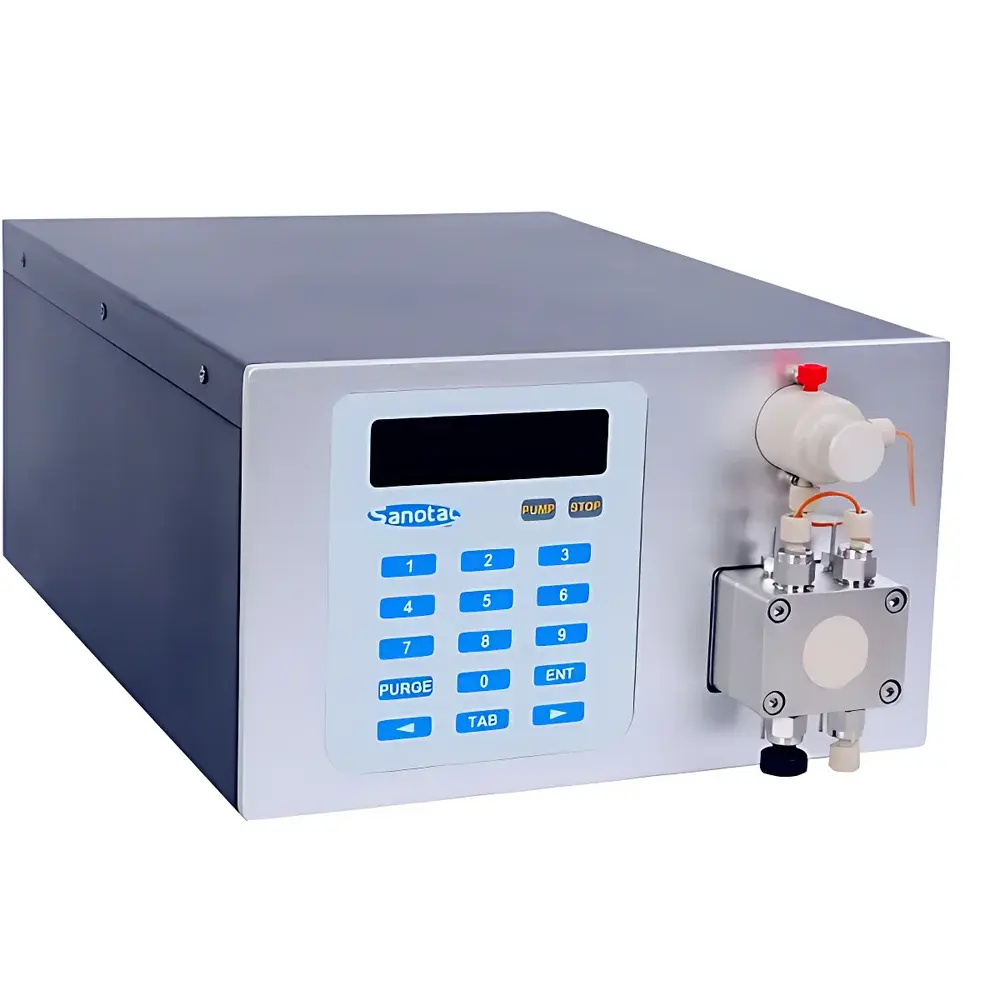
Sanotac AP0013 PEEK High-Pressure Liquid Delivery Pump for Ion Chromatography
| Brand | Sanotac |
|---|---|
| Origin | Shanghai, China |
| Manufacturer Type | Direct Manufacturer |
| Product Category | Domestic |
| Model | AP0013 |
| Instrument Type | Binary Pump |
| Maximum Pressure | 30 MPa |
| Flow Rate Range | 0.001–9.999 mL/min |
| Flow Accuracy | ±0.1% |
| Flow Precision (RSD) | ≤0.1% |
| Pressure Pulsation | ≤0.1 MPa |
| Pump Head Volume | 10 mL |
| Wetted Materials | PEEK, Ruby, PTFE, Ceramic |
| Communication Interfaces | RS232, USB (standard) |
| Display | 256×64 dot matrix LCD with backlight |
| Power Supply | 85–264 VAC, 50 Hz |
| Dimensions | 370 × 240 × 152 mm |
Overview
The Sanotac AP0013 PEEK High-Pressure Liquid Delivery Pump is an engineered solution for precise, pulse-minimized solvent and eluent delivery in ion chromatography (IC) and other demanding analytical and process-critical fluid handling applications. Built on a dual-piston serial architecture with floating piston design, the pump delivers stable, reproducible flow across its full operational range (0.001–9.999 mL/min) at pressures up to 30 MPa. Its all-PEEK fluidic path—complemented by ruby check valves, PTFE seals, and ceramic components—ensures exceptional chemical resistance to strong acids, bases, and aggressive IC eluents (e.g., KOH, methanesulfonic acid), eliminating metal ion leaching and enabling long-term baseline stability in trace anion/cation analysis. Unlike stainless-steel pumps, the AP0013 avoids catalytic surface interactions that compromise separation integrity in low-conductivity or high-sensitivity IC methods. The pump operates on Couette-flow optimized cam profiling combined with real-time electronic pulsation suppression, achieving pressure ripple <0.1 MPa—critical for minimizing detector noise and preserving column lifetime in suppressed conductivity detection systems.
Key Features
- Dual-piston serial configuration with floating piston mechanism for enhanced seal longevity and reduced mechanical hysteresis
- 10 mL PEEK pump head with integrated PEEK inlet/outlet check valves—fully inert to IC-grade eluents and organic modifiers
- Multi-point volumetric flow calibration across the entire range (0.001–9.999 mL/min), supporting trace-level accuracy (±0.1%) and repeatability (RSD ≤0.1%)
- Active pressure pulsation control via synchronized cam profile compensation and digital feedback loop
- Column protection logic with programmable pressure limit setting and zero-offset correction to compensate for thermal drift or viscosity changes
- Rear-column piston washing function using auxiliary solvent line to remove crystalline salt deposits and extend seal service life
- Weight-based closed-loop dosing mode (optional integration with load cells) for gravimetric reactor feed control in catalysis and electrochemical synthesis
- Configurable analog/digital I/O: 0–10 V analog flow setpoint input, dry-contact start/stop, and status relay outputs
Sample Compatibility & Compliance
The AP0013 is validated for use with aqueous eluents (e.g., NaOH, KOH, NH₄HCO₃, HNO₃), organic-aqueous mixtures (e.g., acetonitrile/water), and supercritical CO₂ co-solvents. Its PEEK/ruby/PTFE/ ceramic wetted materials meet USP Class VI biocompatibility requirements and comply with ISO 10993-5 for cytotoxicity. For regulated environments, firmware supports audit-trail-enabled calibration logging and user-access-controlled parameter locking—facilitating alignment with GLP, GMP, and FDA 21 CFR Part 11 requirements when integrated into validated IC workflows. All electrical interfaces conform to IEC 61000-4 electromagnetic compatibility standards.
Software & Data Management
The pump supports native communication via RS232 and USB (standard), with optional RS485/RS422 modules for industrial fieldbus integration. It natively implements Modbus RTU/ASCII and Sanotac’s proprietary ASCII protocol, enabling seamless interoperability with SCADA, DCS, and PLC platforms (including Siemens S7, Rockwell ControlLogix, and Schneider EcoStruxure). The embedded controller allows real-time plotting of flow vs. pressure profiles, progress bar visualization for multi-step gradient programs, and CSV/XLSX export of timestamped flow/pressure logs. Method storage accommodates ≥50 user-defined protocols—including constant, linear ramp, and multi-segment gradient profiles—with one-touch recall and cross-method parameter inheritance. Remote operation is enabled via optional web-based HMI with TLS-secured HTTPS access and role-based authentication.
Applications
- Ion chromatography systems requiring ultra-low background conductivity and minimal metal contamination
- In-line reagent addition in continuous-flow electrochemical reactors and photochemical synthesis units
- Controlled catalyst injection in fixed-bed and slurry-phase hydroprocessing studies
- Supercritical fluid delivery for extraction and particle formation (e.g., RESS, SAS)
- Gravimetrically closed-loop feeding in lab-scale polymerization and battery electrolyte formulation
- Automated sample introduction in hyphenated techniques (e.g., IC-MS, IC-ICP-MS)
- High-pressure liquid delivery in microfluidic assay platforms and chip-based electrophoresis systems
FAQ
What eluents are compatible with the AP0013’s PEEK fluid path?
Aqueous alkalis (up to 100 mM KOH), mineral acids (up to 100 mM HNO₃), ammonium carbonate/bicarbonate buffers, and polar organic solvents (e.g., methanol, acetonitrile) at concentrations ≤40% v/v are fully compatible. Avoid prolonged exposure to concentrated HF, hot chlorinated solvents, or strong oxidizers above 80 °C.
Can the AP0013 be integrated into a PLC-controlled pilot plant?
Yes—via RS485 Modbus RTU or discrete I/O signals, it supports deterministic cycle times (<50 ms) and retains operational state during brief network interruptions.
Is flow calibration traceable to NIST standards?
Calibration is performed using gravimetric measurement against certified reference weights and time-stamped stopwatches per ASTM D3427; certificate of conformance includes uncertainty budget per ISO/IEC 17025 guidelines.
Does the pump support gradient elution in ion chromatography?
Yes—the dual-pump configuration enables binary gradient formation with independent flow control and synchronized pressure compensation across both channels.
What maintenance intervals are recommended for routine operation?
PEEK check valves and seals require inspection every 6 months under continuous IC use; piston wash cycles should execute automatically after each run sequence when enabled.




