
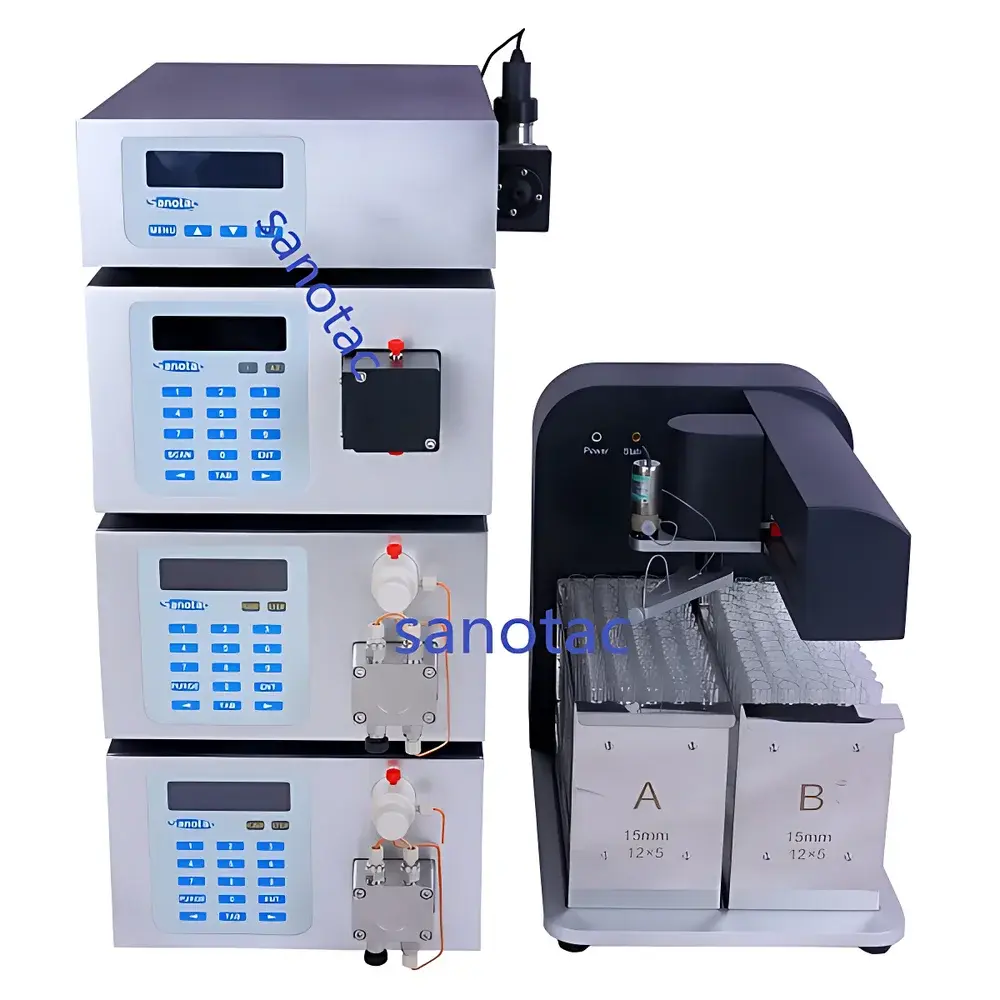
Sanotac Biolot200 Preparative Liquid Chromatography System for Nucleic Acid and Protein Purification
| Brand | Sanotac |
|---|---|
| Origin | Shanghai, China |
| Manufacturer Type | Manufacturer |
| Product Category | Domestic |
| Model | Biolot200 |
| Application Level | Laboratory-Scale |
| Instrument Type | Medium-Low Pressure Preparative LC |
| Flow Rate Range | 0.01–200.00 mL/min |
| Flow Accuracy | ±1% |
| Flow Precision (RSD) | ≤0.5% |
| Maximum Pressure | 10 MPa |
| Wavelength Range | ±1 nm |
| Wavelength Repeatability | 0.2 nm |
| Baseline Noise | ±0.75×10⁻⁵ AU (254 nm, TC = 1 s) |
| Data Acquisition Frequency | 10 Hz |
Overview
The Sanotac Biolot200 is a medium-low pressure preparative liquid chromatography system engineered specifically for the isolation and purification of biomolecules—including proteins, nucleic acids (DNA/RNA), peptides, monoclonal antibodies, viral vectors, insulin analogs, recombinant enzymes, synthetic oligonucleotides, and primers. It operates on the principle of liquid-phase separation under controlled hydrodynamic conditions, utilizing high-precision PEEK piston pumps to deliver stable, pulse-free solvent gradients across chromatographic columns packed with affinity, ion-exchange, size-exclusion, or hydrophobic interaction media. Designed for laboratory-scale process development, the system supports method scouting, column packing evaluation, resin screening, and small-to-medium scale purification (milligram-to-gram quantities), bridging the gap between analytical characterization and early-stage process validation.
Key Features
- Modular architecture with interchangeable detection modules: dual-wavelength UV/Vis detector (190–800 nm), integrated conductivity and pH sensors, and optional refractive index detection—enabling real-time monitoring of multiple physicochemical parameters during elution.
- PEEK fluidic path throughout the entire flow path ensures exceptional biocompatibility, chemical resistance to common buffers (e.g., Tris-HCl, sodium acetate, guanidine HCl), and minimal metal ion leaching—critical for preserving structural integrity of sensitive biomolecules.
- High-accuracy dual-piston pump with active backpressure regulation delivers flow stability at ≤0.5% RSD across the full range (0.01–200 mL/min) and maintains pressure control up to 10 MPa, accommodating both soft gel matrices and rigid monolithic or polymer-based resins.
- Automated fraction collector with dual 60-position racks (15 mm × 150 mm tubes) supports programmable collection modes: time-based, peak-triggered, volume-triggered, loop cycling, and multi-step sequential collection—ensuring reproducible recovery of target fractions under varying elution profiles.
- Intelligent gradient generation engine supports linear, stepwise, and custom-defined gradients; allows real-time adjustment of composition during runtime and offers ±0.5% absolute buffer concentration resolution in AB solvent mixing.
- Self-cleaning pump head design minimizes crystallization risk from volatile buffers (e.g., ammonium acetate) and reduces carryover between runs—enhancing long-term operational reliability and reducing manual maintenance intervals.
Sample Compatibility & Compliance
The Biolot200 accommodates a broad spectrum of biological samples—from crude lysates and clarified supernatants to partially purified intermediates—without requiring extensive prefiltration. Its low-shear, low-turbulence flow path preserves quaternary structure and activity of labile proteins and nucleic acid complexes. The system conforms to GLP-compliant operation standards and supports audit-trail-enabled workflows per FDA 21 CFR Part 11 requirements, including electronic signatures, user access controls, method versioning, and immutable data logging. All hardware components meet IEC 61010-1 safety specifications, and the PEEK-based wetted parts comply with USP Class VI biocompatibility testing criteria.
Software & Data Management
Controlled via BioView™ PC-based workstation software (Windows 10/11 compatible), the system provides intuitive graphical interface for method creation, instrument parameter configuration, real-time chromatogram visualization, and post-run analysis. Method files store complete instrument settings—including pump profiles, detector wavelengths, collection logic, and valve switching sequences—with timestamped execution logs. Raw data are saved in vendor-neutral ASCII format (.csv) and proprietary .bvd binary format, both supporting third-party integration with LIMS and ELN platforms. Software validation documentation—including IQ/OQ protocols and traceability matrices—is available upon request for regulated environments.
Applications
- Development and optimization of purification protocols for therapeutic monoclonal antibodies and Fc-fusion proteins using Protein A, ion exchange, or multimodal resins.
- Isolation of plasmid DNA and mRNA from bacterial or in vitro transcription reactions prior to downstream formulation or transfection studies.
- Desalting and buffer exchange of synthetic peptides following solid-phase synthesis.
- Purification of viral vectors (AAV, lentivirus) through iodixanol gradient centrifugation support or affinity capture columns.
- Process characterization of biosimilar candidates under varying pH, conductivity, and gradient slope conditions.
- Recovery of enzymatically active recombinant proteins expressed in E. coli, yeast, or mammalian cell culture systems.
FAQ
What types of chromatographic techniques can the Biolot200 support?
It supports affinity, ion exchange (IEX), hydrophobic interaction (HIC), size exclusion (SEC), and reversed-phase (RP) chromatography—provided appropriate columns and mobile phases are selected.
Is the system suitable for GMP pilot production?
While designed primarily for lab-scale development and process transfer, its compliance-ready software, hardware traceability, and robust engineering allow qualification for non-sterile intermediate manufacturing steps under GMP Annex 15 guidelines.
Can the UV detector perform simultaneous dual-wavelength measurements?
Yes—the detector uses a dual-lamp source (deuterium + tungsten) with automatic lamp switching and independent wavelength selection for two concurrent channels (e.g., 280 nm for protein and 260 nm for nucleic acid).
Does the system include column oven or temperature control options?
Temperature regulation is not built-in but can be integrated externally via third-party column heaters compatible with standard 1/16″ stainless steel or PEEK tubing connections.
How is data integrity ensured during extended purification runs?
All acquisition events—including detector signals, pump status, valve positions, and fraction triggers—are logged with millisecond timestamps in encrypted binary archives, with checksum verification and automated backup to network drives.
Related Products





