
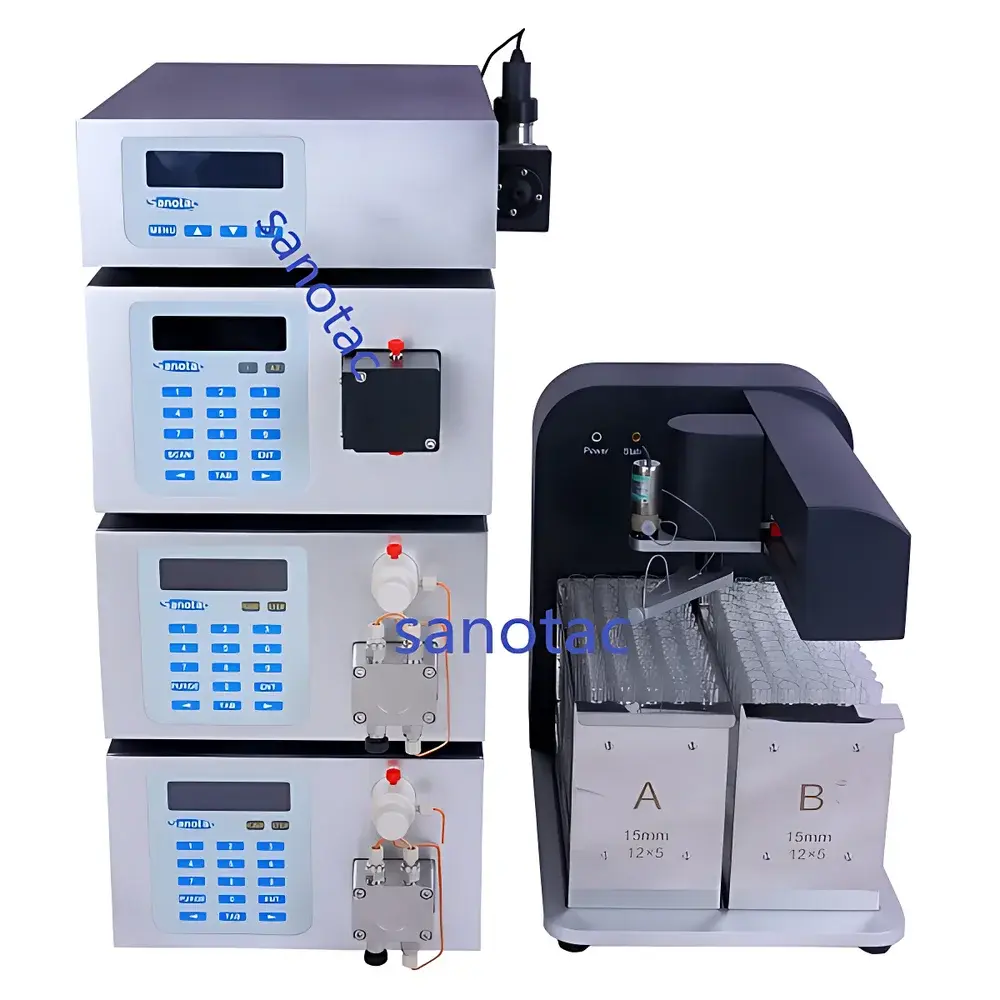
Sanotac BQ1020 Automated Protein Purification System
| Brand | Sanotac |
|---|---|
| Origin | Shanghai, China |
| Manufacturer Type | OEM Manufacturer |
| Region of Origin | Domestic (China) |
| Model | BQ1020 |
| Price Range | USD 7,000 – 14,000 (FOB Shanghai) |
| Purification Principle | Affinity Chromatography (AC) |
| Detector Types | UV-Vis, pH, Conductivity |
| UV Wavelength Range | 190–800 nm |
| Pump Material | PEEK |
| Flow Rate Range | 0.01–200.00 mL/min |
| Flow Accuracy | ≤±1% |
| Maximum Pressure | 20 MPa |
| Pressure Pulsation | ≤0.1 MPa |
| Gradient Modes | Linear, Isocratic, Real-time Gradient Editing |
| Minimum Gradient Increment | 1% |
| UV Light Source | Imported Deuterium + Tungsten Lamp |
| Wavelength Accuracy | ±1 nm |
| Absorbance Range | 0–2 AU |
| Conductivity Range | 0–999.9 mS/cm |
| pH Range | 0–14 |
| Fraction Collector | Dual 60-tube rack (15 mm × 150 mm) |
| Collection Modes | Sequential, Loop, Trigger-based |
| Sample Injection | Manual 10 mL loop (optional 20 mL) |
| Sample Introduction | Liquid or solid-phase loading |
| Power Supply | 220 V ±10%, 50 Hz |
| Control Interface | RS-232 / USB |
| Software Platform | Windows 10/8/7-based workstation |
| Compliance | FDA 21 CFR Part 11 (Audit Trail, Electronic Signatures, User Access Control) |
Overview
The Sanotac BQ1020 Automated Protein Purification System is an engineered solution for high-fidelity, scalable purification of recombinant proteins, monoclonal antibodies, peptides, and other biopharmaceutical macromolecules. Built upon a robust low-pulse PEEK pump architecture and integrated multi-parameter detection, the system implements affinity chromatography (AC) as its primary separation mechanism—leveraging immobilized ligands such as Protein A, Ni-NTA, or glutathione to selectively capture target biomolecules under controlled buffer conditions. Its modular design supports both analytical-scale optimization and preparative-scale processing (up to 200 mL/min), enabling seamless method transfer from R&D to process development. The system operates within a pressure envelope of 0–20 MPa, accommodating rigid media such as agarose-, silica-, or polymer-based resins commonly used in AC, ion exchange (IEX), and size exclusion (SEC) workflows. All fluidic pathways are chemically inert and low-binding, minimizing non-specific adsorption and ensuring reproducible recovery across repeated runs.
Key Features
- High-precision dual-wavelength UV-Vis detector with imported deuterium/tungsten lamp source, delivering stable baseline performance across 190–800 nm (±1 nm wavelength accuracy, 0–2 AU linear absorbance range)
- Simultaneous real-time monitoring of UV absorbance, conductivity (0–999.9 mS/cm), and pH (0–14) via calibrated inline sensors—enabling dynamic gradient validation and elution profiling
- PEEK-based binary gradient pump with flow rate programmability from 0.01 to 200.00 mL/min and ≤±1% volumetric accuracy at all setpoints
- Automated fraction collector supporting dual 60-position racks (15 mm × 150 mm tubes) with trigger-based, sequential, and loop collection modes
- Integrated manual injection valve with standard 10 mL loop (20 mL optional), compatible with both liquid sample loading and solid-phase dissolution protocols
- FDA 21 CFR Part 11-compliant software platform featuring role-based user access control, electronic signatures, full audit trail logging, and data integrity safeguards
Sample Compatibility & Compliance
The BQ1020 accommodates diverse sample matrices including clarified mammalian cell culture supernatants, bacterial lysates, plasma-derived fractions, and plant or microbial extracts. It supports standard resin chemistries—including Protein A/G/L, His-tag chelators, GST, antibody fragments, and lectin-based matrices—without requiring hardware modification. System validation documentation aligns with ICH Q5A(R2), USP , and ISO 13485 requirements for equipment qualification in regulated environments. All electronic records adhere to ALCOA+ principles (Attributable, Legible, Contemporaneous, Original, Accurate, Complete, Consistent, Enduring, Available), satisfying GLP and GMP audit expectations for biologics process development labs.
Software & Data Management
Control and analysis are executed through a native Windows-based workstation application optimized for chromatographic method development. The interface supports drag-and-drop gradient programming, real-time overlay of multiple detector signals (UV280, UV260, pH, conductivity), and automatic peak integration using configurable threshold and baseline algorithms. Raw data files (.raw) are stored in vendor-neutral HDF5 format with embedded metadata (method parameters, timestamps, operator ID, instrument configuration). Export options include CSV, PDF reports, and XML for LIMS integration. Audit trail entries record every parameter change, login/logout event, and file export action—timestamped and digitally signed per 21 CFR Part 11 Subpart B requirements.
Applications
- Purification of therapeutic monoclonal antibodies (mAbs) and antibody-drug conjugates (ADCs) using Protein A affinity capture
- Isolation of His-tagged recombinant proteins from E. coli or insect cell expression systems
- Downstream processing of viral vectors and plasmid DNA for gene therapy applications
- Preparative isolation of glycoproteins, cytokines, and growth factors from serum or tissue homogenates
- Multi-step purification of vaccine antigens (e.g., virus-like particles, subunit proteins) under cGMP-aligned workflows
- Process characterization studies including column loading capacity, binding kinetics, and cleaning-in-place (CIP) validation
FAQ
Does the BQ1020 support method transfer between different flow rates or column dimensions?
Yes—the system’s flow calibration and pressure compensation algorithms maintain consistent residence time and gradient delivery across scale-up scenarios, provided column void volume and bed height ratios are preserved.
Can third-party resins be used without compromising system validation?
Absolutely—the BQ1020 imposes no proprietary resin restrictions; users may qualify any commercially available chromatographic medium meeting mechanical stability and chemical compatibility specifications.
Is remote monitoring or cloud-based data backup supported?
Local network connectivity (Ethernet/USB) enables remote desktop access via IT-approved protocols; however, cloud storage requires on-premise server deployment due to data sovereignty and regulatory constraints in biopharma environments.
What maintenance intervals are recommended for pump seals and UV lamp replacement?
PEEK pump seals are rated for ≥10,000 hours of continuous operation; deuterium lamps require replacement every 1,200–1,500 operating hours, with automated usage tracking built into the software.
How does the system handle viscous or particulate-containing feed streams?
In-line 0.45 µm pre-filters and adjustable backpressure regulation mitigate clogging risks; for high-viscosity samples (e.g., lysates >10 cP), flow rate ramping and pulse-dampening settings are configurable to preserve column integrity.




