
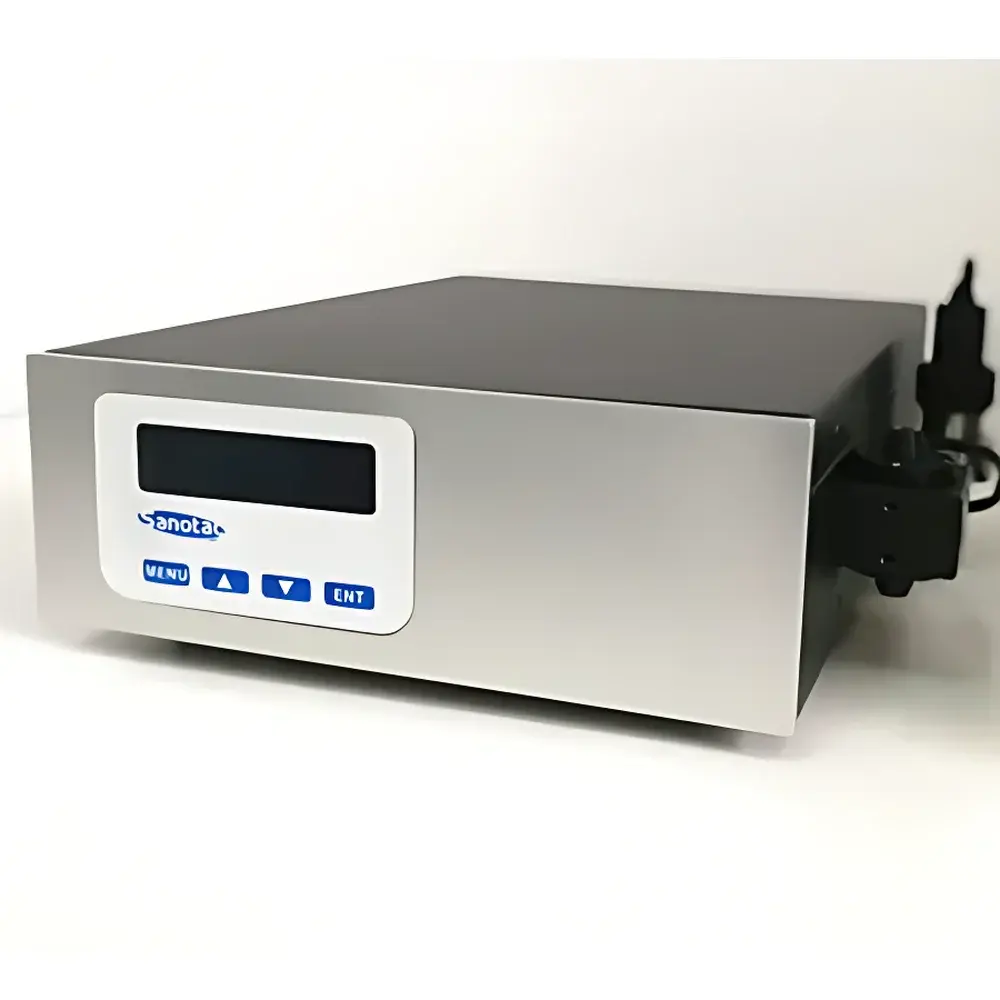
Sanotac C1000 Dedicated Conductivity Detector for Protein Purification Systems
| Brand | Sanotac |
|---|---|
| Model | C1000 |
| Application | In-line conductivity detection for chromatographic protein purification |
| Conductivity Range | 1 µS/cm to 500 mS/cm |
| Temperature Range | 0–99 °C |
| Temperature Accuracy | ±1 °C |
| Conductivity Accuracy | ±2% FS |
| Flow Rate Compatibility | 100–1000 mL/min |
| Tubing Connection | 1/8" (3.2 mm) compression fitting |
| Display | 256×64 dot-matrix backlit LCD |
| Control Interface | Front-panel keypad + PC-based software with remote control capability |
| Power Supply | 85–264 VAC, 50 Hz |
| Dimensions (W×D×H) | 370 × 240 × 95 mm |
| Compliance | FDA 21 CFR Part 11 (audit trail, electronic signature, role-based user access), GLP/GMP-ready architecture |
Overview
The Sanotac C1000 Dedicated Conductivity Detector is an in-line, high-fidelity electrochemical sensor engineered specifically for integration into preparative liquid chromatography systems used in biopharmaceutical process development and manufacturing. Operating on the principle of two-electrode AC conductivity measurement, the C1000 delivers real-time, temperature-compensated conductivity data across a broad dynamic range—from ultra-low ionic strength buffer exchange conditions (1 µS/cm) to high-salt elution steps (up to 500 mS/cm). Its design prioritizes signal stability under variable flow dynamics, minimizing baseline drift during gradient elution or stepwise buffer switching—critical for accurate fraction collection and process monitoring in protein purification workflows. The detector’s robust stainless-steel flow cell and optimized electrode geometry ensure minimal polarization effects and high reproducibility across repeated runs, supporting consistent method transfer between R&D, pilot-scale, and GMP production environments.
Key Features
- Wide linear conductivity range (1 µS/cm to 500 mS/cm) with automatic range switching and built-in temperature compensation (0–99 °C)
- High-flow compatibility (100–1000 mL/min) with low-pressure drop (<0.2 bar at 1000 mL/min), optimized for medium-pressure FPLC and AKTA-class systems
- Modular 1/8″ Swagelok-compatible fluidic interface enabling rapid installation and leak-tight integration into existing chromatography manifolds
- Dual-mode operation: standalone front-panel control with intuitive menu navigation or full remote control via PC workstation software
- Low-noise analog signal output (0–5 V or 4–20 mA) and digital USB/RS-232 interfaces for seamless synchronization with third-party data acquisition platforms
- Self-diagnostic firmware with real-time status reporting—including electrode health monitoring, temperature sensor validation, and flow integrity alerts
Sample Compatibility & Compliance
The C1000 is validated for use with aqueous biological buffers commonly employed in chromatographic purification—including Tris-HCl, sodium acetate, phosphate, and arginine-based formulations—as well as high-conductivity chaotropic agents such as ammonium sulfate and guanidine hydrochloride. It is compatible with common biocompatible tubing materials (PEEK, PTFE, fluorinated ethylene propylene) and resistant to cleaning-in-place (CIP) solutions up to 1 M NaOH. From a regulatory perspective, the device supports compliance with ICH Q5A/Q5B, USP , and ISO 13485 requirements for analytical instrumentation used in biologics manufacturing. Its embedded software architecture adheres strictly to FDA 21 CFR Part 11 mandates, providing full audit trail logging, time-stamped operator actions, electronic signatures with cryptographic binding, and role-based permission levels (Administrator, Operator, Reviewer).
Software & Data Management
The Sanotac ChromoView™ PC software (Windows 10/11, 64-bit) serves as the primary interface for configuration, calibration, and real-time data visualization. It supports multi-channel acquisition (conductivity + optional pH or UV if integrated), customizable alarm thresholds, and automated calibration protocols with traceable reference standards. All raw and processed data are stored in encrypted, tamper-evident .CDF (Common Data Format) files compliant with ASTM E1702 and EU Annex 11 expectations. The software includes batch-level metadata tagging (operator ID, system ID, method version, timestamp), export to CSV/PDF for QA review, and direct integration with LIMS via ODBC or RESTful API. Audit trails are immutable and exportable in PDF/A format for regulatory submission.
Applications
- Monitoring conductivity gradients during ion-exchange chromatography (IEX) of monoclonal antibodies and bispecifics
- Real-time tracking of buffer exchange efficiency in desalting and diafiltration steps (e.g., SEC, size-exclusion chromatography)
- Verification of wash/elution transitions in affinity purification (Protein A, Ni-NTA, GST-tag systems)
- Process analytical technology (PAT) implementation for Quality-by-Design (QbD) workflows per ICH Q8/Q9
- Supporting comparability studies during process scale-up or site transfer
- Validation of cleaning cycles in multi-product facilities through conductivity spike recovery testing
FAQ
Is the C1000 compatible with non-Sanotac chromatography systems?
Yes—the C1000 features universal analog/digital outputs and standard 1/8″ fluidic connections, enabling integration with GE Cytiva AKTA, Bio-Rad NGC, Tosoh EcoSEC, and other major FPLC/HPLC platforms.
Does the detector require periodic recalibration during routine operation?
While factory calibration is stable for ≥6 months under normal lab conditions, Sanotac recommends quarterly verification using NIST-traceable KCl standards (e.g., 1413 µS/cm and 12.88 mS/cm) per internal SOP or regulatory filing requirements.
Can the C1000 be used in sterile or closed-system applications?
It is designed for external in-line mounting upstream or downstream of column manifolds; the flow cell is not sterilizable by autoclave but is compatible with gamma irradiation (upon request) and SIP (steam-in-place) at ≤121 °C for ≤30 min when installed with appropriate thermal isolation.
What level of cybersecurity is implemented in the ChromoView™ software?
The software enforces TLS 1.2+ encrypted communication, Windows Active Directory authentication, and local database encryption using AES-256; all remote access functions are disabled by default and require explicit administrator enablement.
Is technical support available for method development and IQ/OQ/PQ documentation?
Yes—Sanotac provides application engineering support, pre-validated IQ/OQ protocols (aligned with ASTM E2500 and ISPE GAMP 5), and on-site qualification assistance for GMP-compliant installations.




