
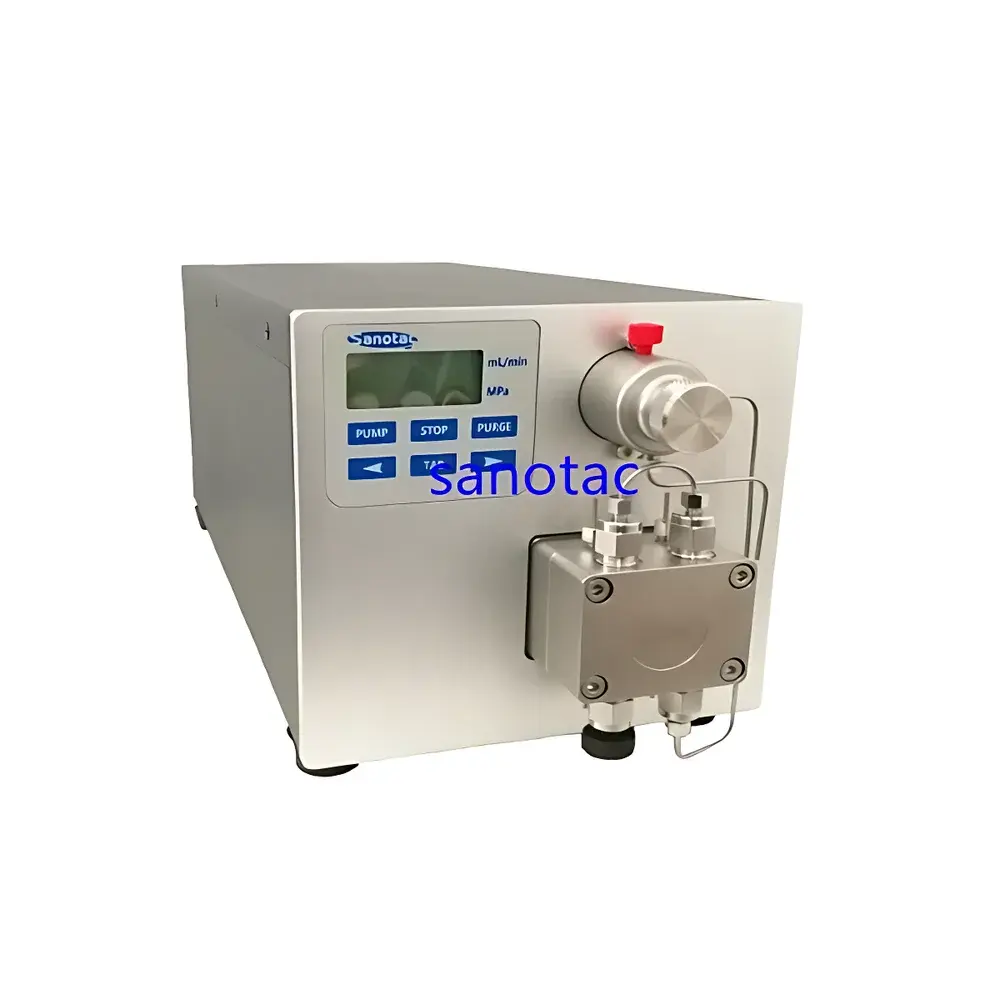
Sanotac CH0011 Analytical High-Pressure Solvent Delivery Pump for Catalyst Evaluation Systems
| Brand | Sanotac |
|---|---|
| Origin | Shanghai, China |
| Manufacturer Type | Direct Manufacturer |
| Product Category | Domestic |
| Model | CH0011 |
| Price Range | USD 1,400 – 2,800 |
| Flow Rate | 0.001–9.999 mL/min |
| Increment | 0.001 mL/min |
| Flow Accuracy | ±0.1% |
| Flow Precision (RSD) | ≤0.1% |
| Maximum Pressure | 42 MPa |
| Pressure Pulsation | ≤0.1 MPa |
| Pump Head Volume | 10 mL |
| Fluidic Path Materials | 316L Stainless Steel, Sapphire, PTFE, Ceramic |
| Tubing Connection | 1/16" Standard |
| Display | 256×64 Dot Matrix LCD with Backlight |
| Control Interface | Front Panel Keypad + RS232/USB Computer Remote Control (Open Protocol) |
| Power Supply | 85–264 VAC, 50 Hz |
| Dimensions (W×D×H) | 370×240×152 mm |
| Pumping Mechanism | Dual-Piston Serial Configuration with Floating Piston Design |
Overview
The Sanotac CH0011 Analytical High-Pressure Solvent Delivery Pump is an engineered precision fluid handling system designed specifically for integration into catalyst evaluation rigs, fixed-bed reactors, and continuous-flow catalytic testing platforms. It operates on the principle of dual-piston serial displacement with floating piston architecture—enabling stable, pulse-minimized delivery across a wide dynamic flow range (0.001–9.999 mL/min) under sustained pressures up to 42 MPa. Unlike generic constant-flow peristaltic or diaphragm pumps, the CH0011 employs microprocessor-controlled solvent compressibility compensation and multi-point flow calibration algorithms to maintain metrological integrity across varying mobile phase densities and viscosities—critical when delivering corrosive or high-boiling solvents (e.g., HCl in methanol, supercritical CO₂ co-solvents, or molten salt precursors) in heterogeneous catalysis studies.
Key Features
- Dual-piston serial pumping mechanism with floating piston design reduces mechanical stress on sealing components, extending seal lifetime by >300% compared to rigid-column alternatives.
- Real-time electronic pulse suppression combined with optimized cam-profile actuation achieves pressure pulsation ≤0.1 MPa—essential for maintaining stable reactor inlet conditions and minimizing baseline drift in inline UV/Vis or conductivity detection.
- Integrated gradient capability supports isocratic, linear, and stepwise solvent composition programming—enabling rapid screening of feedstock composition effects on catalyst deactivation kinetics or selectivity profiles.
- Fluidic path constructed from chemically inert materials: 316L stainless steel wetted surfaces, sapphire check valves, PTFE seals, and ceramic plungers—validated for compatibility with halogenated solvents, strong acids (up to 6 M HCl), and amine-based reaction media.
- Open-protocol RS232/USB interface allows seamless integration with third-party control systems (e.g., LabVIEW, MATLAB, or custom PLC-based reactor automation), supporting full remote parameter setting, real-time status monitoring, and audit-trail logging.
- Front-panel interface with backlit 256×64 dot-matrix display enables standalone operation; stores up to 10 user-defined methods including flow rate ramps, pressure hold sequences, and multi-step gradient profiles.
Sample Compatibility & Compliance
The CH0011 is routinely deployed in ASTM D7213-compliant catalyst aging protocols, ISO 17225-4 biomass conversion trials, and USP method development for pharmaceutical intermediate synthesis. Its material construction meets FDA-relevant extractables/leachables criteria for GMP-aligned process analytical technology (PAT) applications. All firmware and control logic are designed to support GLP/GMP audit requirements—including electronic signature-capable method locking, time-stamped event logs, and password-protected configuration changes. No external lubricants or elastomeric seals contact the fluid stream, eliminating risk of organic contamination during long-duration stability tests (>500 h continuous operation).
Software & Data Management
The pump’s embedded controller records timestamped operational metadata—including actual vs. setpoint flow deviation, pressure transients, motor current draw, and thermal drift—into non-volatile memory. Exportable CSV logs are compatible with LIMS environments and support 21 CFR Part 11 compliance when paired with validated workstation software (e.g., Empower™ or Chromeleon™ via optional driver). The open communication protocol permits custom scripting for adaptive feedback loops—for instance, modulating flow rate in response to inline FTIR-measured reactant conversion or adjusting gradient slope based on real-time GC-FID peak area ratios.
Applications
- Continuous-flow hydrogenation, hydrodesulfurization (HDS), and Fischer–Tropsch synthesis under elevated pressure (≤42 MPa) and temperature (≤300 °C with compatible reactor interface).
- In situ kinetic profiling of supported metal catalysts using pulse-response or transient isotopic labeling techniques requiring sub-milliliter reproducibility.
- Preparative-scale chiral separation for asymmetric catalysis product isolation, where consistent flow delivery directly impacts enantiomeric excess (ee) reproducibility.
- Multi-stream reagent dosing in combinatorial catalyst libraries, enabling parallel evaluation of >24 formulations with independent flow control per channel (when used in multi-pump configurations).
- Calibration and validation of online process analyzers (e.g., Raman spectrometers or tunable diode laser absorption sensors) in pilot-scale chemical reactors.
FAQ
Is the CH0011 suitable for use with aggressive solvents such as concentrated HF or fuming nitric acid?
The standard fluidic path is not rated for HF or fuming HNO₃. Optional PCTFE- or Hastelloy C-276–configured variants are available upon request and require full material compatibility review prior to deployment.
Can the pump be operated in constant-pressure mode?
No—the CH0011 is a constant-flow volumetric displacement pump. For pressure-regulated delivery, it must be paired with an external back-pressure regulator (BPR) and flow sensor in closed-loop configuration.
Does the pump support gradient mixing at the source (low-pressure mixing) or only high-pressure binary blending?
The CH0011 is a single-channel high-pressure pump. Gradient formation requires external low-pressure quaternary mixing modules or integration with a second CH0011 unit in a dual-pump configuration.
What is the recommended maintenance interval for piston seals under continuous 42 MPa operation?
With proper filtration (≤0.22 µm pre-filtering) and solvent degassing, sapphire/PTFE seals demonstrate ≥6,000 hours MTBF at ≤35 MPa; seal replacement is advised every 12 months under full-specification duty cycles.
Is firmware update capability available over USB without vendor intervention?
Yes—field-upgradable firmware binaries are published quarterly on Sanotac’s technical support portal, with SHA-256 checksums and installation scripts compliant with IEC 62443-3-3 security requirements.
Related Products



