
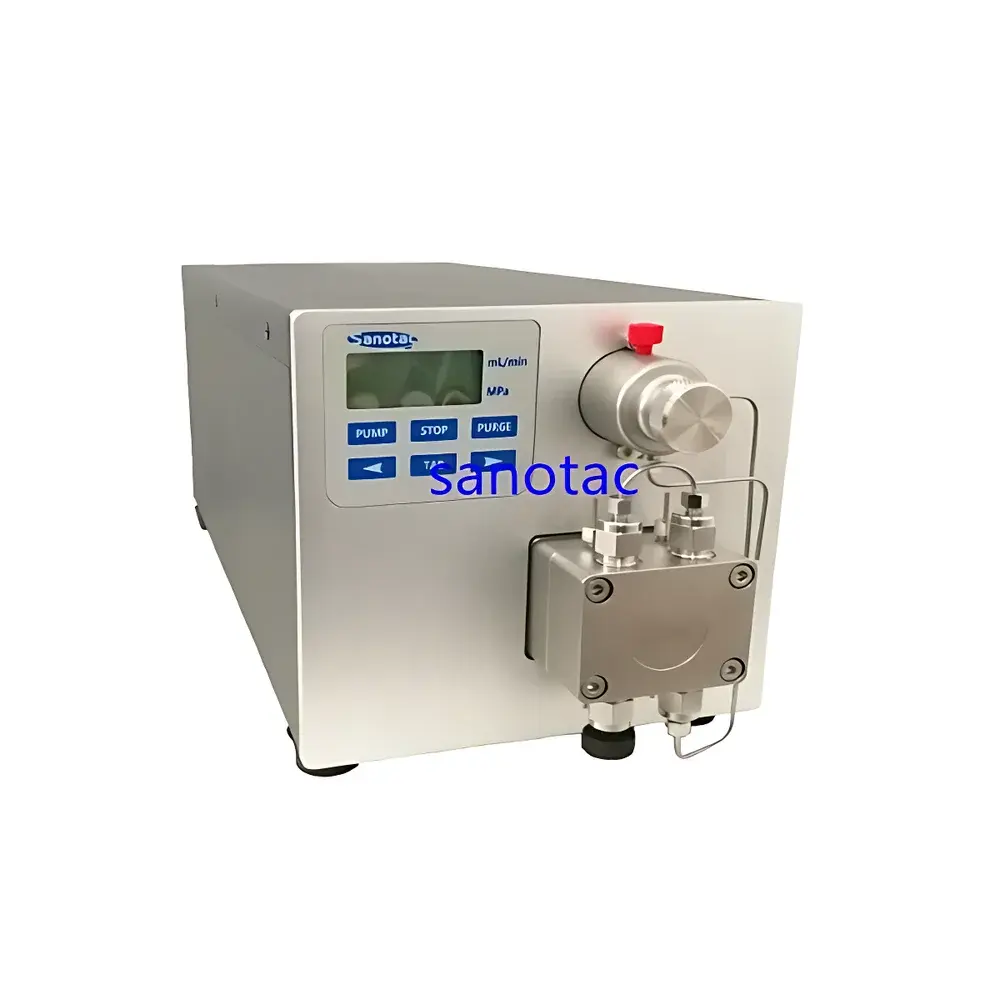
Sanotac CH0012 Analytical High-Pressure Solvent Delivery Pump for Catalytic Evaluation Systems
| Brand | Sanotac |
|---|---|
| Origin | Shanghai, China |
| Manufacturer Type | Direct Manufacturer |
| Product Category | Domestic |
| Model | CH0012 |
| Price Range | USD 1,400 – 2,800 |
| Flow Range | 0.001–9.999 mL/min |
| Flow Increment | 0.001 mL/min |
| Flow Accuracy | ±0.1% |
| Flow Precision (RSD) | ≤0.1% |
| Maximum Pressure | 42 MPa |
| Pressure Pulsation | ≤0.1 MPa |
| Pump Head Volume | 10 mL |
| Drive Mechanism | Dual Parallel Plunger with Floating Plunger Design |
| Flow Control | Microprocessor-Based with Solvent Compressibility Compensation & Multi-Point Flow Calibration |
| Gradient Capability | Isocratic, Linear, and Step Gradient Combination |
| Wetted Materials | 316L Stainless Steel, Sapphire, PTFE, Ceramic |
| Tubing Connection | 1/16" Standard Fittings |
| Display | 256×64 Dot Matrix Backlit LCD |
| Control Interface | Front Panel Keypad + Open-Protocol Computer Remote Control (RS-232/USB) |
| Power Supply | 85–264 VAC, 50 Hz |
| Dimensions | 370 × 240 × 152 mm |
Overview
The Sanotac CH0012 Analytical High-Pressure Solvent Delivery Pump is a precision-engineered fluidic module designed specifically for integration into catalytic evaluation systems and high-performance liquid chromatography (HPLC)-compatible reaction platforms. Operating on the principle of dual parallel plunger reciprocation with floating plunger architecture, the pump delivers stable, pulse-minimized solvent flow under extreme pressure conditions—up to 42 MPa (6,090 psi)—while maintaining metrological integrity across a wide dynamic range (0.001–9.999 mL/min). Its design addresses critical challenges in heterogeneous catalysis studies: consistent reagent delivery to fixed-bed or slurry-phase reactors, precise stoichiometric control during kinetic profiling, and compatibility with aggressive process media including corrosive organometallic solutions, supercritical CO₂ co-solvents, and high-temperature hydrothermal streams. The CH0012 is not a standalone analytical instrument but a subsystem-grade component engineered for OEM integration, meeting mechanical and communication requirements for automated catalyst screening rigs, microreactor arrays, and continuous-flow synthesis modules.
Key Features
- Dual-plunger tandem drive with floating plunger mechanism—reduces seal wear and extends service life under sustained high-pressure operation
- Microprocessor-controlled flow regulation incorporating real-time solvent compressibility compensation and multi-point flow calibration curves
- Low-pressure pulsation (<0.1 MPa) achieved via optimized cam-profile actuation and active electronic pulse suppression
- Chemically inert wetted path comprising 316L stainless steel, sapphire check valves, ceramic plungers, and PTFE seals—validated for compatibility with halogenated solvents, strong acids (e.g., HCl, HNO₃), and basic amine solutions
- Open-protocol remote control interface (RS-232/USB) supporting bidirectional communication with third-party data acquisition systems and chromatographic workstations
- Front-panel programmability with 10 user-defined methods—including gradient shape definition (isocratic, linear, step, or hybrid profiles)—enabling method transfer between lab-scale evaluation and pilot reactor setups
- Self-luminous 256×64 dot-matrix LCD display with intuitive menu navigation and real-time parameter monitoring (flow rate, pressure, error codes)
Sample Compatibility & Compliance
The CH0012 is routinely deployed in applications requiring strict adherence to GLP and GMP-aligned instrumentation practices. Its construction materials comply with ASTM F899 (standard specification for stainless steel forgings) and ISO 8502-9 (surface cleanliness assessment for corrosion resistance). While not certified as a medical device, its pressure containment design conforms to PED 2014/68/EU Annex I essential safety requirements for Category IV fluid systems. For catalytic testing environments governed by ISO 10724-2 (petrochemical catalyst activity measurement) or ASTM D3241 (jet fuel thermal oxidative stability), the pump’s flow accuracy (±0.1%) and repeatability (RSD ≤0.1%) support traceable kinetic data generation. All wetted components are non-leaching and extractables-tested per USP , ensuring minimal interference in downstream spectroscopic or mass spectrometric detection.
Software & Data Management
The CH0012 supports both local and networked operation modes. Its open-command-set protocol enables seamless integration with LabVIEW, Python-based automation frameworks (e.g., PyVISA), and commercial chromatography data systems (CDS) such as Thermo Chromeleon or Waters Empower—without proprietary drivers. Audit trails for method changes, flow/pressure logs, and system alerts are exportable in CSV or XML format. When deployed in regulated environments, the pump can be configured to meet FDA 21 CFR Part 11 requirements through external CDS-level electronic signature enforcement and time-stamped event logging. Firmware updates are delivered via USB memory stick with SHA-256 hash verification to ensure integrity.
Applications
- Fixed-bed and trickle-bed catalytic reactor feed control for hydrodesulfurization (HDS), Fischer–Tropsch synthesis, and ammonia decomposition studies
- High-pressure hydrogenation and oxidation kinetics in continuous-flow microreactors (0.1–10 mL/min range)
- Supercritical fluid processing (scCO₂, scCHF₃) requiring stable sub-mL/min delivery at >30 MPa
- Accelerated catalyst aging protocols involving cyclic pressure/temperature ramping with synchronized reagent dosing
- Multi-stream reagent blending for combinatorial catalyst screening platforms with integrated UV-Vis or online IR monitoring
- Preparative-scale chiral separations and ligand-assisted asymmetric synthesis where solvent purity and pulse-free flow directly impact enantioselectivity
FAQ
Is the CH0012 compatible with aggressive solvents such as aqua regia or anhydrous HF?
The standard CH0012 uses 316L stainless steel and sapphire components, which resist most organic solvents and dilute mineral acids. For aqua regia or anhydrous HF, custom configurations with Hastelloy C-276 or pure titanium wetted parts are available upon request.
Can the pump operate unattended for extended periods (e.g., 72+ hours)?
Yes—its robust thermal management, low-power consumption (<65 W), and self-diagnostic firmware enable continuous operation with scheduled maintenance intervals exceeding 2,000 hours under typical lab conditions.
Does Sanotac provide documentation for IQ/OQ/PQ validation?
Factory test reports (including flow accuracy, pressure hold, and gradient linearity verification) are supplied with each unit. Full validation support packages—including URS templates, FAT/SAT protocols, and raw calibration data—are available as optional services.
What is the recommended maintenance schedule for the plunger seals?
Under normal operation (≤30 MPa, ambient temperature, clean solvents), plunger seals require replacement every 12–18 months. Seal lifetime is extended by >40% when using the optional solvent filtration kit (0.2 µm inline filter).
Is firmware upgrade capability built-in?
Yes—firmware updates are performed via USB port using signed binary files; no disassembly or service technician visit is required.



