
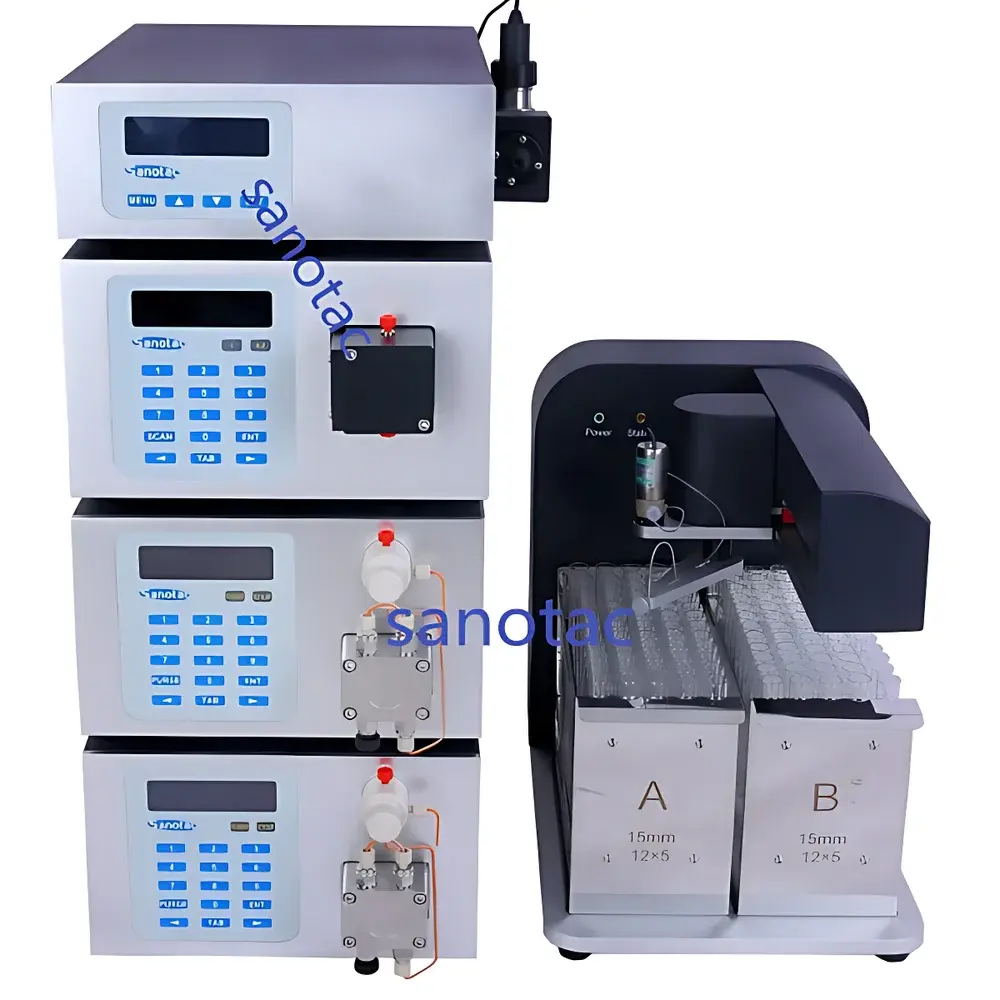
Sanotac CS100 High-Pressure Preparative Liquid Chromatography System
| Brand | Sanotac |
|---|---|
| Origin | Shanghai, China |
| Manufacturer Type | Direct Manufacturer |
| Regional Classification | Domestic (China) |
| Model | CS100 |
| Price Range | USD $14,000 – $28,000 |
| Application Level | Laboratory-Scale |
| Instrument Type | High-Pressure Preparative LC System |
| Flow Rate Range | 0.01–10.00 mL/min |
| Flow Accuracy | ±1% |
| Flow Precision (RSD) | ≤0.5% |
| Maximum Pressure | 20 MPa |
| Wavelength Range | 190–800 nm |
| Wavelength Accuracy | ±1 nm |
| Wavelength Repeatability | 0.2 nm |
| Baseline Noise | ±0.75×10⁻⁵ AU at 254 nm, TC = 1 s |
| Data Acquisition Rate | 10 Hz |
Overview
The Sanotac CS100 High-Pressure Preparative Liquid Chromatography System is an engineered platform for the isolation and purification of bioactive molecules—particularly proteins, peptides, natural product isolates, and synthetic organic compounds—under controlled, scalable chromatographic conditions. Based on high-pressure liquid chromatography (HPLC) principles, the system employs dual-solvent gradient elution, real-time dual-wavelength UV-Vis detection, and programmable fraction collection to support method development, analytical-to-preparative translation, and early-stage process optimization. Its modular architecture enables seamless integration of pump, detector, injection valve, column switching manifold, and fraction collector—all governed by a validated software environment compliant with regulatory data integrity standards. Designed for laboratory-scale purification workflows, the CS100 bridges the gap between analytical characterization and milligram-to-gram scale preparation without compromising resolution, reproducibility, or operational traceability.
Key Features
- Microprocessor-controlled dual-piston parallel pump with dynamic pressure feedback, compensating for solvent compressibility and refill dynamics across the full flow range (0.01–10.00 mL/min)
- Flow pulsation suppression via cam-profile compensation technology, yielding low baseline noise (±0.75×10⁻⁵ AU at 254 nm, 1 s time constant) and enhanced signal stability
- Multi-point flow calibration curves ensuring ±1% flow accuracy and ≤0.5% RSD across the entire operational envelope
- Floating plunger design extending seal service life under sustained 20 MPa pressure operation
- 10 user-defined method programs supporting gradient profile editing (linear, step, or custom), flow ramping, and real-time parameter adjustment during runs
- Dual-wavelength UV-Vis detection with simultaneous monitoring at two independent wavelengths; wavelength programming, stop-flow spectral scanning, and time-based wavelength switching reduce baseline drift and expand linear dynamic range (0–2 AU)
- Intelligent lamp management: automatic D₂/Tungsten lamp switching based on selected wavelength, minimizing downtime and maximizing lamp longevity
- Modular column interface accommodating both stainless-steel and high-pressure glass columns (up to 20 MPa), with optional PEEK pump head for aggressive solvent compatibility
Sample Compatibility & Compliance
The CS100 supports diverse sample matrices including crude protein lysates, herbal extracts, fermentation broths, synthetic intermediates, and oligonucleotide preparations. Its robust fluidic path—constructed from 316L stainless steel and chemically resistant polymers—is compatible with common HPLC solvents (acetonitrile, methanol, water, buffers pH 2–8) and moderate concentrations of acids/bases. The system meets essential performance criteria outlined in ISO 17025 for calibration traceability and aligns with method validation expectations per ICH Q2(R2). All hardware and firmware components are designed for GLP/GMP-aligned environments, and the Sanochrom control software implements full audit trail functionality, electronic signatures, and role-based access control in accordance with FDA 21 CFR Part 11 and CFDA GxP requirements.
Software & Data Management
Control and data acquisition are managed through Sanochrom Chromatography Workstation—a Windows 10–compatible application offering graphical method setup, real-time chromatogram visualization, peak integration, and automated report generation. The software supports USB 2.0 and RS-232 communication protocols and provides direct export to CSV, PDF, and AIA (.cdf) formats for third-party analysis tools. Raw data files include timestamped metadata (instrument ID, operator, method version, environmental logs), and all user actions—including parameter edits, manual injections, and fraction triggers—are immutably recorded in the audit trail. Method templates can be archived, version-controlled, and deployed across multiple CS100 units to ensure inter-laboratory consistency.
Applications
- Purification of recombinant proteins and monoclonal antibody fragments using ion-exchange, size-exclusion, or hydrophobic interaction chromatography
- Isolation of bioactive alkaloids, flavonoids, and terpenoids from plant extracts under gradient RP-HPLC conditions
- Separation and recovery of chiral intermediates in asymmetric synthesis workflows
- Desalting and buffer exchange of peptide libraries prior to mass spectrometry analysis
- Process scouting for downstream purification steps in biopharmaceutical development (e.g., polishing steps post-protein A capture)
- Stability-indicating method development for degradation product profiling in small-molecule APIs
FAQ
What column types are supported by the CS100 system?
The system accommodates standard 1/4″ and 1/8″ stainless-steel preparative columns as well as high-pressure glass columns rated up to 20 MPa. Optional PEEK-compatible fluidic modules enable use with aggressive solvents such as THF or concentrated TFA.
Can the CS100 perform method transfer from analytical to preparative scale?
Yes—the system’s precise flow control, gradient fidelity, and dual-wavelength detection allow retention time and selectivity mapping across scales. Retention modeling tools within Sanochrom software support linear velocity scaling and column volume normalization.
Is the software compliant with FDA 21 CFR Part 11?
Yes. Sanochrom implements electronic signatures, audit trails with immutable timestamps, user authentication, and permission-level controls required for regulated environments.
What is the maximum injection volume supported?
The standard 10 mL fixed-loop preparative injection valve supports discrete injections up to 10 mL; optional larger loops or loopless injection manifolds are available for continuous loading applications.
Does the system support automated fraction collection based on peak detection?
Yes—fraction collection modes include time-based, peak-threshold-triggered, and UV-absorbance-gated collection, with configurable delay compensation to account for detector-to-collector transport lag.





