
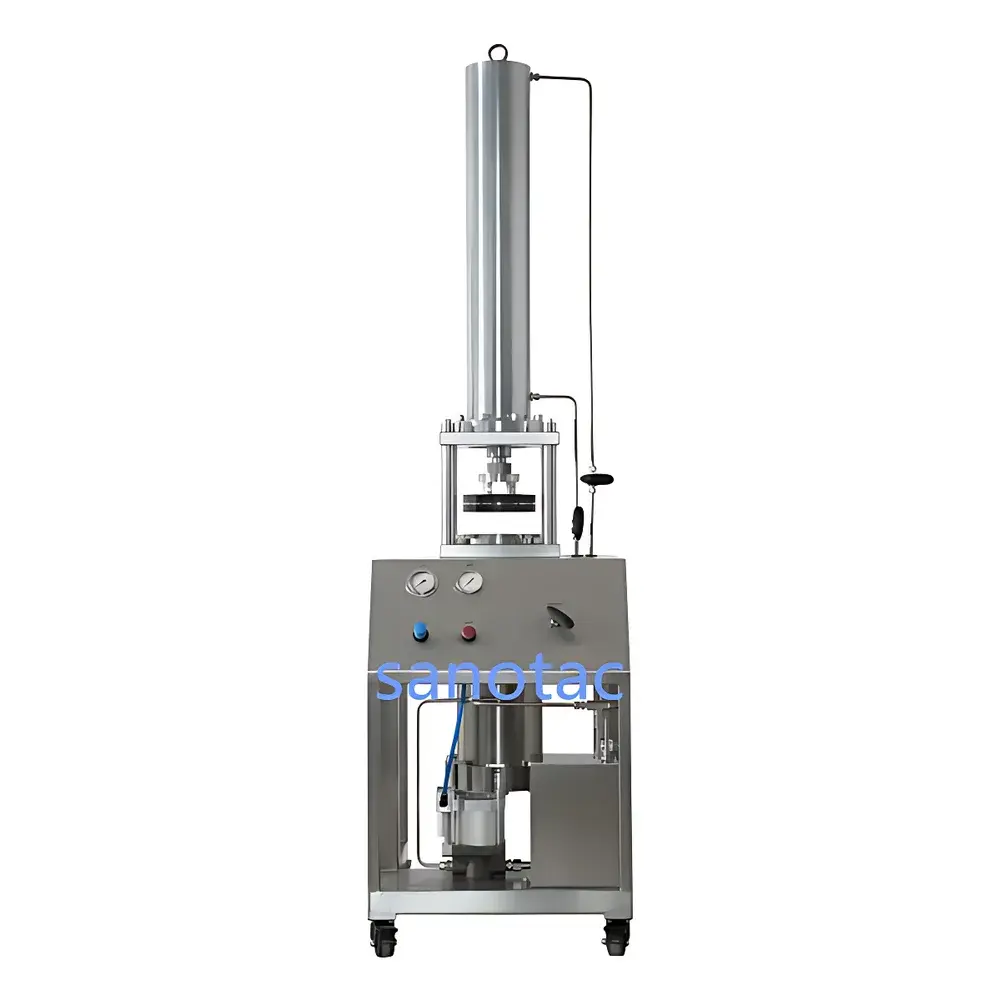
Sanotac DAC300 Dynamic Axial Compression Column System for Preparative Chromatography
| Brand | Sanotac |
|---|---|
| Origin | Shanghai, China |
| Manufacturer Type | Manufacturer |
| Product Category | Domestic |
| Model | DAC300 |
| Application Level | Industrial-Scale Preparation |
| Instrument Type | High-Pressure Preparative Liquid Chromatography System |
| Flow Rate Range | 0.01–3000.00 mL/min |
| Flow Accuracy | ±1% |
| Flow Precision (RSD) | ≤0.5% |
| Maximum Operating Pressure | 10 MPa |
| Wavelength Accuracy | ±1 nm |
| Wavelength Repeatability | 0.2 nm |
| Baseline Noise | ±0.5×10⁻⁵ AU (254 nm, TC = 1 s) |
| Data Acquisition Frequency | 10 Hz |
Overview
The Sanotac DAC300 Dynamic Axial Compression (DAC) Column System is an industrial-grade preparative liquid chromatography platform engineered for high-resolution, high-throughput purification of thermally labile, low- to medium-molecular-weight compounds—including natural products, synthetic intermediates, pharmaceutical actives, and biopolymer fragments. Unlike conventional fixed-bed columns, the DAC300 employs a hydraulically actuated piston to dynamically compress the packed bed during operation, maintaining uniform column packing density under variable flow and pressure conditions. This axial compression mechanism mitigates bed settling, channeling, and void formation—critical failure modes in large-scale chromatographic separations. The system operates on the principle of constant-force radial confinement combined with axial force modulation, enabling stable retention time reproducibility, extended column lifetime (>500 runs under GMP-compliant operation), and consistent resolution across multi-kilogram batch purifications. Designed for seamless integration into cGMP manufacturing environments, the DAC300 meets mechanical and control architecture requirements aligned with ISO 9001-certified equipment validation protocols.
Key Features
- Hydraulic piston-driven dynamic axial compression with nitrogen-assisted sealing: ensures leak-free operation up to 10 MPa while allowing smooth, programmable piston travel (0–500 mm stroke) with ≤0.1 mm positional repeatability.
- Modular high-pressure dual-pump configuration: supports binary or quaternary gradient mixing at flow rates up to 3000 mL/min with pulse-dampened delivery (cam-profile flow compensation) and automatic pump-head rinsing to prevent salt crystallization.
- Full-spectrum UV-Vis detector (190–800 nm) with dual-lamp auto-switching (D₂ + W), ±1 nm wavelength accuracy, and baseline noise <0.5×10⁻⁵ AU at 254 nm (1 s time constant).
- Low-dead-volume linear distributor with ≥98% active cross-sectional utilization; optimized for 5–10 µm spherical silica or polymer-based stationary phases.
- Intelligent fraction collector with three collection modes: peak-triggered (threshold-based), time-segmented, and volume-proportional—each supporting user-defined delay compensation and real-time re-injection logic.
- Integrated control software compliant with FDA 21 CFR Part 11 and CFDA GxP regulations: includes electronic signatures, role-based access control (RBAC), full audit trail logging, and database-driven project management.
Sample Compatibility & Compliance
The DAC300 accommodates preparative-scale columns with internal diameters from 50 mm to 300 mm and maximum bed heights of 500 mm—supporting typical loading capacities of 1–20 g per run for small molecules and up to 500 mg for monoclonal antibody fragments. It is validated for use with silica-based C18, phenyl-hexyl, and cyano phases; polymeric resins (e.g., Toyopearl, Sepharose); and specialty media including chiral selectors and ion-exchange matrices. All wetted parts are constructed from electropolished ASTM A276 316L stainless steel (Ra ≤ 0.2 µm surface finish), ensuring compatibility with aggressive solvents (e.g., THF, DCM, TFA-containing mobile phases) and alkaline buffers (pH 2–12). The system conforms to IEC 61010-1 safety standards and supports IQ/OQ/PQ documentation packages required for regulatory submissions under ICH Q5, Q7, and USP .
Software & Data Management
Sanotac ChromaControl™ v4.2 provides unified instrument control, method development, and data archival within a SQL Server-backed relational database. Each project stores associated method files, raw chromatograms (.chd), calibration curves, and audit logs with immutable timestamps. The software implements ALCOA+ principles: Attributable, Legible, Contemporaneous, Original, Accurate, Complete, Consistent, Enduring, and Available. Electronic signature workflows comply with 21 CFR Part 11 Subpart B requirements, including biometric or PKI-based signing, password complexity enforcement, and session timeout policies. Export modules support CSV, PDF, and .cdf formats for third-party statistical analysis (e.g., JMP, Simca) and LIMS integration via ASTM E1467-compliant APIs.
Applications
- Purification of botanical extracts (e.g., paclitaxel, artemisinin, curcuminoids) under Good Agricultural and Collection Practices (GACP)-aligned workflows.
- Isolation of synthetic drug candidates post-Suzuki coupling or asymmetric hydrogenation—enabling removal of metal catalysts and stereoisomeric impurities.
- Desalting and buffer exchange of peptide intermediates prior to solid-phase synthesis.
- Polysaccharide fractionation (e.g., heparin oligosaccharides) using size-exclusion or anion-exchange DAC columns.
- Process development support for Phase II/III clinical trial material production, with scalability demonstrated from DAC80 (300 mL/min) to DAC300 (3000 mL/min) without method re-optimization.
FAQ
What is the maximum allowable backpressure for continuous operation?
The DAC300 is rated for sustained operation at ≤10 MPa (100 bar); pressure transducers provide real-time feedback with automatic shutdown if >10.5 MPa is detected.
Can the system be validated for GMP manufacturing?
Yes—the hardware design, firmware architecture, and software validation package meet Annex 11 and PIC/S PI 011-3 requirements for computerized system validation (CSV) in pharmaceutical manufacturing.
Is column packing performed in situ or off-line?
Both options are supported: slurry packing can be executed directly in the DAC300 using integrated slurry reservoirs and programmable compression cycles, or pre-packed columns may be installed via quick-clamp flanges.
Does the system support multi-wavelength detection during gradient elution?
Yes—the UV-Vis detector acquires simultaneous dual-wavelength chromatograms (e.g., 214 nm + 280 nm) with independent gain settings and real-time ratio plotting for protein aggregate monitoring.
How is maintenance access designed for routine service?
Front-access modular layout allows full pump head, detector flow cell, and fraction collector valve replacement without disassembling the main frame; all consumables carry serialized QR-coded traceability tags.



