
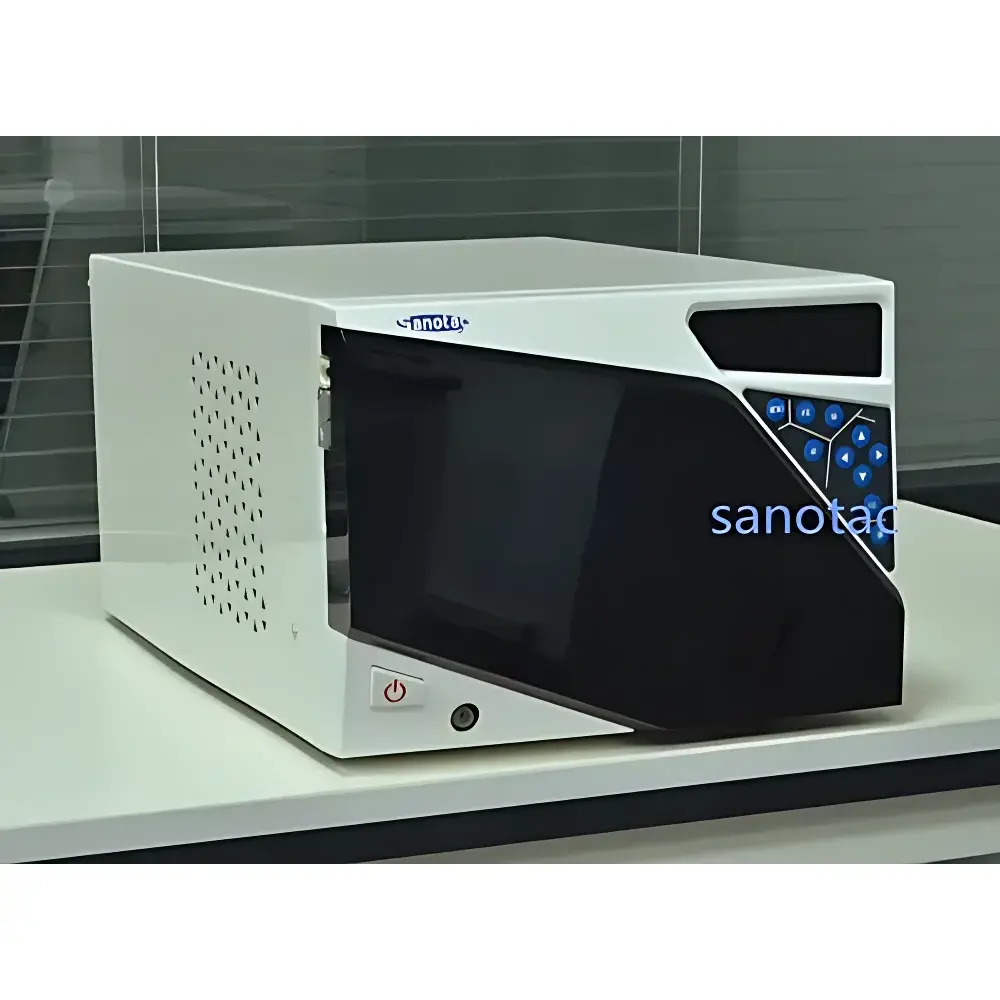
Sanotac ELSD-3000KS Evaporative Light Scattering Detector (OEM-Ready)
| Brand | Sanotac |
|---|---|
| Origin | Shanghai, China |
| Manufacturer Type | Original Equipment Manufacturer (OEM) & Direct Producer |
| Instrument Type | Evaporative Light Scattering Detector (ELSD) |
| Wavelength | 650 nm |
| Detection Mode | Low-Temperature Evaporation |
| Light Source | Semiconductor Laser Diode |
Overview
The Sanotac ELSD-3000KS is a compact, high-performance evaporative light scattering detector engineered for universal detection in liquid chromatography systems. Unlike UV-Vis detectors—which rely on chromophore absorption—ELSD operates on the physical principle of nebulization, solvent evaporation, and light scattering from non-volatile analyte particles. This mechanism enables quantitative detection of compounds lacking strong UV absorbance, including carbohydrates, lipids, saponins, polymers, amino acids, and non-chromophoric pharmaceuticals. The ELSD-3000KS implements a precisely controlled low-temperature evaporation pathway to minimize thermal degradation of labile compounds while maximizing particle formation efficiency. Its semiconductor laser (650 nm) couples with a high-sensitivity photomultiplier tube (PMT) to deliver stable, low-noise signal acquisition across a wide dynamic range. Designed from inception for OEM integration, the unit features standardized mechanical footprints, modular electrical interfaces, and protocol-agnostic digital communication—making it suitable for seamless incorporation into third-party HPLC, preparative LC, and medium-pressure purification platforms.
Key Features
- Compact footprint (26 × 19 × 46 cm) enabling stackable installation with HPLC modules or benchtop integration
- Low-temperature evaporation design: drift tube temperature programmable from ambient to 130 °C (±1 °C accuracy; 1 °C increment)
- Independent nebulizer heating: adjustable from ambient to 56 °C to optimize droplet desolvation for viscous or oily samples
- Real-time gas pressure monitoring (0.01 bar resolution) and flow control (1–4 L/min; ≤1% or ±0.02 L/min accuracy) using clean air or nitrogen
- Automated 16-point self-diagnostic routine covering gas integrity, heater status, PMT gain stability, and solvent trap integrity
- Linear gain adjustment (0.3–30×) and analog output range (–1200 to +1200 mV) for precise signal scaling across concentration gradients
- Adjustable nebulizer angle for method-specific optimization of aerosol dispersion geometry
- Onboard 10-method memory (25 parameters per method), structured menu navigation, and dual-line backlit LCD interface with 10-key input
- Multi-mode connectivity: RS-232, RS-458, USB 2.0, Ethernet (TCP/IP & HTTP), and programmable external event I/O (e.g., laser enable, valve actuation, zero trigger)
- Energy-efficient standby mode with configurable auto-entry criteria and reduced power draw during idle intervals
Sample Compatibility & Compliance
The ELSD-3000KS supports mobile phase flow rates from 0.01 to 3 mL/min, accommodating analytical, semi-preparative, and medium-pressure LC applications. It detects any non-volatile or semi-volatile analyte with volatility lower than the eluent—making it particularly valuable for natural product analysis (e.g., herbal extracts, glycosides), excipient quantification in formulations, polymer molecular weight distribution profiling, and lipidomics workflows. All critical operational parameters—including temperature setpoints, gas pressure, and gain—are traceable via internal logging. The detector’s firmware and associated Clarity®-compatible acquisition software comply with FDA 21 CFR Part 11 requirements, supporting electronic signatures, audit trails, user access levels, and immutable data archiving—essential for GLP and GMP-regulated environments. CE marking confirms conformity with EU electromagnetic compatibility (EMC) and low-voltage directives (2014/30/EU and 2014/35/EU).
Software & Data Management
Sanotac provides native Windows-based acquisition software with full Clarity® DLL integration, enabling direct instrument control and real-time data streaming into third-party chromatography data systems (CDS). The software supports method import/export, baseline correction algorithms, peak integration with customizable thresholds, and export to CSV, ASCII, and AIA (.cdf) formats. Audit trail functionality records all parameter changes, user logins, method executions, and calibration events with timestamps and operator IDs. Data files are stored in encrypted, tamper-evident containers compliant with ALCOA+ principles (Attributable, Legible, Contemporaneous, Original, Accurate, Complete, Consistent, Enduring, Available). Remote monitoring and configuration are enabled via HTTP API endpoints—facilitating centralized fleet management in multi-instrument laboratories.
Applications
- Quantitative analysis of non-UV-absorbing natural products: flavonoid glycosides, triterpene saponins, polysaccharides, and alkaloid salts in traditional Chinese medicine (TCM) extracts
- Fatty acid methyl ester (FAME) profiling in biodiesel and food oil quality control
- Residual solvent and excipient quantification in pharmaceutical final dosage forms per ICH Q2(R2) guidelines
- Size-exclusion chromatography (SEC) of synthetic and natural polymers without UV-active tags
- Method development support for preparative HPLC purification where UV response is inconsistent or absent
- Stability-indicating assays for degradation products lacking chromophores
FAQ
Is the ELSD-3000KS compatible with third-party HPLC systems?
Yes—it supports standard analog voltage input/output, RS-232/RS-485 serial protocols, and TCP/IP-based remote control, enabling interoperability with Agilent, Waters, Shimadzu, Thermo Fisher, and other major CDS platforms.
Does the detector require nitrogen gas, or can compressed air be used?
Either clean, oil-free compressed air or nitrogen may be used; gas pressure must be maintained between 2–5 bar, with flow rate controllable from 1–4 L/min.
What is the minimum detectable mass for typical analytes?
Under optimized conditions, the limit of detection is <1 ng on-column for non-volatile standards such as sucrose or cholesterol; quantitative linearity spans 0.1–30 µg per injection.
How does the ELSD-3000KS ensure long-term signal stability?
Through active temperature stabilization (±1 °C), real-time gas pressure feedback control, automated baseline drift compensation, and 16-point self-diagnostics that verify optical alignment, heater function, and PMT response prior to each run.
Can the unit be integrated into automated purification workflows?
Yes—the programmable external event interface allows synchronization with fraction collector triggers, pump gradient events, and system start/stop commands—enabling fully unattended operation in preparative LC environments.




