
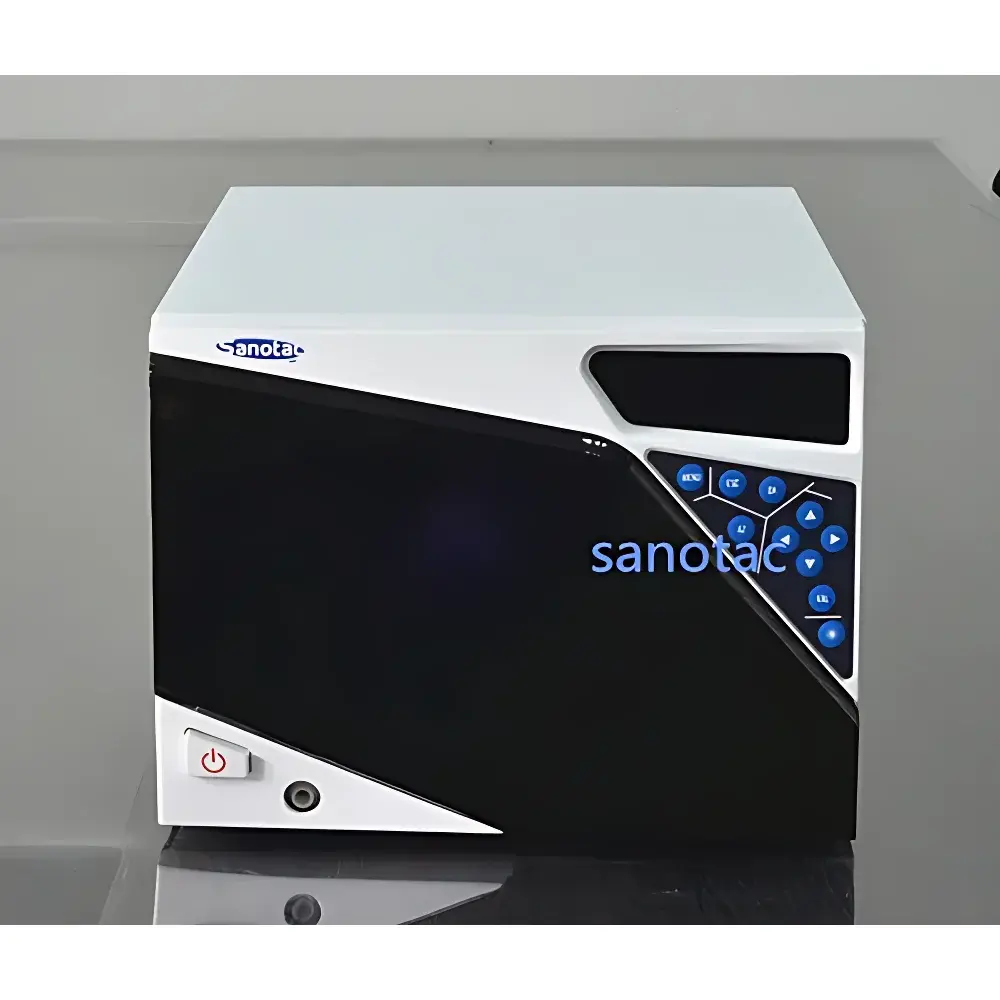
Sanotac ELSD-6000 Evaporative Light Scattering Detector
| Brand | Sanotac |
|---|---|
| Model | ELSD-6000 |
| Origin | Shanghai, China |
| Manufacturer Type | OEM Manufacturer |
| Instrument Type | HPLC-Compatible Evaporative Light Scattering Detector |
| Flow Rate Range | 0.01–3 mL/min |
| Max Operating Pressure | 1 bar |
| Sample Injection Positions | 1 |
| Injection Volume Range | 1 µL–100 µL (system-dependent) |
| Drift Tube Temperature Range | Ambient to 150 °C (1 °C increment) |
| Nebulizer Temperature Range | Ambient to 50 °C (1 °C increment) |
| Light Source | 650 nm, 30 mW Semiconductor Laser |
| Photodetector | Photomultiplier Tube (PMT) |
| Data Acquisition Rate | 20 Hz |
| Baseline Noise | ≤ 0.03 mV |
| Baseline Drift | ≤ 0.3 mV / 60 min |
| Quantitative Reproducibility (RSD) | ≤ 2% |
| Minimum Detectable Mass | < 1 ng |
| Typical Linear Quantitation Range | 0.1–30 µg |
| Gas Supply | Clean, oil-free air or nitrogen |
| Gas Pressure Range | 2–5 bar |
| Gas Flow Control | Mass Flow Controller, accuracy ≤ ±1% or ±0.02 L/min |
| Gain Adjustment | Linear, 0.3–30× continuous |
| Analog Output | –1200 to +1200 mV |
| Digital Interfaces | RS-232, USB, LAN (TCP/HTTP), programmable external event I/O |
| Power | 85–264 VAC, 50 Hz |
| Dimensions (W×H×D) | 260 × 190 × 460 mm |
| Weight | 10 kg |
Overview
The Sanotac ELSD-6000 is a high-performance, HPLC-coupled Evaporative Light Scattering Detector engineered for universal, non-destructive detection of non-chromophoric and semi-volatile analytes—particularly critical in herbal medicine analysis, natural product characterization, and quality control of thermally labile compounds. Unlike UV-Vis or fluorescence detectors, the ELSD-6000 operates on the principle of nebulization, solvent evaporation, and light scattering: the column effluent is atomized into fine droplets, dried in a precisely controlled drift tube, and the resulting solute particles scatter laser light (650 nm, 30 mW) detected by a photomultiplier tube. This mechanism provides consistent response across diverse chemical classes—including carbohydrates, lipids, saponins, terpenoids, and glycosides—regardless of UV absorbance or native fluorescence, making it indispensable for Chinese herbal medicine (CHM) fingerprinting, marker compound quantification, and batch-to-batch consistency assessment per Chinese Pharmacopoeia (ChP) and ICH Q5A guidelines.
Key Features
- Precision Thermal Management: Dual-zone temperature control (drift tube: ambient to 150 °C; nebulizer: ambient to 50 °C) with ±1 °C accuracy and 1 °C resolution ensures reproducible particle formation and minimizes thermal degradation of sensitive phytochemicals.
- Low-Noise Optical Architecture: Optimized collimated laser path and high-gain PMT deliver baseline noise ≤ 0.03 mV and drift ≤ 0.3 mV/60 min—enabling reliable detection at sub-nanogram levels without signal averaging.
- Intelligent Nebulization System: Adjustable nebulizer angle and heated nozzle enhance雾化 efficiency for viscous or oily extracts (e.g., essential oils, fixed oils), while carrier gas encapsulation prevents wall deposition in the detection cell, sustaining long-term signal stability.
- Comprehensive Self-Diagnostics: 16-point automated instrument health check at startup and runtime monitors gas pressure, flow, drift tube temperature, laser status, and valve integrity—preventing solvent ingress and reducing unplanned downtime.
- Regulatory-Ready Control Software: Sanotac Clarity®-integrated software supports FDA 21 CFR Part 11 compliance with full audit trail, electronic signatures, method locking, and user-access-level permissions—validated for GMP/GLP environments.
- Flexible Integration & Connectivity: Native support for RS-232, USB, and Ethernet (TCP/HTTP) enables seamless integration with Agilent, Waters, Shimadzu, and Thermo HPLC systems; programmable external event I/O allows synchronization with fraction collectors or switching valves.
Sample Compatibility & Compliance
The ELSD-6000 is routinely deployed in QC laboratories performing monograph testing per ChP Volume I (Herbal Drugs), USP (Light-Scattering Detectors), and ISO 17025-accredited methods. It accommodates reversed-phase, HILIC, and normal-phase mobile phases—including high-water-content gradients and volatile buffers (e.g., ammonium acetate, formic acid)—without detector saturation. Its universal response supports quantitative analysis of polysaccharides (e.g., astragalosid IV), triterpenoid saponins (e.g., ginsenosides Rb1, Rg1), flavonoid glycosides (e.g., rutin), and alkaloids (e.g., berberine) where UV response is weak or inconsistent. All hardware and firmware meet CE electromagnetic compatibility (EMC) Directive 2014/30/EU and RoHS 2011/65/EU requirements. Full 3Q documentation (IQ/OQ/PQ) is provided, including calibration certificates traceable to NIST standards and validation protocols aligned with ASTM E2500-13 and EU Annex 11.
Software & Data Management
Clarity®-based acquisition software offers dual-mode operation: standalone control via integrated 16×2 LCD and keypad, or full remote management via Windows/macOS/Linux clients. Method templates store up to 10 predefined configurations (25 parameters each), including temperature ramps, gain profiles, and gas flow setpoints—enabling rapid method transfer between instruments. Raw data are saved in vendor-neutral .csv and .cdf formats compliant with LIMS ingestion. Audit trails log all parameter changes, user logins, method executions, and system alerts with immutable timestamps. Electronic signature workflows enforce role-based approval for method modifications and report generation—fully satisfying FDA 21 CFR Part 11 Subpart B and EU GMP Annex 11 requirements for data integrity and ALCOA+ principles.
Applications
- Quantitative profiling of multi-component herbal formulations (e.g., Liuwei Dihuang Wan, Yin Qiao San)
- Stability-indicating assays for heat-labile active ingredients during accelerated degradation studies
- Residual solvent analysis in botanical extracts using headspace-GC/ELSD coupling
- Batch release testing of standardized plant extracts per WHO Guidelines for Herbal Medicines
- Method development for LC-ELSD hyphenation in natural product isolation workflows
- Supporting ICH Q2(R2) validation of analytical procedures for non-UV-absorbing impurities
FAQ
Is the ELSD-6000 compatible with gradient elution methods?
Yes—it maintains stable baseline and linear response across mobile phase composition changes, including water/acetonitrile and water/methanol gradients with 0.1% formic acid.
What carrier gases are recommended, and why does gas purity matter?
Clean, oil-free nitrogen or compressed air (dew point ≤ –40 °C, particulate ≤ 0.01 µm) is required; impurities cause nozzle clogging, variable droplet size, and elevated baseline noise.
Can the ELSD-6000 be validated for GMP manufacturing environments?
Yes—full IQ/OQ/PQ documentation, 3Q-certified calibration kits, and Part 11-compliant software enable direct use in pharmaceutical production QC labs under FDA and NMPA oversight.
How does the ELSD-6000 handle high-salt mobile phases?
It tolerates up to 50 mM ammonium acetate or formate; however, post-run needle wash and periodic drift tube cleaning are recommended to prevent salt accumulation.
Does the instrument support real-time remote monitoring?
Yes—via embedded web server (LAN interface), users can view live chromatograms, temperature/pressure readings, and alarm status from any networked device without proprietary client software.





