
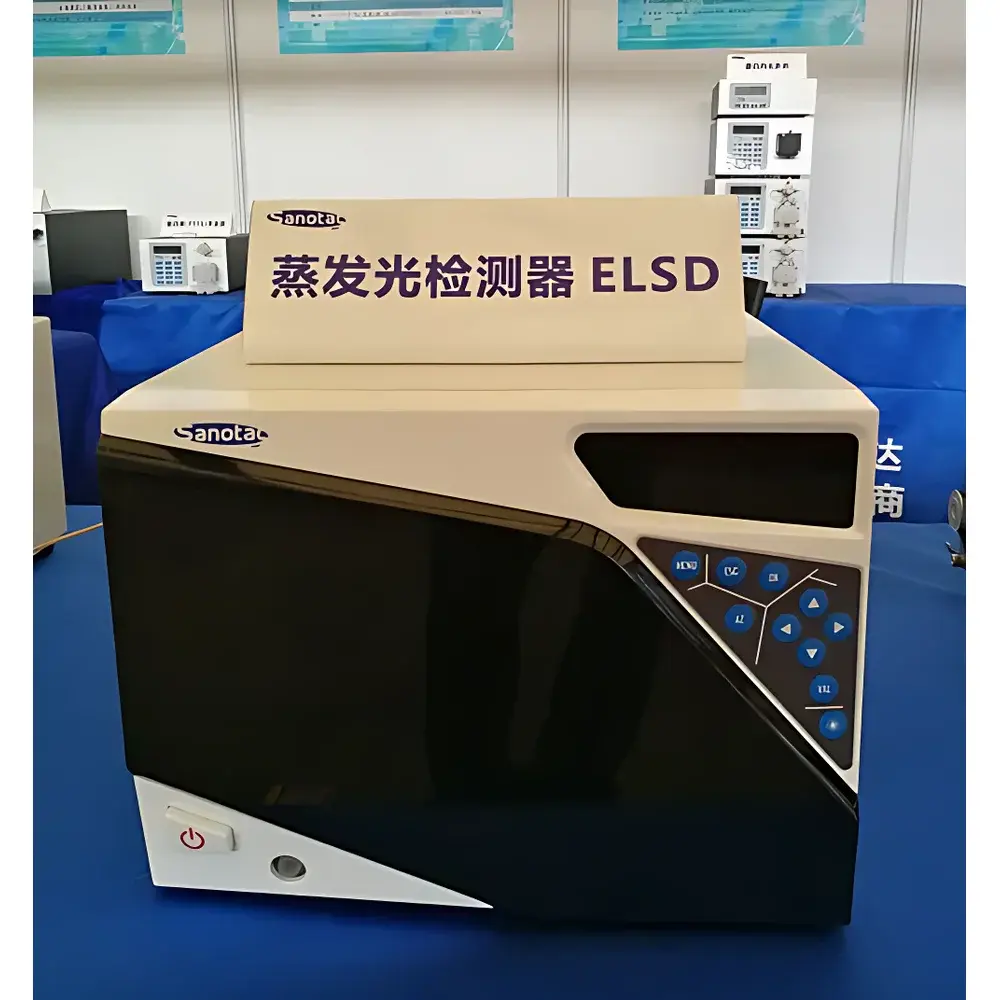
Sanotac ELSD-6000 Evaporative Light Scattering Detector
| Brand | Sanotac |
|---|---|
| Model | ELSD-6000 |
| Detector Type | Evaporative Light Scattering Detector (ELSD) |
| Wavelength | 650 nm |
| Detection Principle | Low-Temperature Evaporation Mode |
| Light Source | Semiconductor Laser |
| Evaporation Temperature Range | Ambient to 130 °C (1 °C increment) |
| Nebulization Temperature Range | Ambient to 56 °C (1 °C increment) |
| Temperature Control Accuracy | ±1 °C |
| Gas Requirement | Clean Compressed Air or Nitrogen |
| Gas Pressure Range | 2–5 bar |
| Gas Pressure Sensing Accuracy | 0.01 bar |
| Gas Flow Rate | 1–4 L/min |
| Gas Flow Control Accuracy | ≤1% or 0.02 L/min |
| Mobile Phase Flow Rate | 0.01–3 mL/min |
| Baseline Noise | ≤0.03 mV |
| Baseline Drift | ≤0.3 mV / 30 min |
| Minimum Detectable Mass | <1 ng |
| Typical Quantitation Range | 0.1–30 µg |
| Quantitation Repeatability (RSD₆) | ≤2% |
| Dynamic Range | 10⁴ (at fixed gain) |
| Analog Output Range | −1200 to +1200 mV |
| Gain Adjustment | Continuous, 0.3–30× |
| Output Offset Range | −1000 to +1000 mV |
| Sampling Rate | 100 Hz (digital), 20 Hz (analog) |
| Dimensions (W×H×D) | 26×19×46 cm |
| Weight | 10 kg |
| Power Supply | 85–264 VAC, 50 Hz |
Overview
The Sanotac ELSD-6000 is a high-performance evaporative light scattering detector engineered for universal, non-destructive detection of non-volatile and semi-volatile analytes in liquid chromatography systems. Unlike UV-Vis absorbance detectors, the ELSD-6000 operates on the principle of nebulization, solvent evaporation, and light scattering—making it particularly suitable for compounds lacking chromophores, including carbohydrates, lipids, surfactants, polymers, glycosides, and natural product constituents. Its low-temperature evaporation mode minimizes thermal degradation of thermally labile compounds while ensuring consistent droplet formation and particle sizing across a broad range of mobile phase compositions—including gradients containing volatile and non-volatile modifiers. The detector integrates a 650 nm semiconductor laser source and a high-sensitivity photomultiplier tube (PMT), delivering stable signal output with low baseline noise (≤0.03 mV) and minimal drift (≤0.3 mV/30 min), meeting and exceeding requirements specified in JJG 1512–2015 for HPLC detector performance validation.
Key Features
- Compact footprint (26 × 19 × 46 cm) designed to align with standard HPLC pump width—ideal for space-constrained laboratories and modular LC system integration.
- Optimized internal temperature field management ensures uniform thermal distribution across the drift tube and nebulizer chamber, enhancing reproducibility and reducing condensation artifacts.
- Dual independent temperature control: evaporation zone (ambient to 130 °C, ±1 °C accuracy) and nebulization zone (ambient to 56 °C, ±1 °C accuracy), both adjustable in 1 °C increments for method optimization.
- Integrated gas flow regulation with real-time pressure sensing (0.01 bar resolution) and precision mass-flow control (±1% or ±0.02 L/min), compatible with nitrogen or clean compressed air.
- Front-accessible nebulizer tube design enables rapid visual inspection and routine cleaning without disassembly—reducing downtime and operator error.
- Intelligent standby mode reduces power consumption by >40% and cuts nitrogen usage by over 50%, activated manually, remotely via LAN/RS-485, or on scheduled timers.
- 16-point self-diagnostic system continuously monitors critical subsystems—including laser status, gas valve integrity, heater function, and PMT voltage—ensuring operational reliability and traceable instrument health logging.
Sample Compatibility & Compliance
The ELSD-6000 is validated for use with reversed-phase, normal-phase, HILIC, and supercritical fluid chromatography (SFC) methods. It supports mobile phase flow rates from 0.01 to 3 mL/min and tolerates common solvents (e.g., acetonitrile, methanol, water, THF, chloroform) as well as aqueous buffers with low concentrations of non-volatile salts (e.g., ≤10 mM ammonium acetate/formate). Its universal detection capability makes it especially valuable in herbal medicine QC (e.g., quantification of saponins and polysaccharides in TCM extracts), lipidomics (fatty acid methyl esters, phospholipids), polymer molecular weight distribution analysis, and excipient profiling in pharmaceutical formulations. The detector complies with ISO/IEC 17025 documentation practices and supports GLP/GMP workflows through full audit-trail functionality in its FDA 21 CFR Part 11–compliant software suite.
Software & Data Management
Data acquisition and instrument control are managed via Sanotac’s native Clarity™ chromatography software (v6.0+), licensed for multi-platform deployment (Windows/Linux) and interoperable with third-party HPLC systems including Agilent, Waters, Shimadzu, and Thermo Fisher. The software implements electronic signatures, user role-based access control, immutable audit trails, and secure data archiving—fully satisfying regulatory expectations for analytical instrument qualification under FDA 21 CFR Part 11 and EU Annex 11. Ten preconfigured method templates (each storing up to 25 parameters) can be recalled automatically during sequence execution. Digital output (LAN/TCP/HTTP) enables seamless integration into LIMS and MES environments, while analog output (−1200 to +1200 mV, programmable offset and gain) maintains compatibility with legacy integrators and chart recorders.
Applications
- Quantitative analysis of UV-transparent compounds: sucrose, lactose, trehalose, dextran, and cyclodextrins in food and biopharmaceutical matrices.
- Profiling of unsaturated fatty acids and triglyceride species in fish oil, algae extracts, and infant formula.
- Stability-indicating assays for non-chromophoric drug substances and degradation products in forced degradation studies.
- Residual solvent and excipient quantification in lyophilized biologics and nanoparticle drug carriers.
- Method development support for gradient elution in hydrophilic interaction chromatography (HILIC) of polar metabolites.
FAQ
Does the ELSD-6000 require nitrogen gas exclusively, or can compressed air be used?
Yes—clean, oil-free compressed air (dew point ≤ −40 °C, particulate ≤ 0.01 µm) is fully supported and recommended for routine operation to reduce consumable costs. Nitrogen is preferred for ultra-low-noise applications or when using highly oxygen-sensitive mobile phases.
What is the minimum detectable mass for cholesterol in methanol under standard conditions?
The typical limit of detection is <1 ng on-column for cholesterol dissolved in methanol, corresponding to a concentration of ≤5.0 × 10⁻⁶ g/mL at 1 mL/min flow rate.
How does the ELSD-6000 handle gradient elution with increasing organic solvent content?
Its adaptive drift tube cooling system and dynamic gas flow compensation maintain consistent aerosol particle size and scattering efficiency across gradients—eliminating baseline humps commonly observed in older ELSD designs.
Is firmware upgrade supported remotely?
Yes—firmware updates can be deployed over LAN or USB using signed binary packages verified via SHA-256 checksums, preserving system integrity and compliance traceability.
Can the ELSD-6000 be operated unattended overnight?
Absolutely—the built-in watchdog timer, automatic shutdown on communication loss, and scheduled standby activation ensure safe, compliant unattended operation for extended sequences.




