
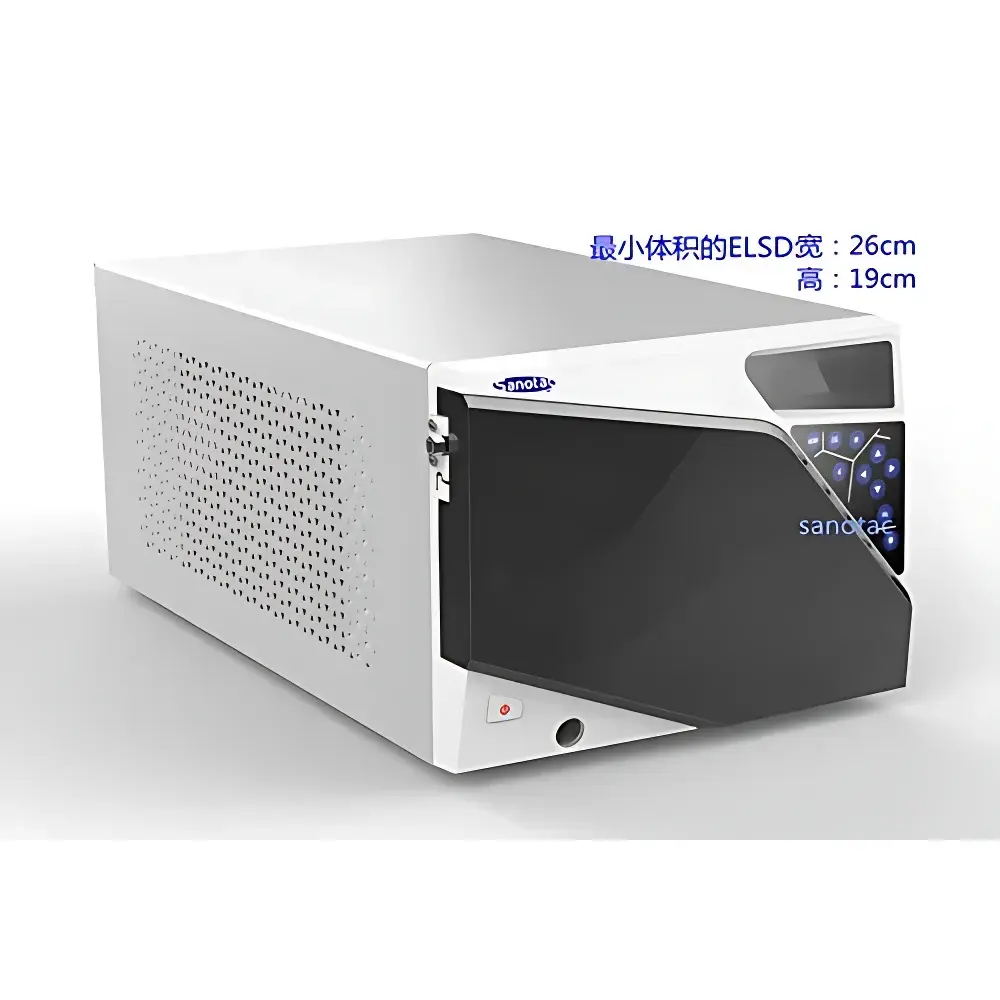
Sanotac ELSD-6000 Evaporative Light Scattering Detector
| Brand | Sanotac |
|---|---|
| Model | ELSD-6000 |
| Origin | Shanghai, China |
| Manufacturer Type | Manufacturer |
| Instrument Type | Evaporative Light Scattering Detector (ELSD) |
| Light Source | 650 nm semiconductor laser |
| Detection Principle | Mass-sensitive, non-destructive aerosol light scattering |
| Drift Tube Temperature Range | Ambient to 130 °C (1 °C increments) |
| Nebulizer Temperature Range | Ambient to 56 °C |
| Gas Flow Rate | 1–4 L/min (accuracy ≤1% or ±0.02 L/min) |
| Gas Pressure Range | 2–5 bar (pressure detection accuracy: 0.01 bar) |
| Mobile Phase Flow Rate Compatibility | 0.01–3 mL/min |
| Baseline Noise | ≤0.03 mV |
| Baseline Drift | ≤0.3 mV / 30 min |
| Minimum Detectable Mass | <1 ng |
| Typical Quantitation Range | 0.1–30 µg |
| Quantitative Repeatability (RSD) | ≤2% |
| Dynamic Range | 10⁴ (at fixed gain) |
| Gain Adjustment | Continuous, 0.3–30 |
| Analog Output | –1200 to +1200 mV |
| Data Acquisition Rate | 100 Hz (digital), 20 Hz (filtered) |
| Dimensions (W×H×D) | 26×19×46 cm |
| Weight | 10 kg |
| Compliance | FDA 21 CFR Part 11 (audit trail enabled in Clarity™ software) |
| Software Interface | RS-232, RS-485, USB, LAN (TCP/HTTP), programmable external event I/O |
Overview
The Sanotac ELSD-6000 is a high-performance evaporative light scattering detector engineered for universal, mass-based detection in liquid chromatography systems. Unlike UV-Vis absorbance detectors—which rely on chromophore-dependent optical properties—the ELSD-6000 operates on the principle of nebulization, solvent evaporation, and light scattering from non-volatile analyte particles. This makes it uniquely suited for compounds lacking strong UV chromophores, such as saponins (e.g., astragaloside IV), carbohydrates, lipids, polymers, and natural product glycosides. In pharmacopoeial analysis of traditional Chinese medicines—including Astragalus membranaceus—the ELSD-6000 delivers robust, reproducible quantification where UV detection fails due to weak or absent absorption at conventional wavelengths (e.g., only ~201 nm endpoint absorption for astragaloside IV). Its design adheres to core principles of quantitative HPLC detection: low baseline noise (<0.03 mV), minimal drift (≤0.3 mV/30 min), and precise thermal control (±1 °C) across both drift tube and nebulizer zones—critical for method transferability and regulatory compliance.
Key Features
- Compact footprint (26 × 19 × 46 cm) enabling seamless integration with stacked HPLC configurations
- High-sensitivity 650 nm semiconductor laser coupled with low-noise photomultiplier tube detection
- Independent dual-zone temperature control: drift tube (ambient–130 °C, 1 °C resolution) and nebulizer (ambient–56 °C)
- Programmable gas flow (1–4 L/min) with real-time pressure monitoring (0.01 bar resolution) and automatic safety cutoff
- Adjustable雾化 angle and heated nozzle—optimized for viscous or oily samples including saponin-rich extracts
- Linear gain tuning (0.3–30) and analog output offset (–1000 to +1000 mV) for peak height optimization without signal saturation
- 16-point automated self-diagnostic routine covering gas valves, heater status, laser activation, and flow integrity
- Full audit trail, electronic signatures, and user access control compliant with FDA 21 CFR Part 11 requirements via Clarity™ software
Sample Compatibility & Compliance
The ELSD-6000 detects any non-volatile or semi-volatile analyte with volatility lower than the mobile phase—regardless of UV absorbance, fluorescence, or electrochemical activity. It is routinely applied to pharmacopoeial assays per Chinese Pharmacopoeia (ChP), USP , and EP 2.2.28 for quality control of herbal active ingredients, including astragaloside IV in Astragali Radix. Method validation parameters—including specificity, linearity (0.1–30 µg), LOD (<1 ng), precision (RSD ≤2%), and robustness—are fully supported under GLP/GMP-aligned workflows. The detector’s gas delivery system accepts clean compressed air or nitrogen (2–5 bar), eliminating solvent compatibility constraints associated with RI detectors. All firmware and software modules undergo periodic verification per ISO/IEC 17025:2017 Annex A.3 (software validation) and are compatible with 21 CFR Part 11-compliant chromatography data systems (CDS).
Software & Data Management
The ELSD-6000 interfaces natively with industry-standard CDS platforms via multiple protocols: RS-232, RS-485, USB, and Ethernet (TCP/HTTP). Its embedded Clarity™ dynamic link library (DLL) enables bidirectional communication with third-party HPLC controllers—including Agilent, Waters, Shimadzu, and Thermo systems—without proprietary lock-in. The included Clarity™ software provides full method management (10 methods × 25 parameters), real-time parameter logging, and time-stamped audit trails for all configuration changes, calibration events, and user logins. Raw detector signals are acquired at 100 Hz and post-processed with configurable digital filtering (20 Hz output). All data files are stored in vendor-neutral formats (e.g., .CDF, .CSV) with embedded metadata—including instrument ID, operator, timestamp, and environmental conditions—for traceability in regulatory submissions.
Applications
- Quantitative HPLC-ELSD determination of astragaloside IV in Astragalus root and compound formulas per ChP monographs
- Analysis of non-UV-absorbing phytochemicals: ginsenosides, glycyrrhizin, polyphenol glycosides, and triterpene saponins
- Fatty acid methyl ester (FAME) profiling in lipidomics without derivatization
- Carbohydrate mapping in polysaccharide-based therapeutics (e.g., heparin analogs, arabinogalactans)
- Polymer molecular weight distribution (MWD) assessment when coupled with SEC
- Stability-indicating assays for APIs lacking chromophores—particularly in early-phase formulation development
FAQ
Is the ELSD-6000 compatible with gradient elution methods?
Yes—its rapid thermal equilibration (<60 s between setpoint changes) and stable baseline under varying organic solvent composition make it suitable for binary and ternary gradients.
What mobile phases are recommended for astragaloside IV analysis using this detector?
Acetonitrile–water (32:68 v/v) is validated for kromasil C18 columns (4.6 × 250 mm, 5 µm); other volatile modifiers (e.g., formic acid ≤0.1%) may be used with appropriate nebulizer temperature adjustment.
Does the detector require daily maintenance beyond standard HPLC system upkeep?
No scheduled consumables are required; routine cleaning of the nebulizer capillary and drift tube every 200 injections ensures optimal performance and longevity.
Can the ELSD-6000 be operated unattended overnight?
Yes—integrated hardware watchdog timers, automatic shutdown on gas loss or overtemperature, and remote monitoring via LAN enable secure unattended operation.
How does ELSD compare to CAD (Charged Aerosol Detection) for saponin analysis?
While CAD offers higher sensitivity for some polar analytes, ELSD demonstrates superior ruggedness in high-salt or buffer-containing mobile phases—and requires no corona discharge voltage regulation, reducing long-term calibration drift.





