
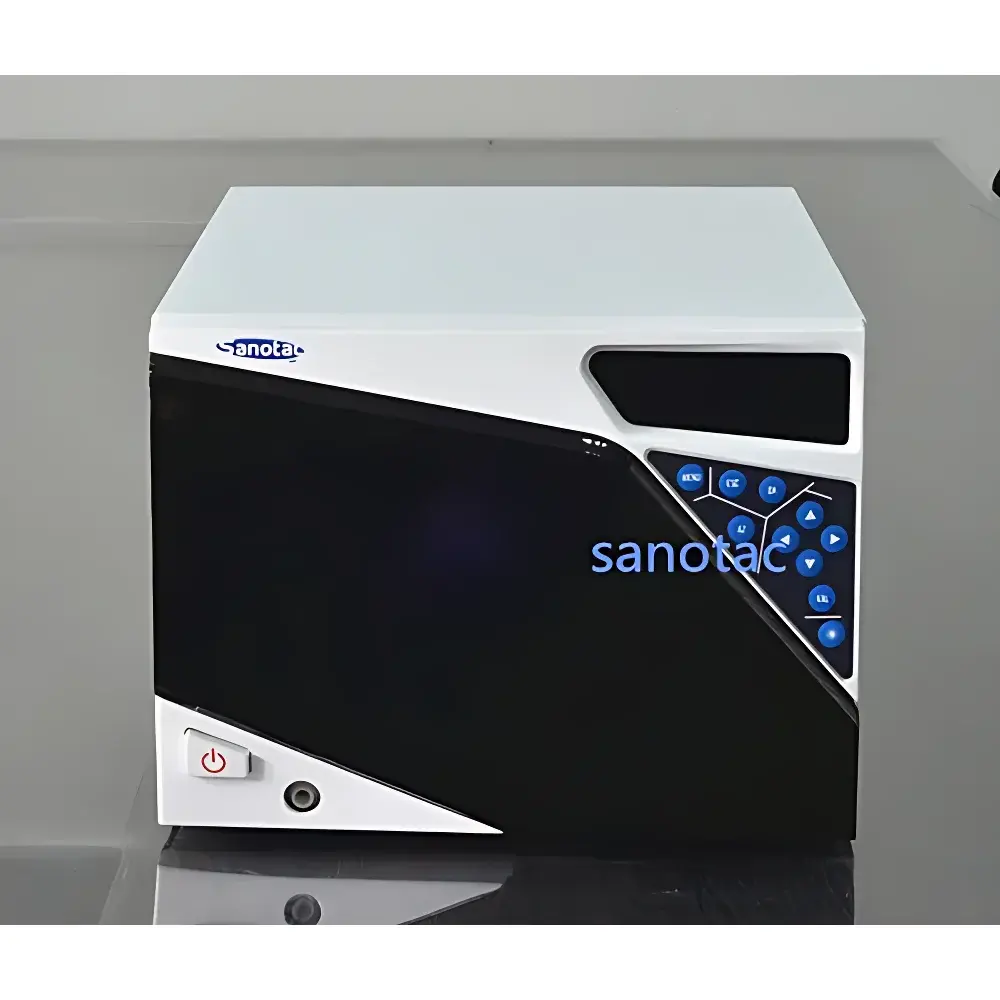
Sanotac ELSD6000 Plus Evaporative Light Scattering Detector (EasyChrom Workstation-Driven Version)
| Brand | Sanotac |
|---|---|
| Origin | Shanghai, China |
| Manufacturer Type | Manufacturer |
| Product Category | Domestic |
| Model | ELSD6000 Plus |
| Instrument Type | Evaporative Light Scattering Detector (ELSD) |
| Wavelength | 650 nm |
| Detection Mode | Low-Temperature Evaporation |
| Light Source | Semiconductor Laser |
Overview
The Sanotac ELSD6000 Plus is a high-performance, benchtop evaporative light scattering detector engineered for universal, non-destructive quantification of non-volatile and semi-volatile analytes in liquid chromatography. Operating on the fundamental principle of nebulization, solvent evaporation, and light scattering detection, it delivers mass-sensitive response independent of chromophore presence—making it especially valuable for compounds lacking UV absorbance, such as carbohydrates, lipids, polymers, saponins, and excipients. Unlike refractive index (RI) detectors, the ELSD6000 Plus exhibits superior sensitivity (detection limit <1 ng), minimal temperature dependence, and stable baseline performance (<0.03 mV noise, ≤0.3 mV/30 min drift). Its compact footprint (26 × 19 × 46 cm) enables seamless integration into stacked HPLC configurations, while its native digital signal output eliminates the need for external analog-to-digital converters when interfaced with Sanotac’s EasyChrom series workstations (EasyChrom, EasyChrom 1000, EasyChrom 2000).
Key Features
- Direct digital communication with EasyChrom chromatography data systems—no external ADC required
- Integrated low-noise photomultiplier tube (PMT) detector with 650 nm semiconductor laser illumination for consistent scattering efficiency
- Precise dual-zone thermal control: evaporation chamber (room temp–130 °C, ±1 °C accuracy) and nebulizer block (room temp–56 °C, ±1 °C accuracy)
- Programmable gas flow regulation (1–4 L/min, ≤1% or 0.02 L/min accuracy) using clean air or nitrogen (2–5 bar input pressure, 0.01 bar monitoring resolution)
- Automated 16-point self-diagnostic routine covering gas integrity, heater status, laser activation, valve operation, and flow path safety interlocks
- Rapid auxiliary cooling system and adjustable-angle nebulizer tube to optimize droplet size distribution and minimize carryover
- Energy-efficient standby mode with reduced power draw and automatic thermal stabilization upon wake-up
Sample Compatibility & Compliance
The ELSD6000 Plus supports gradient-compatible mobile phases containing volatile solvents (e.g., acetonitrile, methanol, water, THF, chloroform), excluding non-volatile buffers (e.g., phosphate, sulfate salts) unless paired with volatile counterions (e.g., ammonium acetate/formate). It accommodates flow rates from 0.01 to 3 mL/min, making it suitable for analytical-scale UHPLC, HPLC, and preparative LC systems. The detector complies with general laboratory instrumentation requirements under ISO/IEC 17025 for method validation and supports audit-ready data acquisition when used with Clarity™ CDS (via Colibrick™ interface), enabling full traceability per FDA 21 CFR Part 11 for electronic records and signatures. Its robust architecture meets GLP/GMP environmental operating specifications (15–30 °C, 20–80% RH, non-condensing), and its sealed optical path minimizes contamination risk during long-term unattended operation.
Software & Data Management
The ELSD6000 Plus integrates natively with Sanotac’s proprietary multi-platform chromatography software and fully supports Clarity™ 5.x/6.x via dynamic-link library (DLL) interface. Method storage includes up to 10 user-defined protocols, each containing 25 configurable parameters (e.g., evap temp, nebulizer temp, gas flow, gain, offset, sampling rate). All settings are recalled automatically during sequence execution. Communication interfaces include RS-232, RS-485, USB, and TCP/IP (HTTP-based LAN control), enabling remote monitoring and event-triggered actions (e.g., auto-zero, laser shutdown, gas valve actuation). Raw digital output is sampled at 100 Hz (configurable to 20 Hz), with analog output range ±1200 mV and continuously adjustable gain (0.3–30×). Audit trails, parameter change logs, and instrument status timestamps are embedded in exported .csv and .cdf files.
Applications
This ELSD serves as a primary detection solution in regulated and research environments where UV-invisible analytes dominate. Key use cases include: quantification of polysaccharides and glycosides in traditional Chinese medicine (TCM) extracts per Chinese Pharmacopoeia monographs; profiling of fatty acids and triglycerides in food and biodiesel analysis; characterization of synthetic and natural polymers (e.g., PEG, dextran); assay of amino acid derivatives and peptide fragments in bioprocess monitoring; and stability-indicating analysis of pharmaceutical formulations containing non-UV-absorbing excipients (e.g., lactose, mannitol, hydroxypropyl methylcellulose). Its wide dynamic range (10⁴ at fixed gain) and quantitative repeatability (≤2% RSD) support validated methods aligned with ICH Q2(R2) guidelines.
FAQ
Does the ELSD6000 Plus require a separate analog-to-digital converter to connect with EasyChrom software?
No—its native digital signal output connects directly to EasyChrom workstations without an external ADC.
Can the detector operate with nitrogen instead of compressed air?
Yes—both clean, oil-free compressed air and nitrogen (2–5 bar) are supported; nitrogen improves baseline stability in sensitive applications.
Is the ELSD6000 Plus compatible with third-party HPLC systems (e.g., Agilent, Waters, Shimadzu)?
Yes—via RS-232/RS-485 or TCP/IP, and through Clarity™ CDS with Colibrick™ hardware interface.
What is the minimum detectable mass for a typical compound like sucrose?
Under optimized conditions, the limit of detection is <1 ng on-column for sucrose, corresponding to ~0.1 µg absolute mass.
How does the instrument prevent solvent condensation or residue buildup in the detection chamber?
Through real-time gas pressure monitoring, adaptive temperature ramping, automated purge cycles, and fail-safe interlocks that disable nebulization if gas flow falls below threshold.
Related Products






