
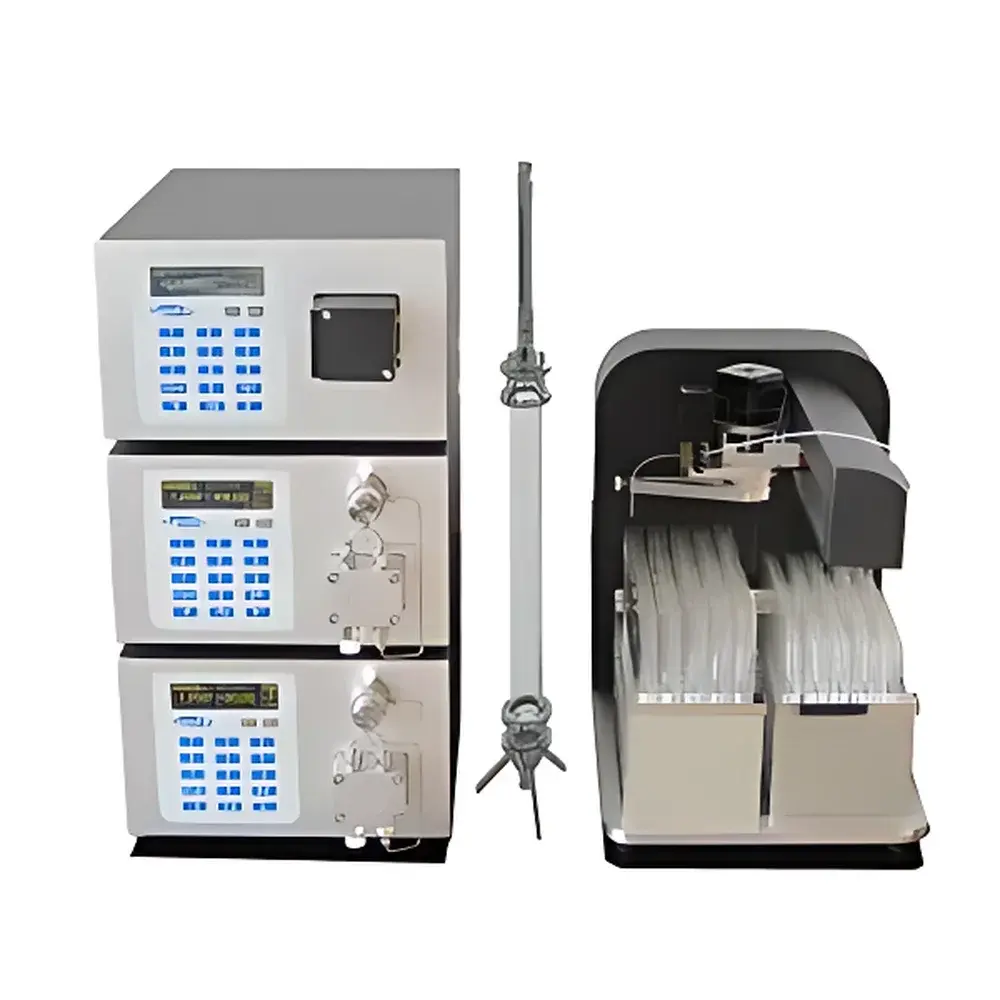
Sanotac ePurify-100 Medium-Pressure Preparative Liquid Chromatography System
| Brand | Sanotac |
|---|---|
| Origin | Shanghai, China |
| Manufacturer Type | Manufacturer |
| Product Category | Domestic |
| Model | ePurify-100 |
| Application Level | Laboratory Grade |
| Instrument Type | Medium-Low Pressure Preparative LC |
| Flow Rate Range | 0.01–100.00 mL/min |
| Flow Accuracy | ±1% |
| Flow Precision (RSD) | ≤0.5% |
| Maximum Pressure | 10 MPa |
| Wavelength Range | 190–800 nm |
| Wavelength Accuracy | ±1 nm |
| Wavelength Repeatability | 0.2 nm |
| Baseline Noise | ±0.75×10⁻⁵ AU (254 nm, TC = 1 s) |
| Data Acquisition Rate | 10 Hz |
Overview
The Sanotac ePurify-100 is a modular, medium-pressure preparative liquid chromatography (PLC) system engineered for high-fidelity isolation and purification of bioactive compounds from complex natural matrices—particularly functional food ingredients, botanical extracts, nutraceuticals, and synthetic intermediates. Operating on the principle of reversed-phase or normal-phase partition chromatography, the system delivers precise solvent gradient elution, real-time dual-wavelength UV-Vis detection, and programmable fraction collection under controlled pressure (up to 10 MPa) and flow (0.01–100.00 mL/min). Its architecture integrates a dual-piston, microprocessor-controlled pump with cavity pressure feedback and solvent compressibility compensation—enabling stable flow delivery across the full dynamic range without pulsation-induced baseline disturbance. Designed for laboratory-scale process development and gram-to-tens-of-grams purification, the ePurify-100 bridges the gap between analytical HPLC and industrial-scale prep systems, offering reproducible method transfer, regulatory-compliant operation, and seamless scalability to pilot-scale workflows.
Key Features
- High-precision dual-piston pump with PEEK or 316L stainless steel wetted parts; supports gradient elution with up to four solvents and real-time adjustment of flow rate and gradient profile.
- Dual-wavelength UV-Vis detector (190–800 nm) featuring deuterium and tungsten lamp auto-switching, ±1 nm wavelength accuracy, and simultaneous dual-channel absorbance monitoring for co-eluting component discrimination.
- Low-noise optical design: baseline noise ≤±0.75×10⁻⁵ AU at 254 nm (1 s time constant); optimized flow cell geometry and temperature-stabilized optics minimize drift and enhance signal-to-noise ratio.
- Intelligent fraction collector with hybrid linear-rotary motion mechanism, sub-millisecond valve switching, independent waste channel, and delay-volume compensation for precise peak-triggered collection.
- Modular hardware interface supporting stainless steel and medium-pressure glass columns (up to 50 mm ID); compatible with standard 13–15 mm OD test tubes (max. 120 positions), with automatic rack recognition and misalignment prevention.
- Sanochrom™ control software compliant with FDA 21 CFR Part 11: audit trail logging, electronic signatures, user role management, and method locking for GLP/GMP-aligned environments.
Sample Compatibility & Compliance
The ePurify-100 accommodates diverse sample formats—including crude plant extracts, fermented broths, hydrolyzed protein digests, and synthetic reaction mixtures—without requiring pre-filtration beyond 0.45 µm. Its pressure and flow flexibility supports silica-, C18-, amino-, and diol-based stationary phases in column diameters from 10 mm to 50 mm. The system meets ISO/IEC 17025 calibration traceability requirements for flow and wavelength performance. All UV detection parameters conform to ASTM E275 and USP specifications for photometric accuracy and linearity. Data integrity protocols—including secure user authentication, immutable audit trails, and encrypted method storage—facilitate compliance with pharmaceutical quality systems (ICH Q5, Q7) and food safety standards (ISO 22000, FSSC 22000).
Software & Data Management
Sanochrom™ software provides unified control of pump, detector, and fraction collector via USB or RS-232 interfaces on Windows 7/8/10 platforms. It enables full method programming—including multi-step gradients, wavelength time programs, stop-flow spectral scanning, and conditional collection logic (time, volume, threshold, or derivative-based triggers). Real-time multi-wavelength chromatograms are displayed alongside collected fraction maps. Raw data (.chd) and processed reports (.pdf/.xlsx) are stored with embedded metadata (operator, timestamp, instrument ID, versioned method). Software validation documentation—including IQ/OQ protocols and 21 CFR Part 11 configuration files—is provided for regulated laboratories. Export options include AIA/CDF format for integration with LIMS and ELN platforms.
Applications
- Purification of polyphenols (e.g., resveratrol, quercetin), carotenoids (β-carotene, lutein), and flavonoid glycosides from fruit, vegetable, and algal extracts.
- Isolation of bioactive peptides and minor alkaloids from traditional herbal matrices (e.g., Ginkgo biloba, Epimedium sagittatum) under GMP-relevant conditions.
- Separation of enantiomeric pairs and regioisomers in synthetic nutraceutical intermediates using chiral or HILIC columns.
- Desalting and buffer exchange of small-molecule APIs prior to crystallization or formulation studies.
- Method scouting and robustness testing for downstream scale-up to semi-preparative or production-scale chromatography systems.
FAQ
What column types and dimensions are supported?
The ePurify-100 accepts standard medium-pressure columns with internal diameters from 10 mm to 50 mm, including stainless steel, glass-jacketed, and disposable cartridge formats. Both reversed-phase (C18, C8) and normal-phase (silica, NH₂) media are routinely deployed.
Can the system be validated for regulated use?
Yes—Sanochrom™ software includes 21 CFR Part 11 compliance features (electronic signatures, audit trails, method locking), and IQ/OQ documentation packages are available upon request for GxP environments.
How is dwell volume compensated during gradient method transfer?
The system allows user-defined delay volume input in the collection module; combined with real-time UV signal processing, this ensures accurate fraction assignment even when transferring methods from analytical to preparative scales.
Is remote monitoring or integration with lab automation possible?
While native Ethernet connectivity is not included, RS-232 and USB interfaces support third-party SCADA or LabVIEW integration via custom drivers; remote desktop access to the host PC is feasible within secure network architectures.
What maintenance intervals are recommended for the pump and detector?
Pump seals require inspection every 500 operational hours; UV lamps are rated for ≥2,000 hours and feature automatic usage logging. Annual calibration of flow rate and wavelength accuracy is advised per ISO/IEC 17025 guidelines.




