
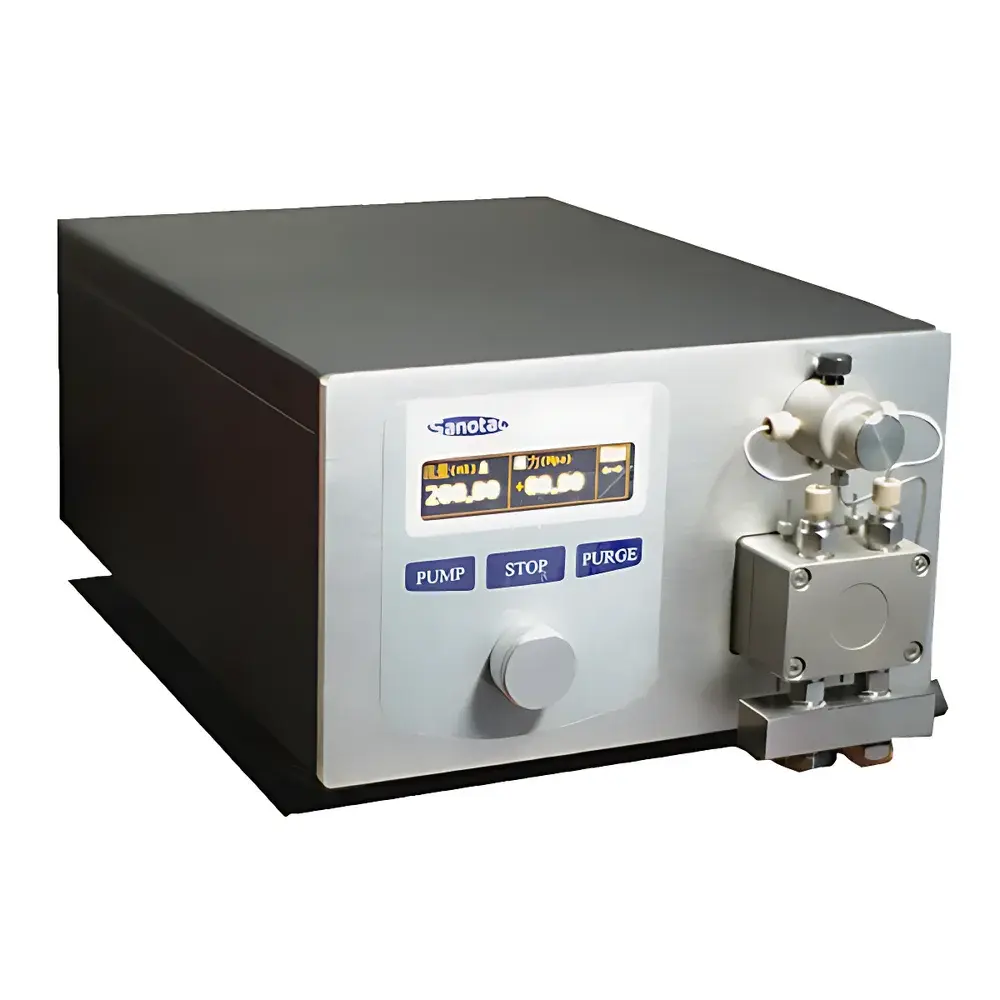
Sanotac FLASH1020 High-Pressure Dual-Piston Precision Metering Pump
| Brand | Sanotac |
|---|---|
| Origin | Shanghai, China |
| Manufacturer Type | Direct Manufacturer |
| Product Category | Domestic |
| Model | FLASH1020 |
| Price Range | USD 1,400 – 2,800 |
| Flow Rate | 10–10,000 mL/min |
| Maximum Pressure | 42 MPa |
| Pump Head Volume | 100 mL |
| Max Operating Pressure (Rated) | 20 MPa |
| Construction Materials | Stainless Steel / Titanium / PTFE / PCTFE / Hastelloy / PEEK |
| Control Interface | Microprocessor-Based Dual-Drive System with Open Communication Protocol (RS-485/Modbus or Ethernet optional) |
| Gradient Capability | Isocratic, Linear, and Step Gradient Combinations |
| Pulse Dampening | Cam Profile Compensation + Electronic Flow Pulse Suppression |
| Seal Longevity | Floating Piston Design with Imported Swiss Check Valves |
Overview
The Sanotac FLASH1020 is a high-pressure, dual-piston precision metering pump engineered for demanding laboratory and pilot-scale applications requiring stable, reproducible fluid delivery under elevated pressure conditions. Based on positive displacement reciprocating piston technology, the FLASH1020 employs a parallel dual-head architecture synchronized via a precision-machined camshaft to deliver continuous, pulse-minimized flow across an exceptionally wide dynamic range—from 10 mL/min up to 10,000 mL/min—while maintaining rated pressure capability of 20 MPa (2900 psi), with short-term tolerance up to 42 MPa (6090 psi). Its design integrates fundamental principles of compressibility compensation and real-time volumetric calibration, enabling accurate solvent delivery in systems where fluid density, viscosity, and thermal expansion significantly affect volumetric fidelity—particularly critical in supercritical fluid processing, catalytic reaction engineering, and preparative liquid chromatography.
Key Features
- Dual-piston parallel drive system with microprocessor-controlled synchronization ensures consistent phase offset and minimizes net flow pulsation.
- Multi-point flow calibration algorithm compensates for solvent compressibility across pressure gradients, supporting accurate delivery of organic solvents, water, CO₂-based supercritical fluids, and viscous catalyst slurries.
- Cam profile optimization combined with electronic pulse suppression reduces pressure ripple to < ±0.5% of set pressure—essential for sensitive detector interfaces and reactor feed stability.
- Floating piston assembly decouples axial load from seal contact surface, extending service life of high-pressure sealing elements; paired with OEM Swiss-sourced sapphire-seat check valves for >10⁷ cycle durability.
- Open communication protocol (Modbus RTU over RS-485 standard, optional TCP/IP) enables seamless integration into third-party LIMS, SCADA, or chromatography data systems without proprietary middleware.
- Ten onboard user-programmable methods support complex gradient profiles—including hybrid isocratic/linear/step sequences—with independent ramp rate control per segment.
Sample Compatibility & Compliance
The FLASH1020 accommodates chemically aggressive media through modular wetted-material configurations: 316L stainless steel for general-purpose use; titanium grade 2 for chloride-rich environments; PTFE- and PCTFE-lined heads for strong acids and fluorinated solvents; Hastelloy C-276 for hot alkaline or oxidizing streams; and PEEK-composite variants for ultra-high-purity pharmaceutical or battery electrolyte handling. All configurations comply with ISO 8503-2 surface roughness standards for hygienic fluid pathways and meet mechanical safety requirements per EN 61000-6-2/6-4 (EMC) and EN 61010-1 (electrical safety). While not certified for ASME B31.3 process piping, the pump is routinely deployed in GLP-compliant labs performing ASTM D6982 (catalyst slurry dosing), USP (HPLC method transfer), and ISO 17025-accredited validation protocols.
Software & Data Management
Local operation utilizes a backlit 4.3-inch capacitive touchscreen with intuitive icon-driven navigation and real-time graphical display of flow, pressure, and motor torque. All method parameters—including gradient timepoints, flow ramps, hold durations, and pressure limits—are timestamped and stored with audit trail metadata. When connected to external controllers, the pump supports full 21 CFR Part 11 compliance via optional digital signature modules and electronic record retention (≥18 months). Raw operational logs export in CSV format with millisecond-resolution timestamps, facilitating root-cause analysis during process deviation investigations or regulatory inspections.
Applications
- Preparative and process-scale liquid chromatography (prep-LC, SMB, simulated moving bed)
- Catalyst injection and co-feed control in fixed-bed and slurry-phase reactors
- Supercritical CO₂ extraction and impregnation systems
- Electrolyte formulation and electrode slurry metering in battery R&D
- High-pressure polymerization initiation (e.g., ethylene, propylene)
- Chemical dosing in corrosion testing loops and accelerated aging chambers
- Calibration reference flow sources for gravimetric and turbine-based flow meters
FAQ
What is the maximum continuous operating pressure for the FLASH1020?
The pump is rated for continuous operation at 20 MPa (2900 psi); brief excursions up to 42 MPa are permitted for system purge or transient pressure testing.
Can the FLASH1020 be used with corrosive solvents like hydrofluoric acid?
Only with PCTFE- or Hastelloy C-276-configured wetted parts—standard stainless steel heads are incompatible with HF.
Is gradient programming possible without external software?
Yes—ten fully editable gradient methods can be defined and executed directly from the front panel interface.
Does the pump support automatic leak detection or dry-run protection?
No built-in sensor-based dry-run detection is included; however, motor current monitoring and pressure deviation alarms can be configured as proxy indicators via external PLC logic.
Are calibration certificates traceable to NIST or other national standards bodies available?
Factory calibration reports (ISO/IEC 17025 accredited) are provided upon request; NIST-traceable flow verification requires third-party metrology lab engagement.



