
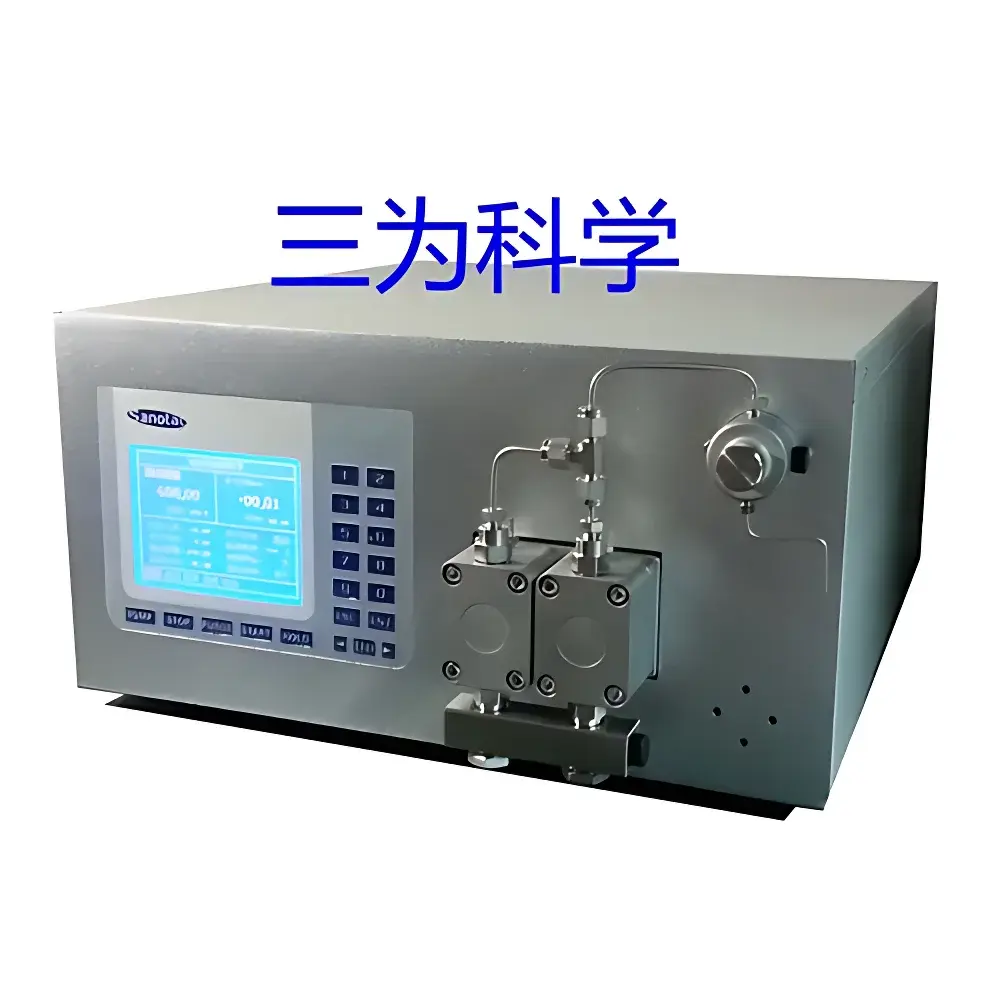
Sanotac FY0013 High-Pressure Solvent Delivery Pump
| Brand | Sanotac |
|---|---|
| Origin | Shanghai, China |
| Manufacturer Type | Direct Manufacturer |
| Model | FY0013 |
| Flow Range | 0.001–9.999 mL/min |
| Flow Increment | 0.001 mL/min |
| Flow Accuracy | ±0.1% |
| Flow Precision (RSD) | ≤0.1% |
| Max Pressure | 42 MPa |
| Pressure Pulsation | ≤0.1 MPa |
| Pumping Mechanism | Dual-piston series configuration with floating piston design |
| Wetted Materials | 316L stainless steel, ruby, PTFE, ceramic |
| Tubing Connection | 1/16" standard |
| Display | 256×64 dot matrix backlit LCD |
| Control Interface | Front-panel keypad + RS232/USB computer reverse control (open protocol) |
| Power Supply | 85–264 VAC, 50 Hz |
| Dimensions | 370 × 240 × 152 mm |
| Compliance | Designed for GLP-compliant lab environments |
Overview
The Sanotac FY0013 High-Pressure Solvent Delivery Pump is an engineered constant-flow precision instrument designed for demanding chemical synthesis applications requiring stable, programmable, and pulse-free fluid delivery under elevated pressure. Based on dual-piston serial pumping architecture with floating piston mechanics, the FY0013 operates on positive displacement principles—ensuring volumetric accuracy independent of solvent compressibility or backpressure fluctuations. Its core function is to deliver reagents, catalysts, or solvents at precisely defined flow rates across a wide dynamic range (0.001–9.999 mL/min), supporting reaction systems where stoichiometric control, residence time consistency, and thermal safety are critical—especially in exothermic or hazardous transformations such as nitration, fluorination, peroxidation, and carbonylation. The pump’s maximum pressure rating of 42 MPa enables compatibility with high-backpressure microreactors, packed-bed catalytic systems, and supercritical fluid-assisted synthesis setups.
Key Features
- High-accuracy flow control: Achieves ±0.1% flow accuracy and ≤0.1% RSD via multi-point flow calibration curves, solvent compressibility compensation algorithms, and real-time microprocessor feedback.
- Low-pressure pulsation design: Integrates cam-profile optimization and electronic flow-pulse suppression to maintain pressure stability ≤0.1 MPa, minimizing mechanical stress on reactor seals and improving reproducibility in continuous-flow chemistry.
- Dual-piston serial architecture with floating piston mechanism: Reduces seal wear by dynamically equalizing load distribution across piston surfaces, extending service life of high-pressure sealing components.
- Chemically inert fluid path: Constructed from 316L stainless steel, sapphire check valves, ceramic plungers, and PTFE seals—compatible with aggressive media including concentrated acids, halogenated solvents, anhydrous reagents, and oxidizers.
- Flexible gradient capability: Supports isocratic, linear, and step-gradient profiles; programmable via front-panel interface or external workstation using open-protocol RS232/USB communication.
- Human-centric operation: Features a 256×64 backlit LCD display, intuitive keypad navigation, and onboard storage for up to 10 user-defined methods—including flow rate, gradient slope, hold time, and pressure limit parameters.
Sample Compatibility & Compliance
The FY0013 accommodates a broad spectrum of process liquids—from low-viscosity organic solvents (e.g., THF, DCM, acetonitrile) to moderately viscous reagent slurries and ionic liquid mixtures—without compromising delivery fidelity. Its wetted materials meet ASTM F2136 and ISO 10993-1 biocompatibility screening prerequisites for non-invasive contact, making it suitable for pharmaceutical intermediate synthesis under cGMP-aligned workflows. While not certified as a medical device, its mechanical robustness, traceable calibration routines, and support for electronic audit trails align with FDA 21 CFR Part 11 requirements when integrated into validated chromatographic or flow chemistry platforms. All units undergo factory pressure testing at 1.5× rated maximum (63 MPa) and include material certification documentation per EN 10204 3.1.
Software & Data Management
The FY0013 implements an open-command-set communication protocol (ASCII-based, documented in technical appendix), enabling seamless integration with third-party laboratory data systems—including Empower, Chromeleon, LabSolutions, or custom Python/Node.js control scripts. It supports timestamped event logging (start/stop, error codes, pressure alarms), real-time flow/pressure telemetry streaming, and method synchronization across multi-pump configurations. When deployed within a GLP-regulated environment, the pump can be configured to generate immutable log files compliant with ALCOA+ principles (Attributable, Legible, Contemporaneous, Original, Accurate, Complete, Consistent, Enduring, Available). Optional firmware updates provide enhanced cybersecurity features, including TLS-enabled remote diagnostics and role-based access control for method editing.
Applications
This pump serves as a core fluidic actuator in automated synthesis platforms for fine chemical manufacturing, API route scouting, and library diversification. Typical use cases include: pressurized hydrogenation in flow reactors; controlled addition of diazonium salts in azo-coupling sequences; metered delivery of phosgene substitutes in carbamoylation; solvent-controlled crystallization in continuous antisolvent precipitation; and precise co-injection of monomers in living radical polymerization. Its reliability under sustained 42 MPa operation also supports applications in supercritical CO₂ extraction pre-concentration, hydrothermal synthesis feed systems, and electrochemical flow cell electrolyte circulation—where long-term flow stability directly impacts product purity and batch-to-batch equivalence.
FAQ
What is the maximum allowable viscosity for stable operation?
The FY0013 maintains specified accuracy up to 20 cP at 5 mL/min and 42 MPa; for viscosities >10 cP, pre-heating the fluid path to reduce resistance is recommended.
Can the pump handle abrasive slurries?
It is not recommended for solid-laden suspensions exceeding 0.5 µm particle size; optional ceramic-plunger upgrades improve abrasion resistance for limited slurry duty.
Is firmware update capability available?
Yes—field-upgradable via USB stick; release notes and validation reports are provided with each version.
Does the pump support analog signal input for external flow modulation?
No; only digital command protocols (RS232/USB) are supported—no 0–10 V or 4–20 mA analog interface is built-in.
What documentation accompanies the unit for regulatory submissions?
Factory calibration certificate (NIST-traceable), material compliance dossier (RoHS/REACH), electrical safety report (IEC 61010-1), and software verification summary are included in the shipping package.



