
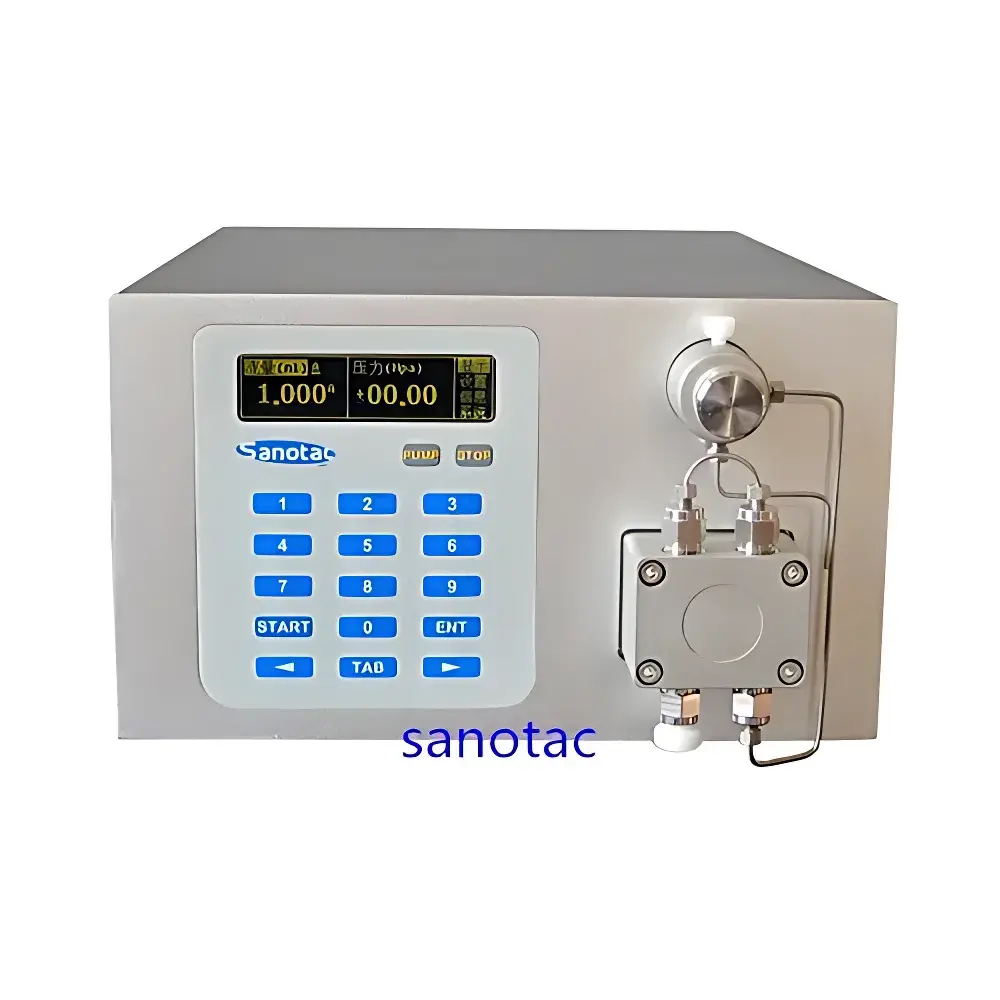
Sanotac GC0530 High-Pressure, High-Precision Dual-Piston Constant Flow Pump for Fixed-Bed and Fluidized-Bed Reactor Systems
| Brand | Sanotac |
|---|---|
| Origin | Shanghai, China |
| Manufacturer Type | OEM/ODM Manufacturer |
| Country of Origin | China |
| Model | GC0530 |
| Price Range | USD 1,400 – 2,800 |
| Flow Range | 0.01–50.00 mL/min |
| Flow Increment | 0.01 mL/min |
| Flow Accuracy | ±0.5% |
| Flow Precision (RSD) | ≤0.1% |
| Max Pressure | 30 MPa |
| Pressure Pulsation | ≤0.2 MPa |
| Pumping Mechanism | Dual-piston parallel mode with floating piston design |
| Wetted Materials | 316L stainless steel, ruby, PTFE, ceramic |
| Tubing Connection | 1/16" standard fittings |
| Display | 256×64 dot matrix backlit LCD |
| Control Options | Front-panel keypad + RS232/USB computer remote control (open protocol) |
| Power Supply | 85–264 VAC, 50 Hz |
| Dimensions (W×D×H) | 370×240×152 mm |
Overview
The Sanotac GC0530 is a high-pressure, high-precision dual-piston constant flow pump engineered specifically for integration into fixed-bed and fluidized-bed catalytic reaction test systems, hydroprocessing units, and catalyst evaluation rigs. It operates on the principle of positive displacement via synchronized parallel dual-piston actuation, incorporating floating piston architecture to minimize mechanical stress on sealing components under sustained high-pressure conditions. Designed for continuous, pulse-dampened delivery of aggressive solvents, corrosive reagents, or viscous process streams—common in petrochemical, fine chemical, and energy research—the GC0530 delivers stable volumetric flow across a wide dynamic range (0.01–50.00 mL/min) at pressures up to 30 MPa. Its microprocessor-controlled solvent compressibility compensation and multi-point flow calibration algorithm ensure traceable accuracy (±0.5%) and exceptional repeatability (RSD ≤0.1%), meeting the metrological requirements of GLP-compliant laboratory environments and pre-regulatory catalyst performance screening.
Key Features
- Dual-piston parallel pumping mechanism with floating piston design—reduces seal wear and extends service life under prolonged high-pressure operation.
- Integrated cam-profile compensation and real-time electronic flow pulsation suppression—limits pressure ripple to ≤0.2 MPa, critical for stable reactor hydrodynamics and accurate kinetic data acquisition.
- Multi-point flow curve calibration across the full operational range—enables consistent accuracy from ultra-low (0.01 mL/min) to high-flow (50 mL/min) regimes without manual recalibration.
- Chemically inert wetted path comprising 316L stainless steel, ruby check valves, PTFE seals, and ceramic plungers—compatible with halogenated solvents, strong acids (e.g., HCl, H₂SO₄), caustics, and high-temperature hydrocarbon feeds.
- Open-protocol RS232/USB interface—supports bidirectional communication with third-party chromatography data systems (CDS), LIMS, or custom SCADA platforms; no proprietary driver required.
- Front-panel programmability with 10 user-defined methods—allows storage of flow rate, gradient profile (isocratic, linear, step), and pressure limit settings for rapid method recall during multi-condition catalyst testing.
Sample Compatibility & Compliance
The GC0530 is routinely deployed in ASTM D3241 (jet fuel thermal oxidative stability), ISO 10724 (catalyst testing under simulated industrial conditions), and USP method transfer workflows requiring precise reagent delivery. Its fluidic architecture conforms to ASME B31.3 process piping guidelines for lab-scale reactor feed systems. All wetted materials comply with FDA 21 CFR Part 177 (indirect food additives) and EU Regulation (EC) No. 1935/2004 for contact with food simulants—making it suitable for pharmaceutical excipient evaluation and nutraceutical process development. The pump’s mechanical design supports GMP-aligned maintenance logs, and its firmware records audit-trail-capable event timestamps (power-on, pressure fault, flow deviation >1.5% threshold) per ALCOA+ principles.
Software & Data Management
The GC0530 communicates via ASCII-based command set over RS232 or USB virtual COM port—fully documented in the publicly available Communication Protocol Manual (v3.2). It integrates natively with Thermo Fisher Chromeleon, Waters Empower, and Agilent OpenLab CDS through generic pump device drivers. For custom automation, Python, LabVIEW, and MATLAB APIs are provided with example scripts for batch-run catalyst aging protocols. All flow and pressure data are timestamped at 100 Hz resolution and exportable as CSV or HDF5—supporting post-hoc correlation with online GC/TCD or mass spectrometry outputs in time-synchronized reaction monitoring.
Applications
- Catalyst deactivation studies under realistic pressure/temperature gradients in fixed-bed microreactors.
- Fluidized-bed Fischer–Tropsch synthesis feed control with precise syngas (H₂/CO) ratio modulation.
- Hydrodesulfurization (HDS) and hydrodenitrogenation (HDN) screening using model sulfur/nitrogen compounds in high-boiling distillates.
- Continuous-flow hydrogenation of unsaturated fatty acids or chiral intermediates under 20–30 MPa H₂ partial pressure.
- Accelerated solvent extraction (ASE) and supercritical fluid delivery in material synthesis workflows.
- Calibration and validation of inline densitometers, Coriolis meters, or ultrasonic flow sensors in pilot-scale loops.
FAQ
Is the GC0530 compatible with aggressive solvents such as concentrated HF or fuming nitric acid?
The standard 316L/PTFE/ruby configuration is not rated for anhydrous HF or >90% HNO₃. For such applications, Sanotac offers optional Hastelloy C-276 or pure titanium (Grade 7) fluidic modules—contact technical support for material compatibility matrices.
Can the pump maintain flow stability during rapid temperature cycling (e.g., 25°C → 200°C) in a heated reactor feed line?
Yes—its active solvent compressibility compensation dynamically adjusts piston stroke volume based on real-time fluid density estimates derived from temperature and viscosity inputs (requires external PT100 sensor integration via optional analog input module).
Does the GC0530 meet FDA 21 CFR Part 11 requirements for electronic records and signatures?
While the pump itself does not store electronic signatures, its open-protocol interface enables full traceability when integrated into validated CDS environments that implement Part 11 controls—including audit trails, role-based access, and electronic signature capture at the system level.
What is the recommended preventive maintenance interval under continuous 24/7 operation at 25 MPa?
Sanotac specifies 6-month intervals for seal inspection and cam lubrication under these conditions; lifetime expectancy of ruby check valves exceeds 12,000 operating hours with proper filtration (≤0.5 µm upstream).



