
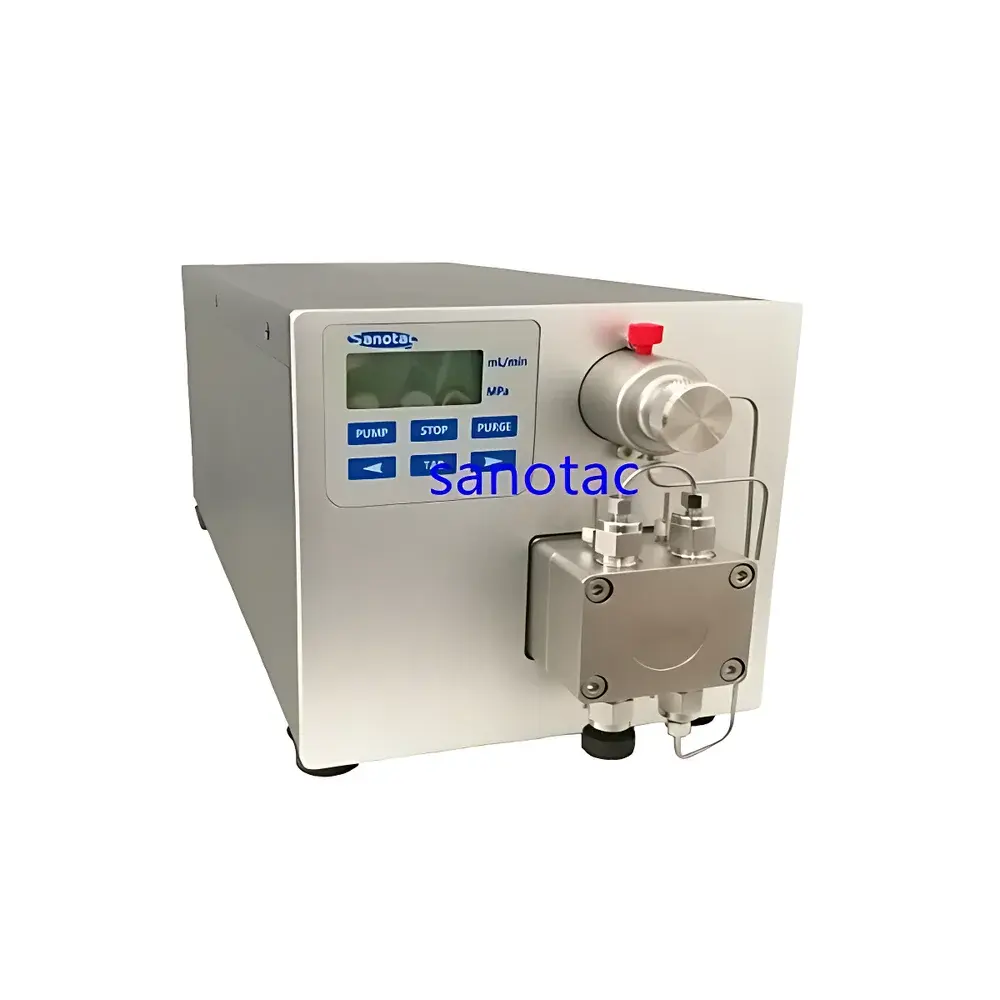
Sanotac GJ0010 High-Pressure Constant-Flow Pump for Microreactor Construction
| Brand | Sanotac |
|---|---|
| Origin | Shanghai, China |
| Manufacturer Type | Manufacturer |
| Product Category | Domestic |
| Model | GJ0010 |
| Price Range | USD 1,400 – 2,800 |
| Flow Range | 0.001–9.999 mL/min |
| Flow Increment | 0.001 mL/min |
| Flow Accuracy | ±0.1% |
| Flow Precision (RSD) | ≤0.1% |
| Max Pressure | 42 MPa |
| Pressure Pulsation | ≤0.1 MPa |
| Fluidic Path Materials | 316L Stainless Steel, Sapphire, PTFE, Ceramic |
| Tubing Connection | 1/16" Standard Fitting |
| Display | 256×64 Dot Matrix LCD with Backlight |
| Control Interface | Front Panel Keypad + RS232/USB Computer Remote Control |
| Power Supply | 85–264 VAC, 50 Hz |
| Dimensions | 370 × 240 × 152 mm |
Overview
The Sanotac GJ0010 is a high-precision, high-pressure constant-flow pump engineered specifically for microreactor system integration and continuous-flow chemical synthesis applications. It operates on a dual-piston serial drive architecture with floating piston design—optimized to minimize compressibility-induced flow deviation and deliver stable volumetric delivery under elevated backpressure. Unlike conventional peristaltic or syringe pumps, the GJ0010 employs cam-profile compensation, real-time electronic pulse suppression, liquid compressibility correction algorithms, and multi-point flow calibration to achieve sub-0.1% RSD flow repeatability across its full operating range (0.001–9.999 mL/min) at pressures up to 42 MPa. Its modular fluid path—constructed from chemically inert and pressure-rated materials including 316L stainless steel, sapphire check valves, ceramic plungers, and PTFE seals—ensures compatibility with aggressive solvents, catalyst slurries, hydrogen gas-saturated media, and corrosive reagents common in heterogeneous catalysis, hydrogenation, and photochemical microreactor workflows.
Key Features
- Dual-piston serial pumping mechanism with dynamically compensated cam profile for reduced mechanical hysteresis and enhanced long-term stability
- Real-time electronic pressure pulsation suppression (<0.1 MPa peak-to-peak), critical for laminar flow control in microchannels with hydraulic diameters <500 µm
- Liquid compressibility compensation algorithm active across all flow rates and pressure conditions, correcting for solvent-dependent volume contraction
- Multi-point flow calibration routine (≥12 points) traceable to NIST-certified gravimetric standards, supporting ISO/IEC 17025-compliant validation protocols
- Front-panel keypad and backlit 256×64 dot-matrix LCD enabling standalone operation without external software dependency
- RS232 and USB interfaces compliant with Modbus RTU and SCPI command sets for seamless integration into LabVIEW, MATLAB, or custom PLC-based reactor control systems
- Modular wetted path configuration options—including 316L SS, PEEK, Hastelloy C-276, titanium, and PTFE variants—for application-specific chemical compatibility and ASME B31.3 process piping compliance
Sample Compatibility & Compliance
The GJ0010 supports continuous delivery of low- to medium-viscosity liquids (0.3–500 mPa·s), suspensions (≤5 wt% solid loading, particle size <10 µm), and gas-liquid mixtures (e.g., H₂-dissolved methanol, CO₂-expanded ethanol). Its 1/16" standardized tubing interface enables direct coupling to microstructured reactors (e.g., Corning AFR, Chemtrix BV, Vapourtec E-Series), fixed-bed catalytic cartridges, and high-pressure view cells. All models meet CE Machinery Directive 2006/42/EC and EMC Directive 2014/30/EU requirements. Optional Ex d IIB T4 certification available for hazardous area deployment (ATEX Zone 1). Fluid path materials comply with USP Class VI biocompatibility testing and FDA 21 CFR Part 11–ready audit trail logging when operated via validated software modules.
Software & Data Management
Sanotac’s proprietary PumpControl Suite (v3.2+) provides remote parameter setting, real-time flow/pressure trending, method scheduling, and CSV-exported time-stamped data logs with millisecond-resolution timestamps. The software implements role-based user access control, electronic signature capability, and immutable audit trails aligned with GLP and GMP Annex 11 expectations. For integration into distributed control environments, OPC UA server support enables bidirectional communication with DeltaV, Siemens Desigo, or Emerson DeltaV DCS platforms. All firmware updates are digitally signed and verified prior to installation to ensure integrity and traceability.
Applications
- Continuous-flow hydrogenation in packed-bed microreactors using Pd/C or Raney Ni catalysts
- High-pressure supercritical fluid processing (scCO₂, scCHF₃) requiring stable mass flow under density-variable conditions
- Automated catalyst screening rigs with parallel feed control across 4–8 reaction channels
- Photochemical synthesis in quartz microtubes under UV irradiation and inert atmosphere
- In-line FTIR/NMR sampling loops requiring pulse-free flow to avoid signal distortion
- Preparative-scale electrosynthesis with current-controlled reagent dosing precision
FAQ
What is the maximum allowable inlet pressure for the GJ0010 when used with gas-saturated solvents?
The pump is rated for ambient inlet pressure only; upstream gas dissolution must occur downstream of a pressure-regulated degassing module or via in-line saturator configured to maintain ≤0.5 MPa absolute inlet pressure.
Can the GJ0010 be operated in gradient mode with multiple solvents?
Yes—when paired with Sanotac’s optional four-channel low-dead-volume proportioning valve (GVM-4), it supports binary to quaternary solvent gradients with ≤0.2% compositional error at 1 mL/min.
Is flow calibration traceable to national metrology institutes?
Calibration certificates include uncertainty budgets referenced to NIST SRM 2810 (water) and NIST SRM 2811 (ethylene glycol), with measurement uncertainty ≤0.03% k=2.
Does the pump support fail-safe shutdown upon pressure over-limit detection?
Yes—programmable pressure limit thresholds (0.1–42 MPa) trigger immediate stop-and-hold action with relay output signaling to external safety interlocks (SIL 2 compliant).
What maintenance intervals are recommended for extended 24/7 operation?
Plunger seals and check valves require replacement every 6,000 hours of cumulative runtime; full preventive maintenance (including cam wear inspection and encoder recalibration) is scheduled at 12,000-hour intervals.
Related Products



