
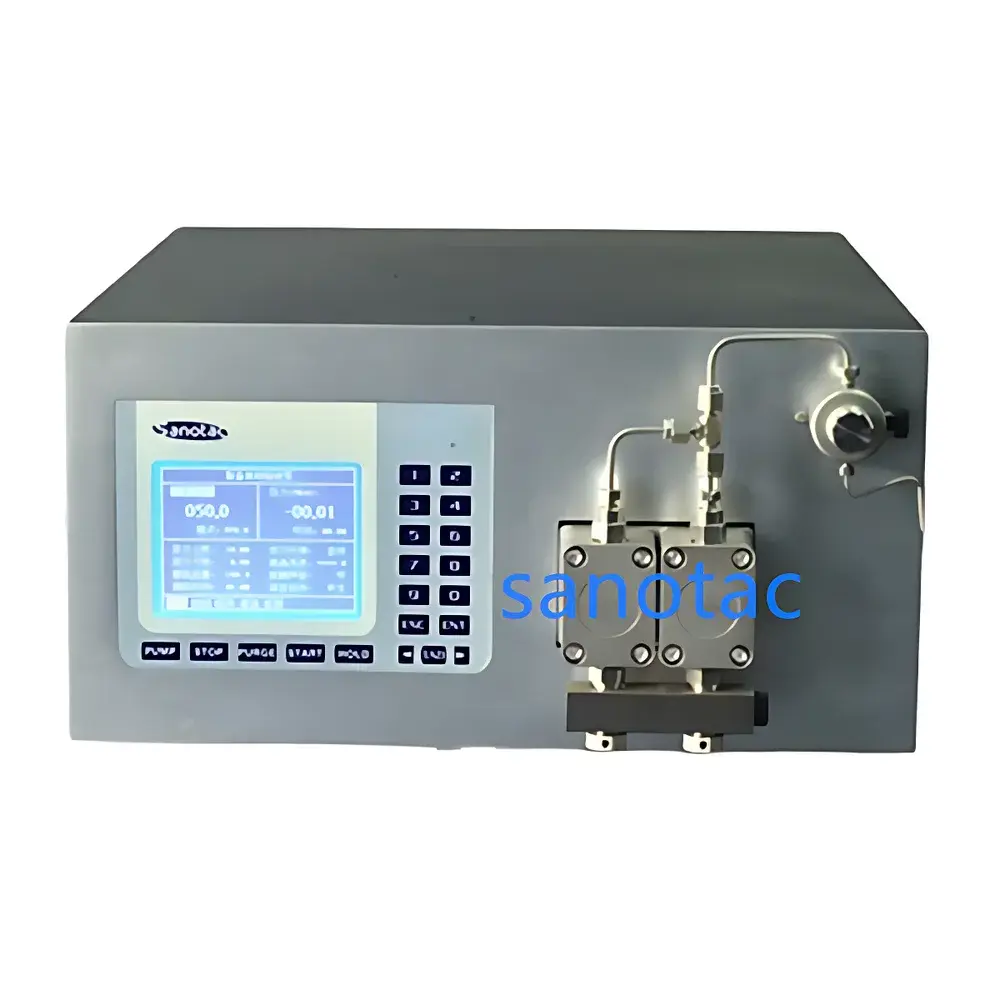
Sanotac H1110 Hastelloy High-Pressure Constant Flow Pump
| Brand | Sanotac |
|---|---|
| Origin | Shanghai, China |
| Manufacturer Type | Direct Manufacturer |
| Model | H1110 |
| Flow Rate | 1000 mL/min |
| Maximum Pressure | 10 MPa |
| Flow Accuracy | ±0.5% |
| Flow Precision (RSD) | ≤0.5% |
| Pressure Pulsation | ≤0.5 MPa |
| Drive Mechanism | Dual Parallel Plunger with Floating Plunger Design |
| Wetted Materials | Hastelloy C-276, Sapphire, PTFE, Ceramic |
| Tubing Connection | 1/8" Hastelloy Tubing |
| Display | 256×64 Dot Matrix Backlit LCD |
| Communication Interfaces | RS232, USB, RS485 |
| Protocols | Sanotac Proprietary, Modbus ASCII/RTU |
| Power Supply | 85–264 VAC, 50 Hz |
| Dimensions | 550 × 420 × 222 mm |
Overview
The Sanotac H1110 Hastelloy High-Pressure Constant Flow Pump is an engineered solution for precise, stable, and corrosion-resistant fluid delivery in demanding laboratory and pilot-scale process environments. Designed around dual parallel plunger architecture with floating plunger compensation, the pump delivers continuous, pulse-minimized flow across its full operational range (0.1–1000.0 mL/min) at pressures up to 10 MPa. Its core measurement principle relies on positive displacement volumetric actuation, calibrated via multi-point gravimetric or volumetric verification traceable to NIST-traceable standards. Unlike peristaltic or diaphragm-based alternatives, the H1110 employs mechanically synchronized plungers with real-time cam-profile compensation and electronic pulse suppression algorithms—ensuring minimal pressure transients (<0.5 MPa) critical for catalytic reaction stability, microreactor residence time control, and high-pressure chromatographic separations. The pump is purpose-built for integration into automated chemical synthesis platforms, high-pressure hydrogenation systems, supercritical fluid processing, and continuous flow reactors where long-term fluid integrity, material compatibility, and deterministic flow behavior are non-negotiable.
Key Features
- Dual parallel plunger system with floating plunger design for mechanical load balancing and extended seal life
- Hastelloy C-276 wetted path—including pump head, check valves, and 1/8″ tubing connections—ensuring resistance to chloride-induced stress corrosion cracking, strong acids (e.g., HCl, H₂SO₄), and oxidizing media at elevated temperatures and pressures
- Multi-point flow calibration capability supporting user-defined correction tables for volumetric accuracy across the entire 0.1–1000 mL/min range (±0.5% flow accuracy, ≤0.5% RSD)
- Integrated column cleaning function enabling post-stroke back-flushing of plunger seals with inert solvent, reducing abrasive wear and extending maintenance intervals
- Real-time pressure setpoint adjustment with zero-point offset compensation to mitigate thermal drift and line-pressure feedback effects
- Modular analog/digital I/O: 0–5 VDC and 4–20 mA analog inputs/outputs; discrete TTL-level start/stop and fault signaling
- Front-panel backlit LCD (256×64 pixels) with intuitive menu navigation and simultaneous display of flow rate, pressure, status flags, and program progress
Sample Compatibility & Compliance
The H1110 accommodates a broad spectrum of process fluids—including aggressive reagents (e.g., concentrated mineral acids, halogenated solvents), high-viscosity polymer melts (up to ~500 cP at 50°C), and suspensions containing sub-10 µm particulates—without degradation of flow fidelity or structural integrity. All wetted components comply with ASTM B575 Grade C-276 specifications for wrought Hastelloy alloy. Non-metallic elements (sapphire ball seats, PTFE seals, ceramic plungers) meet USP Class VI biocompatibility requirements where applicable. The pump’s electrical architecture conforms to IEC 61000-6-3 (EMI emission) and IEC 61000-6-2 (immunity) standards. For regulated environments, firmware supports audit-trail-enabled operation when paired with validated SCADA/DCS systems compliant with FDA 21 CFR Part 11 and EU Annex 11 requirements—enabling electronic signature, parameter change logging, and method version control.
Software & Data Management
The H1110 supports both embedded and external software-driven operation. Local control enables programmable flow profiles—including constant, linear ramp, multi-step gradient, and user-defined time-segmented sequences—with real-time visualization of flow vs. pressure curves and dynamic progress tracking. All operational data (timestamped flow, pressure, temperature if externally sensed, error codes) are logged internally and exportable in CSV or XLSX formats with optional graphical overlays. Remote operation is enabled via optional PC-based software supporting TCP/IP over Ethernet or serial tunneling, with TLS-secured command transmission. Integration with third-party platforms (e.g., LabVIEW, MATLAB, Siemens TIA Portal, Emerson DeltaV) is facilitated through native Modbus RTU/ASCII register mapping and custom protocol SDKs. Calibration records, method files, and system diagnostics are stored with SHA-256 checksums to ensure data integrity and reproducibility.
Applications
- Continuous-flow hydrogenation and cross-coupling reactions in microchannel reactors requiring stable stoichiometric feed ratios under 8–10 MPa H₂ pressure
- High-pressure liquid chromatography (HPLC) and preparative SFC systems utilizing corrosive mobile phases (e.g., HFIP, TFA/water mixtures)
- Catalytic screening in autoclave-integrated test rigs for petrochemical catalyst evaluation (Fischer–Tropsch, hydrodesulfurization)
- Automated synthesis platforms for pharmaceutical intermediates where GMP-aligned traceability and repeatability are mandated
- Supercritical CO₂ extraction systems requiring precise co-solvent metering at 15–30 MPa
- Corrosion testing loops simulating downhole oilfield conditions (H₂S/CO₂/brine environments)
- Radioisotope handling systems in nuclear chemistry labs, leveraging Hastelloy’s low neutron activation cross-section
FAQ
What materials are in contact with the fluid path?
The wetted materials consist exclusively of Hastelloy C-276 (pump head, valves, tubing), sapphire (ball seats), ceramic (plunger surfaces), and PTFE (seals). No stainless steel or aluminum components are exposed to process fluid.
Is the pump compatible with PLC-based industrial control systems?
Yes—it provides native Modbus RTU/ASCII support over RS485 and analog 4–20 mA / 0–5 V I/O, enabling direct integration into Allen-Bradley, Siemens, and Mitsubishi PLC architectures without gateway hardware.
Can flow calibration be performed in-house without factory service?
Yes—users can execute multi-point gravimetric calibration using NIST-traceable balances and certified volumetric glassware; calibration coefficients are stored in non-volatile memory and persist through power cycles.
Does the pump support gradient elution for preparative chromatography?
Yes—its embedded controller supports up to 99-step programmable flow gradients with dwell volume compensation, and it synchronizes seamlessly with UV/RI detector triggers via TTL handshake signals.
What is the recommended maintenance interval under continuous 24/7 operation?
With proper fluid conditioning and use of compatible solvents, major service (seal replacement, valve inspection) is required every 6,000 operating hours; column cleaning cycles should be scheduled every 200–500 hours depending on slurry content.



