
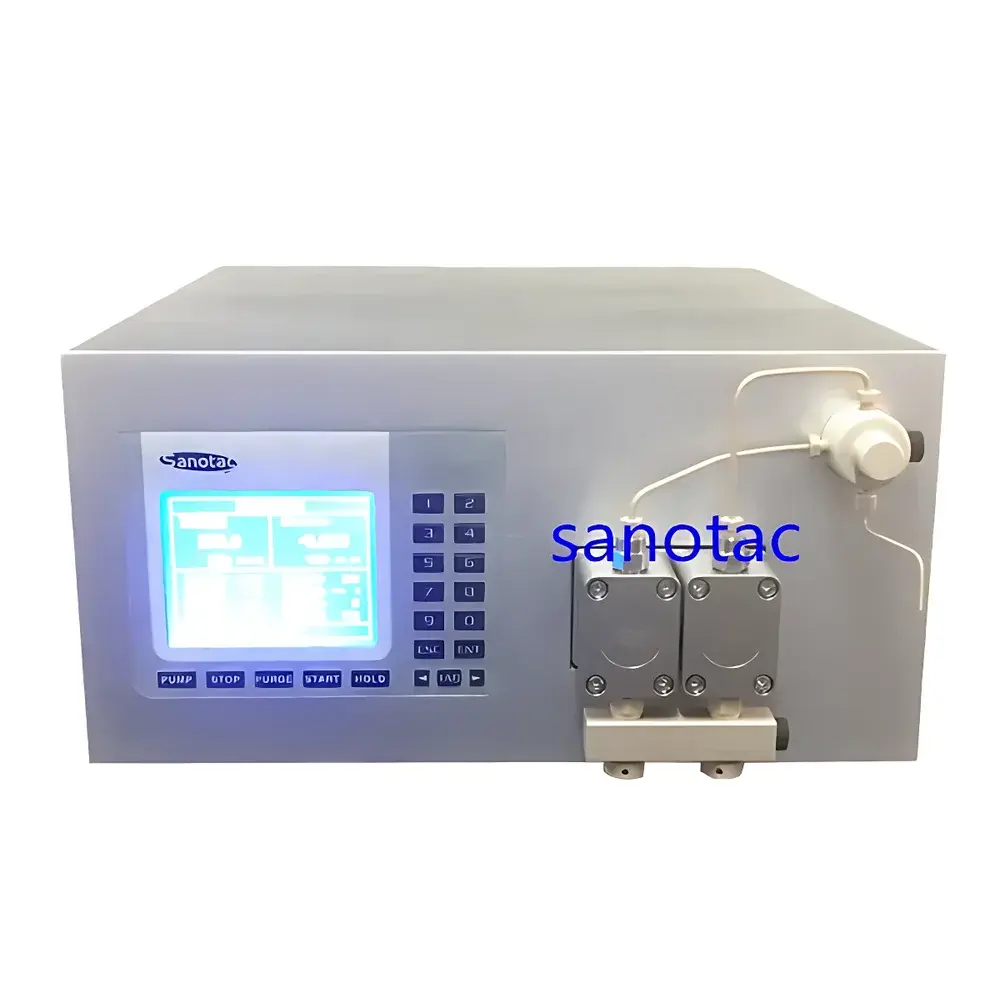
Sanotac HLB0530 High-Pressure Constant Flow Pump
| Brand | Sanotac |
|---|---|
| Origin | Shanghai, China |
| Manufacturer Type | Direct Manufacturer |
| Regional Classification | Domestic (China) |
| Model | HLB0530 |
| Price Range | USD 1,400 – 2,800 |
| Max Pressure | 42 MPa |
| Flow Range | 0.01–50.00 mL/min |
| Flow Reproducibility | ≤ ±0.5% |
| Volumetric Efficiency | ≥98% |
| Continuous Operation | >240 h |
| Power Supply | 220 V ±10%, 50 Hz ±2 Hz |
| Power Consumption | ~75 W |
| Dimensions (L×W×H) | 350 × 314 × 175 mm³ |
| Weight | 9 kg |
| Wetted Materials | 316L SS / Titanium / PTFE / Sapphire / Filled-PTFE |
| Tubing Connections | Inlet/Outlet Φ1/8″ or Φ1/16″ (OD × Wall Thickness) |
| Display | Integrated LCD Parameter Interface |
| Environmental Compliance | Passes 500 km road transport test |
Overview
The Sanotac HLB0530 is a precision-engineered high-pressure constant flow pump designed for demanding laboratory and pilot-scale applications requiring stable, pulse-free liquid delivery across extended operational cycles. Utilizing a dual-cam-driven, multi-piston positive displacement architecture with ceramic-coated titanium or 316L stainless steel plungers, the HLB0530 achieves true volumetric displacement control—enabling consistent flow rates independent of backpressure fluctuations up to 42 MPa (6,090 psi). Its core principle relies on mechanical synchronization between cam rotation and plunger stroke volume, minimizing flow pulsation (<2% peak-to-peak) and eliminating reliance on feedback-based electronic pressure compensation. This makes it particularly suitable for applications where flow integrity directly impacts reaction kinetics, phase behavior, or analytical signal stability—such as catalytic evaluation in fixed-bed reactors, supercritical fluid processing, and preparative HPLC-compatible synthesis platforms.
Key Features
- High-pressure capability: Up to 42 MPa (AP-series compatible) or 30 MPa (SP-series variants), with optional configurations using titanium, PTFE-lined, or Hastelloy C-276 wetted materials for aggressive media handling.
- Exceptional flow reproducibility: ≤ ±0.5% RSD over full operating range (0.01–50.00 mL/min), verified per ISO 5725-2:2019 guidelines for repeatability assessment.
- Volumetric efficiency ≥98%: Achieved through precision-ground plunger-cylinder interfaces and low-compliance check valve design with sapphire seats—minimizing internal leakage and compressibility effects.
- Robust thermal and mechanical stability: Validated for uninterrupted operation exceeding 240 hours at rated pressure and flow; passes ASTM D4169-23 Distribution Cycle 2 (simulated Class II road transport).
- Integrated LCD interface: Real-time display of setpoint flow rate, actual flow, system pressure, runtime, and error codes—supporting local parameter verification without external software.
- Modular electrical architecture: Optional explosion-proof (ATEX-certified) and remote-controlled (up to 12 m cable length) configurations available for hazardous or spatially constrained environments.
Sample Compatibility & Compliance
The HLB0530 accommodates a broad spectrum of process liquids—including corrosive reagents (e.g., anhydrous HF, fuming nitric acid, chlorosulfonic acid), high-viscosity polymer solutions (>500 cP), supercritical CO₂ co-solvents, and aqueous pharmaceutical buffers. All wetted surfaces comply with USP Class VI biocompatibility requirements when configured with PTFE, filled-PTFE, or titanium components. The pump meets CE marking directives (2014/30/EU EMC, 2014/35/EU LVD) and supports GLP/GMP audit readiness via traceable calibration records and non-volatile parameter logging. For regulated pharmaceutical applications, optional 21 CFR Part 11–compliant firmware enables electronic signature, audit trail, and role-based access control when integrated with Sanotac’s SCADA-compatible control suite.
Software & Data Management
While fully functional in standalone mode, the HLB0530 supports RS-485 Modbus RTU and optional USB-C digital interfaces for integration into centralized lab automation systems. Sanotac’s PumpLink™ PC software (Windows 10/11) provides real-time flow/pressure trending, programmable multi-step gradient profiles, automatic leak detection via flow decay analysis, and CSV-exportable operational logs timestamped to UTC. All firmware updates are cryptographically signed and delivered via secure HTTPS endpoints—ensuring integrity and compliance with IEC 62443-3-3 cybersecurity standards for industrial control devices.
Applications
- Catalyst testing: Precise reagent metering in fixed-bed and microchannel reactors for kinetic studies of hydrogenation, nitration, sulfonation, fluorination, carbonylation, and oxidation reactions.
- Supercritical fluid processing: Stable CO₂ or ethane delivery in extraction, impregnation, and particle formation systems (e.g., SAS, PGSS).
- Preparative chromatography: Gradient-capable flow delivery for flash and medium-pressure LC systems (10–30 MPa range).
- Nuclear fuel cycle research: Corrosion-resistant titanium/PTFE configuration for uranyl nitrate, TBP/kerosene, and molten salt handling.
- Environmental simulation: Long-duration leaching tests (ASTM D5039, EPA Method 1311) requiring uninterrupted flow under variable head conditions.
- Chemical process intensification: Integration with continuous flow photochemistry, electrochemical synthesis, and microwave-assisted reactors where pulse-free flow prevents residence time distribution distortion.
FAQ
What materials are in contact with the fluid path, and how do they affect chemical compatibility?
The standard wetted materials include 316L stainless steel, titanium Grade 2, PTFE, sapphire, and filled-PTFE seals. Titanium offers superior resistance to chlorine-containing and oxidizing acids; PTFE-lined configurations handle hydrofluoric acid and bromine trifluoride; sapphire valves ensure longevity with abrasive slurries.
Is the pump suitable for GMP-regulated environments?
Yes—when equipped with optional audit-trail firmware and calibrated per ISO/IEC 17025-accredited procedures, the HLB0530 supports FDA 21 CFR Part 11 compliance for electronic records and signatures.
Can flow rate be programmed dynamically during operation?
Yes—via PumpLink™ software or Modbus commands, users can define up to 99 sequential flow steps with ramping, hold, and pause functions—enabling complex reaction protocols without manual intervention.
What maintenance intervals are recommended for continuous operation?
Plunger seals require replacement every 1,500–2,000 operating hours under typical organic solvent use; check valves should be inspected every 500 hours in abrasive or particulate-laden streams. Full service kits and OEM-certified calibration services are available globally.
Does the pump support remote diagnostics and predictive failure alerts?
Yes—the embedded controller monitors motor current draw, pressure deviation from setpoint, and temperature rise trends. Anomalies trigger event logs and optional email/SNMP notifications via network-enabled gateway modules.
Related Products



