
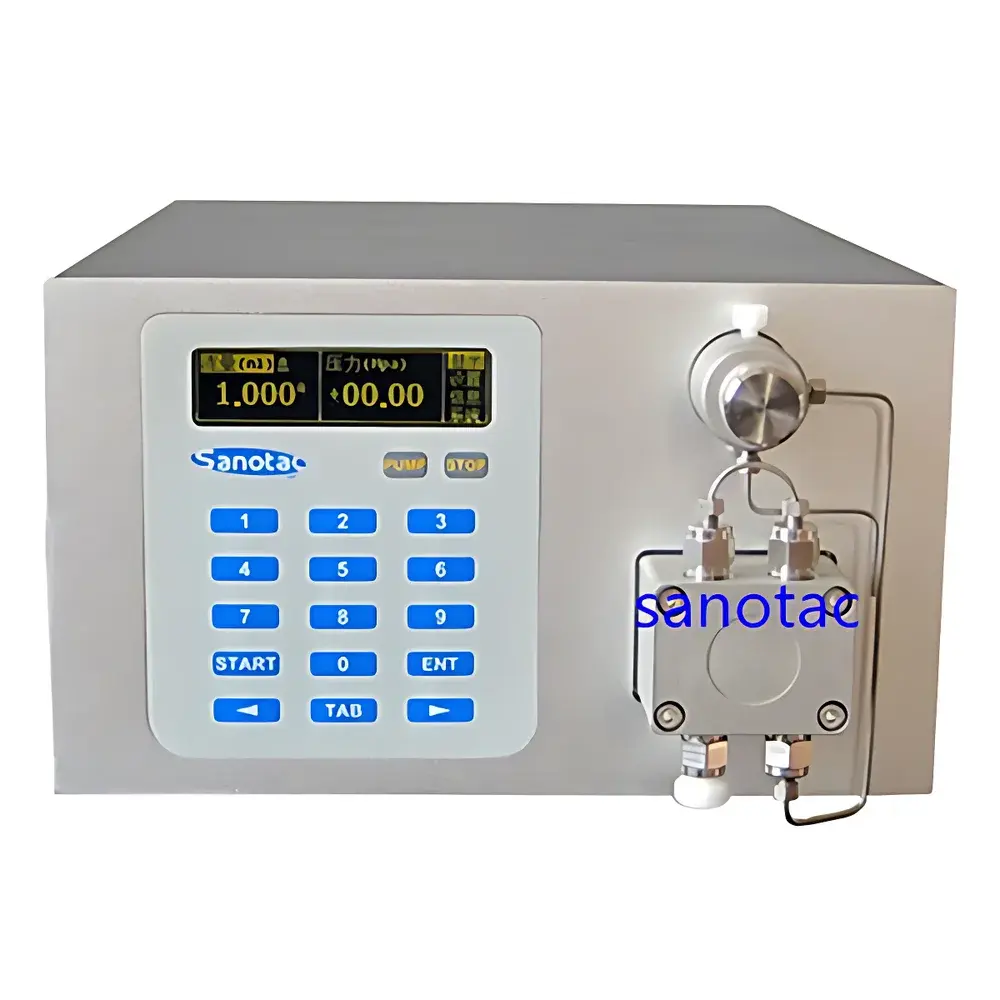
Sanotac ISN140 High-Pressure Liquid Chromatography (HPLC) Pump
| Brand | Sanotac |
|---|---|
| Origin | Shanghai, China |
| Manufacturer Type | OEM/ODM Producer |
| Instrument Type | Isocratic Pump |
| Max Pressure | 40 MPa |
| Flow Rate Range | 0.0001–1 mL/min |
| Flow Accuracy | ±0.1% |
| Flow Precision (RSD) | ≤0.1% |
| Pressure Pulsation | ≤0.1 MPa |
| Priming Mode | Dual-Piston Serial Drive with Floating Piston Design |
| Wetted Materials | 316L Stainless Steel, Sapphire, PTFE, Ceramic |
| Connection | 1/16″ Standard Fitting |
| Display | 256×64 Dot Matrix Backlit LCD |
| Communication | RS232 & USB (Standard), RS485/RS422 (Optional), Sanotac Proprietary & Modbus RTU Protocols |
| Power Supply | 85–264 VAC, 50 Hz |
| Dimensions | 370 × 240 × 152 mm |
Overview
The Sanotac ISN140 High-Pressure Liquid Chromatography (HPLC) Pump is an isocratic precision delivery system engineered for ultra-low-flow, high-pressure liquid handling in analytical and preparative chromatographic applications. Based on dual-piston serial drive architecture with a floating piston mechanism, the ISN140 achieves exceptional pressure stability and flow continuity under demanding operational conditions—up to 40 MPa (5,800 psi). Its core operating principle relies on positive displacement via precisely actuated sapphire-ruby check valves and ceramic-coated stainless-steel pistons, minimizing compressibility effects and enabling accurate solvent delivery across the full dynamic range of 0.0001–1 mL/min. Designed as a drop-in replacement for legacy U.S.-sourced HPLC pumps, the ISN140 maintains compatibility with industry-standard LC modules—including UV/VIS, fluorescence, conductivity, and mass spectrometric detectors—while supporting rigorous regulatory environments such as ISO/IEC 17025-accredited laboratories and GMP-compliant IVD manufacturing workflows.
Key Features
- Ultra-low flow capability: Programmable resolution down to 0.0001 mL/min, suitable for capillary LC, microfluidic separation, and low-volume column chemistries (e.g., 50–150 µm ID columns)
- Floating piston design with high-wear-resistant seals: Reduces mechanical hysteresis and extends service life beyond 10,000 hours under continuous operation
- Multi-stage pulse suppression: Integrated cam-profile compensation and real-time electronic flow pulsation correction ensure pressure ripple ≤0.1 MPa at all flow points
- Onboard zero-point calibration and pressure offset adjustment: Compensates for thermal drift and fluid compressibility without external instrumentation
- Dual-column cleaning mode: Automated post-stroke piston rinsing with secondary solvent path minimizes seal degradation and particle accumulation
- Modular I/O architecture: Supports analog voltage input (0–10 V), digital TTL triggers, and relay-based start/stop control for integration into closed-loop reactor or synthesis platforms
Sample Compatibility & Compliance
The ISN140 accommodates a broad spectrum of mobile phases, including aqueous buffers, organic solvents (acetonitrile, methanol, THF), corrosive eluents (HF, strong acids/bases up to pH 0–14 when equipped with PEEK or Hastelloy wetted parts), and viscous solutions (e.g., polymer dissolution media). All fluidic pathways are constructed from chemically inert materials—316L stainless steel, sapphire check valves, PTFE seals, and ceramic piston rods—to ensure long-term integrity under aggressive chemical exposure. The pump conforms to electromagnetic compatibility standards per IEC 61326-1 and meets safety requirements under IEC 61010-1 for laboratory equipment. Its firmware architecture supports audit-trail-enabled operation compliant with FDA 21 CFR Part 11 when deployed with optional secure software packages and user-access-controlled parameter locking.
Software & Data Management
The ISN140 operates natively via embedded firmware with real-time visualization of flow rate vs. pressure curves, program execution progress indicators, and dynamic error logging. Data acquisition includes timestamped records of setpoint, actual flow, system pressure, motor current, and temperature—all exportable in CSV and PNG formats via USB or serial interface. Method libraries support up to 99 programmable flow profiles, each configurable with ramp, hold, and step sequences; methods can be recalled locally or triggered remotely through SCADA/DCS systems using Modbus RTU over RS485. Optional PC-based control software provides GLP-compliant electronic signatures, version-controlled method archiving, and automated calibration report generation aligned with ISO/IEC 17025 Clause 6.5.2.
Applications
- Capillary and nano-LC systems for proteomics and metabolomics sample analysis
- Ion chromatography (IC) for trace anion/cation quantification in environmental water testing
- Gel permeation chromatography (GPC) requiring stable low-flow delivery for high-molecular-weight polymer characterization
- Post-column derivatization setups in amino acid and HbA1c analyzers used in clinical diagnostics
- Automated reagent delivery in modular IVD platforms and point-of-care testing instruments
- Controlled infusion in lab-scale continuous-flow reactors and electrochemical synthesis cells
FAQ
What is the minimum detectable flow increment?
The ISN140 offers true 0.0001 mL/min resolution across its entire operating range, enabled by 24-bit stepper motor positioning and closed-loop encoder feedback.
Can the pump operate with aggressive solvents like hydrofluoric acid?
Yes—when configured with PEEK pump heads and fluoropolymer fluidic components (optional configuration), it supports HF, concentrated phosphoric acid, and other highly corrosive mobile phases.
Does the pump support gradient elution?
No—the ISN140 is an isocratic pump. Gradient functionality requires external solvent selection valves or integration with a compatible quaternary mixing module.
Is remote firmware update supported?
Firmware updates are performed via USB-connected host PC using Sanotac’s certified utility; over-the-air (OTA) updates are not implemented for security and validation integrity reasons.
How is flow accuracy verified during routine maintenance?
Built-in gravimetric calibration mode allows users to perform traceable flow verification using certified balance and timed collection, with automatic R² calculation and deviation reporting against ISO 5725-2 criteria.




