
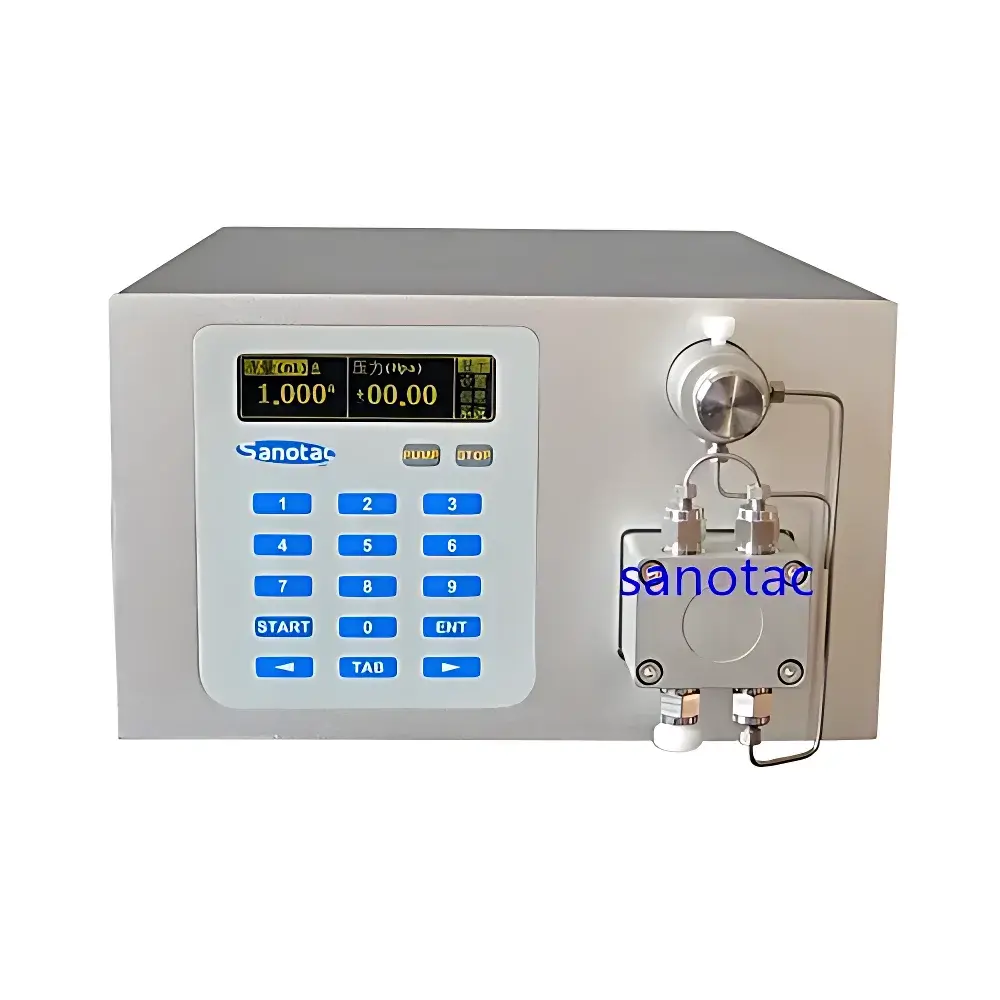
Sanotac ISP1020 Intelligent High-Pressure Constant Flow Pump
| Brand | Sanotac |
|---|---|
| Model | ISP1020 |
| Origin | Shanghai, China |
| Manufacturer Type | Direct Manufacturer |
| Flow Range | 0.01–100.00 mL/min |
| Maximum Operating Pressure | 20 MPa |
| Flow Accuracy | < ±0.5% |
| Communication Interfaces | RS-232, RS-485, RS-422, USB |
| Control Protocols | Modbus RTU, Modbus ASCII, Custom Serial Protocol |
| Analog Input Support | 0–5 V DC, 4–20 mA |
| Data Export Format | Excel (.xlsx) |
| Compliance | CE-marked design principles |
Overview
The Sanotac ISP1020 Intelligent High-Pressure Constant Flow Pump is an engineered precision fluid delivery system designed for demanding laboratory and pilot-scale applications requiring stable, programmable, and traceable flow control under elevated pressure conditions. Based on positive displacement piston pump architecture with integrated pressure transduction and real-time digital feedback, the ISP1020 delivers high reproducibility across its full operational range (0.01–100.00 mL/min) at pressures up to 20 MPa. Its core function is to maintain constant volumetric or gravimetric flow rates independent of downstream resistance variations — a critical requirement in catalytic reaction systems, continuous-flow synthesis, HPLC pre-column loading, membrane filtration studies, and high-pressure material processing. Unlike basic peristaltic or diaphragm pumps, the ISP1020 incorporates closed-loop pressure monitoring and adaptive motor control logic to compensate for fluid compressibility, viscosity shifts, and system backpressure fluctuations—ensuring consistent mass transfer kinetics and process repeatability.
Key Features
- Real-time dual-curve visualization: Simultaneous graphical display of pressure (MPa) and flow rate (mL/min or g/min) on the embedded 4.3-inch TFT touchscreen interface
- Dual-mode flow programming: Select between constant-flow mode (fixed setpoint) or multi-segment gradient mode (up to 16 user-defined time/flow steps)
- Configurable pressure management: Programmable upper/lower pressure limits with automatic shutdown, plus zero-pressure calibration prior to startup
- Unit flexibility: Seamless switching between volumetric (mL/min) and mass-based (g/min) flow units using user-input density values
- Field-adjustable flow calibration: Dedicated calibration wizard allowing end-user adjustment of flow gain parameters to match system-specific tubing compliance, fluid density, and sensor drift
- Analog I/O integration: 0–5 V and 4–20 mA inputs enable direct linkage with load cells, balance transmitters, or PLCs for closed-loop gravimetric feeding (e.g., reactor feed via loss-in-weight control)
- Protocol versatility: Native support for Modbus RTU, Modbus ASCII, and customizable serial command sets for interoperability with SCADA, DCS, and LIMS platforms
- Audit-ready data logging: Timestamped pressure and flow datasets stored internally and exportable to Excel (.xlsx) format with optional metadata tagging (operator ID, batch number, experiment tag)
Sample Compatibility & Compliance
The ISP1020 is compatible with non-corrosive and mildly aggressive liquids including water, organic solvents (e.g., methanol, acetonitrile, THF), aqueous salt solutions, and low-viscosity polymer melts (≤ 500 mPa·s at operating temperature). Wetted parts consist of 316L stainless steel, sapphire-plated ceramic check valves, and PTFE/UHMWPE seals — ensuring chemical compatibility per ASTM F2136 and ISO 10993-5 guidelines for short-term contact. While not certified for explosive atmospheres (ATEX/IECEx), its electrical design conforms to IEC 61010-1 safety standards for laboratory equipment. When deployed in regulated environments, the device supports 21 CFR Part 11-compliant workflows through external software integration (e.g., LabArchives or Empower), enabling electronic signatures, audit trails, and role-based access control for configuration changes.
Software & Data Management
The pump operates standalone via its onboard GUI or integrates into automated workflows via serial or USB virtual COM port. Sanotac’s SanoFlu PC software (Windows 10/11) provides advanced scripting, remote parameter synchronization across multiple pumps, and synchronized data acquisition from auxiliary sensors (e.g., inline pH, conductivity, temperature). All configuration profiles—including communication port settings, pressure thresholds, gradient programs, and calibration coefficients—are saved as encrypted .sfp files for version-controlled deployment. Raw time-series data includes millisecond-resolution timestamps, raw ADC counts, and compensated engineering units — facilitating post-hoc uncertainty analysis per ISO/IEC 17025 requirements. Exported Excel files include worksheet tabs for raw data, metadata headers, and statistical summaries (mean, SD, CV%) over user-defined intervals.
Applications
- Continuous-flow chemistry reactors requiring precise stoichiometric reagent dosing under backpressures >15 MPa
- High-pressure liquid chromatography (HPLC) method development and column conditioning protocols
- Membrane fouling studies where controlled flux and transmembrane pressure must be maintained independently
- Electrochemical cell feeding in fuel cell or electrolyzer R&D setups
- Calibration reference source for flow meters and mass flow controllers (MFCs) per ISO 4064-2
- Automated sample introduction in ICP-MS or GC-MS systems requiring pulse-free delivery
- Material science labs performing high-pressure rheological testing of nanofluids or colloidal suspensions
FAQ
What is the maximum allowable viscosity for stable operation at 100 mL/min and 20 MPa?
The ISP1020 maintains rated accuracy up to 500 mPa·s at 25°C when operated within its specified pressure–flow envelope. Viscosities exceeding this threshold require derating of maximum pressure or flow rate per the manufacturer’s viscosity compensation chart.
Does the pump support NIST-traceable flow calibration?
Yes — the built-in calibration routine accepts user-provided reference flow measurements (e.g., from a gravimetric standard or certified rotameter) and applies linear correction factors. Full calibration records, including reference instrument ID and date, are embeddable in exported Excel logs.
Can multiple ISP1020 units be synchronized for parallel operation?
Yes — using RS-485 daisy-chaining with Modbus addressing, up to 32 units can be coordinated via master controller for synchronized start/stop, ramping, and data aggregation without timing skew.
Is firmware update capability available remotely?
Firmware updates are performed via USB stick or serial connection using signed .bin files. Over-the-air (OTA) updates are not supported to preserve integrity in validated environments.
What mechanical maintenance intervals are recommended?
Piston seal replacement is advised every 6,000 operating hours or 12 months, whichever occurs first. Check valve inspection is recommended quarterly in continuous-duty applications involving particulate-laden fluids.
Related Products



