
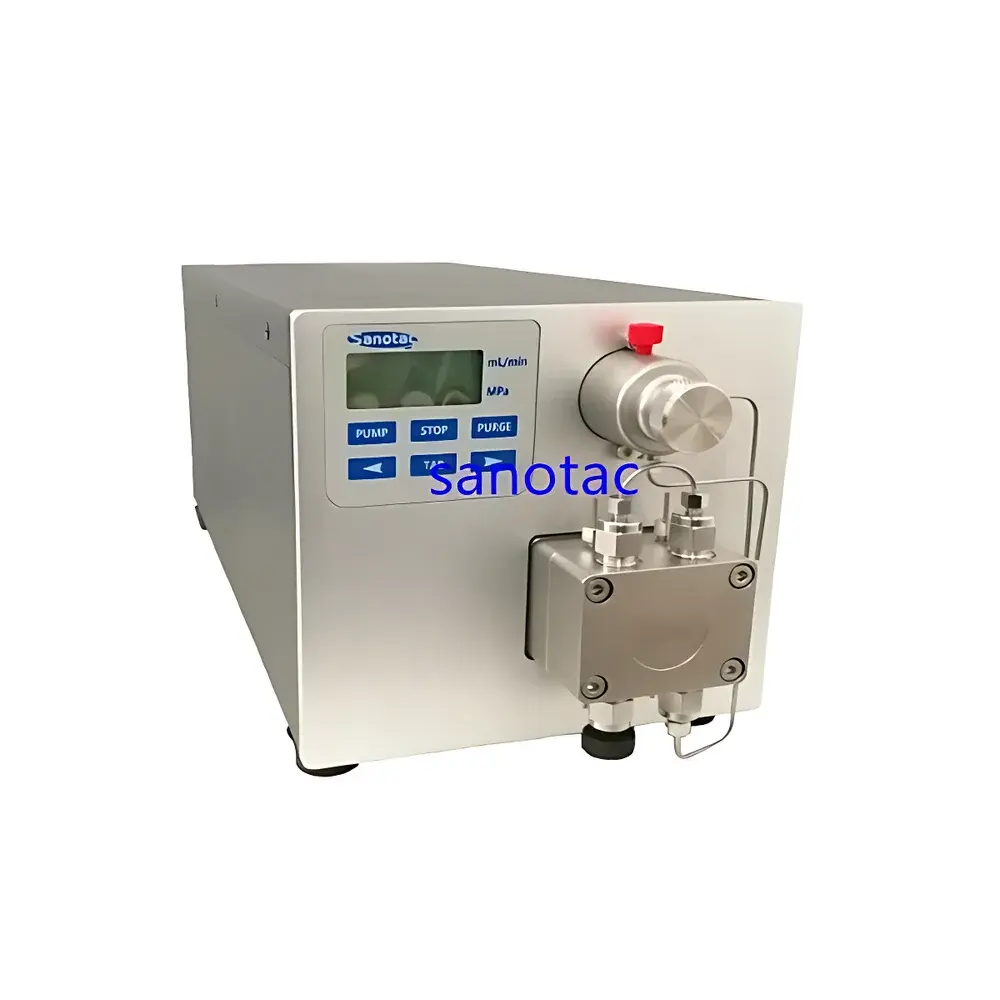
Sanotac JL-0013 High-Pressure Constant Flow Pump for Distillation & Process Integration
| Brand | Sanotac |
|---|---|
| Origin | Shanghai, China |
| Manufacturer Type | Direct Manufacturer |
| Model | JL-0013 |
| Flow Range | 0.001–9.999 mL/min |
| Flow Increment | 0.001 mL/min |
| Flow Accuracy | ±0.1% |
| Flow Precision (RSD) | ≤0.1% |
| Max Pressure | 42 MPa |
| Pressure Pulsation | ≤0.1 MPa |
| Pump Head Material | 316L Stainless Steel, Sapphire, PTFE, Ceramic |
| Tubing Connection | 1/16″ Standard |
| Display | 256×64 Dot Matrix Backlit LCD |
| Control Interface | Front Panel Keypad + RS232/USB Computer Remote Control (Open Protocol) |
| Power Supply | 85–264 VAC, 50 Hz |
| Dimensions | 370 × 240 × 152 mm |
Overview
The Sanotac JL-0013 High-Pressure Constant Flow Pump is an engineered solution for precise, stable, and pulse-free fluid delivery in demanding laboratory-scale distillation systems, catalytic reaction setups, supercritical fluid applications, and continuous-flow process development. Designed around a dual-piston serial architecture with floating plunger mechanics, the pump operates on positive displacement principles to deliver consistent volumetric flow across its full dynamic range—from trace-level additions (0.001 mL/min) to high-throughput feeding (9.999 mL/min)—under sustained pressures up to 42 MPa (6090 psi). Its core functionality supports both isocratic and programmable gradient elution profiles, enabling seamless integration into multi-stage separation trains, reactive distillation columns, and closed-loop solvent recovery units. The device complies with fundamental mechanical safety and electromagnetic compatibility requirements per IEC 61000-6-3 and IEC 61000-6-2, and its construction materials—316L stainless steel wetted surfaces, sapphire check valves, ceramic plungers, and PTFE seals—are selected for long-term chemical resistance against organic solvents, acids, bases, and supercritical CO₂.
Key Features
- Dual-piston serial configuration with floating plunger design minimizes seal wear and extends service life under continuous high-pressure operation.
- Microprocessor-based control with real-time solvent compressibility compensation and multi-point flow calibration ensures ±0.1% flow accuracy and ≤0.1% RSD across the entire 0.001–9.999 mL/min range.
- Low-pressure pulsation (<0.1 MPa) achieved via optimized cam-profile actuation and active electronic pulse suppression—critical for pressure-sensitive downstream components such as packed columns or membrane separators.
- Open communication protocol (RS232/USB) enables bidirectional remote control from third-party chromatography data systems (CDS), LIMS, or custom LabVIEW/Python automation frameworks—fully compliant with ASTM E1384 and ISO/IEC 17025 traceability requirements.
- Backlit 256×64 dot-matrix display provides real-time visualization of flow rate, pressure, gradient profile, and system status; supports storage of up to 10 user-defined method programs.
- Modular wetted path constructed from chemically inert materials: 316L stainless steel manifolds, sapphire inlet/outlet check valves (Swiss-sourced), ceramic-plated plungers, and PTFE-sealed interfaces—validated for compatibility with halogenated solvents, concentrated HNO₃/H₂SO₄, anhydrous amines, and scCO₂.
Sample Compatibility & Compliance
The JL-0013 is routinely deployed in applications requiring strict adherence to process integrity and material compatibility standards—including ASTM D6300 (precision of liquid-phase injection), ISO 17025-accredited QC laboratories, and GLP-compliant pilot-scale reaction engineering studies. Its 316L/PTFE/sapphire fluidic pathway meets USP Class VI biocompatibility criteria for non-leaching performance and is compatible with solvents used in pharmaceutical intermediate synthesis (e.g., THF, DMF, acetonitrile, dichloromethane) and petrochemical upgrading (e.g., toluene, xylene, chlorobenzene). All firmware operations log timestamped event records—including flow deviations, pressure limit triggers, and calibration events—to support audit readiness under FDA 21 CFR Part 11 when integrated with validated CDS environments.
Software & Data Management
The pump supports native ASCII command protocol over RS232 or USB virtual COM port, allowing direct integration with commercial chromatography software (e.g., Chromeleon, Empower, OpenLAB) or in-house Python-based orchestration scripts. System logs include flow setpoint vs. actual deviation history, pressure trend snapshots, and error codes—all exportable in CSV format. Firmware updates are performed via secure signed HEX file upload; all configuration changes are stored in non-volatile memory with write-protection options to prevent accidental parameter overwrite during routine operation.
Applications
- Feedstock delivery in lab-scale fractional distillation and extractive distillation rigs.
- Precise co-injection of catalysts, initiators, or modifiers into continuous-flow hydrogenation or oxidation reactors.
- Supercritical fluid processing (SFE, SFC, impregnation) requiring stable CO₂ or ethanol delivery at >30 MPa.
- Foam extrusion and polymerization feed systems where pulse-free flow prevents bubble nucleation artifacts.
- Electrolyte metering in battery electrolyte formulation and fuel cell membrane hydration studies.
- Calibration reference flow source for gravimetric or thermal mass flowmeter validation per ISO 4064-2.
FAQ
What is the maximum operating pressure and flow range for the JL-0013?
The JL-0013 delivers flow rates from 0.001 to 9.999 mL/min at pressures up to 42 MPa (6090 psi) using its standard 10 mL displacement pump head.
Is the pump compatible with aggressive solvents such as concentrated sulfuric acid or hydrofluoric acid?
While the 316L stainless steel body offers broad corrosion resistance, HF and hot concentrated H₂SO₄ require optional titanium or Hastelloy C-276 wetted-path configurations—contact technical support for custom material certification.
Does the pump support gradient programming with external triggering signals?
Yes—via TTL-compatible start/stop inputs and analog voltage input (0–5 V) for synchronized gradient ramping with external event controllers or temperature modules.
Can the pump be validated for GMP-regulated environments?
When operated within a documented IQ/OQ protocol and integrated with audit-trail-enabled software, the JL-0013 meets foundational requirements for equipment qualification per Annex 15 and USP .
What maintenance intervals are recommended for long-term reliability?
Plunger seals and check valves should be inspected every 500 operational hours or after exposure to abrasive slurries; full recalibration is advised annually or following any mechanical impact event.



